
French Bulldog Cost of Ownership: 2026 Budget Guide
Before anything else on this page. If your French Bulldog is struggling to breathe, has a blue-tinged tongue or gums, or has collapsed, stop reading and contact an emergency veterinarian now. The American College of Veterinary Surgeons lists exercise intolerance, cyanosis and collapse among the signs seen in brachycephalic dogs — "brachycephalic" simply means short-headed — and notes they are common following over-activity, excitement, or excessive heat or humidity. Heat is the trigger most likely to catch a new owner out, and what overheating looks like before it reaches that point is set out under what overheating looks like.
If you think your dog has swallowed something toxic, call your own veterinarian, or one of the two animal poison control services operating in the United States:
- ASPCA Animal Poison Control Center — (888) 426-4435. Available every hour of every day. The ASPCA states that a consultation fee may apply and does not publish the amount on its own page. AAHA reported the figure as $95 per incident in September 2025; treat that as a third-party number and confirm it on the call.
- Pet Poison Helpline — (855) 764-7661. Available 24 hours a day. Pet Poison Helpline states a fee of $89 per incident covering the initial consultation and any follow-up consultations with you or your veterinarian, verified on its own site on August 7, 2026.
One state exception. Since July 1, 2025, Georgia's Senate Bill 105 has stopped both services from giving risk assessments or treatment guidance directly to Georgia pet owners. AAHA reports that both hotlines are currently unable to assist Georgia pet owners directly, and the Georgia Poison Center states the same. Both services can still advise a veterinarian. So in Georgia, call your own veterinarian or an emergency clinic first and let them make the poison-control call. Every other state is unaffected as of August 7, 2026.
Pet Poison Helpline's own guidance is not to give any home antidote and not to make your dog vomit without first speaking to a veterinarian or to the helpline. Neither service is free, and neither is a substitute for an examination when your dog needs one.
There is no honest single national number for what a French Bulldog costs. What you spend depends on whether you bring home a puppy or an adult rescue, where you live, what your dog actually weighs, how much of the grooming and training you do yourself, and whether you carry veterinary risk with an insurance premium or with your own savings — and those last two are alternatives, not a pair to be added together.
So this page gives you the structure rather than a headline figure: three separate budgets — first-year setup, recurring annual care, and one risk-financing line — the categories that belong in each, and the rules that stop you counting the same money twice.
Only a handful of figures on this page are published as numbers, and every one of them is a fee taken from the organization that charges it and re-checked on August 7, 2026 — three of them are set out in full, carrying every field a published row needs. The rest carry their collection status instead, because the sampled rows behind a French Bulldog cost range are not finished, and a number without its sources would be worth less than no number.
Do this first. Decide whether you are budgeting for a puppy or an adult rescue. Enter your ZIP and your dog's actual or expected adult weight. Choose an insurance premium or a savings reserve — one, never both. Then work down the first-year matrix, filling each row from a source you can open and date. An hour of local price collection gives you a figure that applies to your dog, which no published average can.
Cost snapshot — French Bulldog, United States. Dataset status as of August 7, 2026.
| Budget line | What goes into it | Where the figure comes from | Status |
|---|---|---|---|
| First-year total | Acquisition, one-time setup, first-year veterinary care, annualized food, grooming, training, identification and licensing | Paw Parent Index rows plus your own local prices | Not collected — Index v1 in collection |
| Annual recurring total | Food, routine veterinary care, grooming, training and enrichment, license renewal, replacements | Paw Parent Index rows plus your own local prices | Not collected — Index v1 in collection |
| Monthly view | Annual recurring total divided by twelve. Acquisition and one-time setup stay out of it | Calculated from your annual figure | Available as soon as you fill the annual rows |
| Risk financing | One of two things, never both: an insurance premium, or a self-funded reserve contribution | A quote you run yourself, or your own reserve decision | Sampled quotes not collected; your own quote works today |
| Acquisition | Adoption fee or purchase price | You enter it. One verified rescue example appears further down | User-entered |
| Optional services | Boarding, daycare, dog walking, travel | You enter them, and only if you select them | Off by default — not in the headline total |
What "Not collected" means here: the Paw Parent Index rows behind these totals are still being assembled — the ages, states, providers and policy design are not yet locked, so no sampled figure exists to publish. A row is published only once it passes the six-field test. Until then the worksheet runs on your own local prices. The method is set out under how this budget was built.
Where to start. Pick the branch that matches you:
- Deciding whether you can keep a French Bulldog, not just bring one home? Start with the annual recurring budget rather than the first-year one. Year one is a spike; the recurring line is the real commitment.
- Adopting a dog of two or older? Start with the adult-rescue path. Spay or neuter, vaccinations and a microchip may already be done and paid for.
- Already hold savings you can genuinely leave untouched? Choose a written self-funded reserve instead of a premium, and read the two options side by side before you commit.
- Still deciding whether this breed suits your household, your climate and your budget? Buy nothing at all yet. The worksheet costs nothing and tells you more than any product will.
- Worried you cannot afford the care? Read the next section first. There are real routes, and asking early works better than asking late.

What if I can't afford my French Bulldog's veterinary care?
Cost worry is common, it is not a character failing, and it is worth raising out loud rather than absorbing. The American Veterinary Medical Association's own guidance is blunt about the timing: the sooner you seek treatment for an illness or injury, the better the chance of avoiding more advanced — and more expensive — care.
- Tell your veterinarian you have a limit. The AVMA advises sharing the concern directly, because a range of care options is often available and a personalized plan can be built around your circumstances. A veterinarian who knows your ceiling can prioritize differently. One who does not know cannot.
- Ask about payment arrangements. The AVMA notes that many clinics offer payment plans, deferred payments, or financing, that not every clinic can, and that it is always worth asking.
- Look for a nonprofit or low-cost clinic. In some areas these offer basic services to owners with limited incomes. The AVMA notes they usually focus on preventive care — checkups, vaccinations, spay and neuter — and may have limited capacity for emergencies or advanced diagnostics, so check what a given clinic can actually handle before you rely on it.
- Check a veterinary teaching hospital. The AVMA notes that some veterinary schools provide financial assistance to owners who can demonstrate need, and publishes the list of accredited veterinary colleges you can work from.
- Apply to an assistance fund. The AVMA maintains a list of organizations that may help, including RedRover Relief, The Pet Fund, Brown Dog Foundation, Frankie's Friends, Paws 4 a Cure, the Banfield Foundation and Best Friends Animal Society. The AVMA states plainly that it does not endorse any specific program. Read each one's eligibility rules before applying, and — its advice, and ours — keep asking even after a refusal, because programmes and funding change.
- Try breed-specific help. The AVMA notes that some organizations provide breed-specific financial assistance. For this breed, the French Bull Dog Club of America maintains a list of French Bulldog rescue organizations, several of which know the breed's costs well.
- Ask locally. The AVMA suggests your state veterinary medical association or a local humane organization, either of which may keep a list of local resources that never reaches a national page.
- If you are thinking about rehoming, that conversation belongs with a rescue, not with shame. Breed rescues take owner surrenders as a routine part of what they do — the French Bulldog Rescue Network runs a surrender process for exactly this. Deciding a dog would be better placed elsewhere is a decision some households reach responsibly, and it is better made early and openly than late.
None of this is a reason to delay an examination your dog needs. If the situation is an emergency, go, and have the money conversation at the clinic.
On this page
- What if I can't afford my French Bulldog's veterinary care?
- What this budget can and cannot tell you
- How do I read this budget without double-counting?
- What goes into the first year with a French Bulldog?
- What will I spend every year after that?
- Should I budget an insurance premium or a savings reserve?
- Why might my French Bulldog budget differ from another owner's?
- Grooming is skin care, not coat care
- Food quantity follows the dog, not the breed
- Climate is a real line item
- What overheating looks like, and when it becomes an emergency
- Breathing is a veterinary question with budget consequences
- The spine is worth one exam and one conversation
- Training is timed by your veterinarian
- Screening records tell you about a record, not about a dog's future
- What might a rescue adoption already include?
- How do I build a low, base or high scenario?
- Which costs are optional, and how should I plan for emergencies?
- How was this budget built, and what is still missing?
- How do I choose what to buy without guessing?
- Questions new French Bulldog guardians ask
- What to do next
What this budget can and cannot tell you
This is a cost worksheet, not veterinary advice and not a health forecast. It does not assign a condition, a procedure or a treatment price to French Bulldogs as a group, and you will not find a disease list here: a breed is not a diagnosis. Your veterinarian sets your dog's care plan after examining the dog; this page helps you price that plan and the routine care around it.
The eight inputs that change your answer most
| Input | Why it moves the total |
|---|---|
| Life stage | Year one carries vaccinations, spay or neuter, training and setup an adult rescue may already have behind it |
| State and ZIP | Veterinary fees, grooming rates, licensing and insurance pricing are all local |
| Your dog's actual weight | Food quantity and parasite-prevention dosing bands follow weight, not breed |
| Service mix | Whether you groom, trim nails and train at home or pay for it |
| Acquisition path | Adoption or purchase, and what the fee already covers |
| Climate | Cooling and comfort costs differ between a mild ZIP and a hot, humid one |
| Risk financing | Premium or reserve — alternatives, and picking one changes the recurring line |
| Optional services | Boarding, daycare, walking and travel sit outside the headline by default |
How do I read this budget without double-counting?
Four categories run through every table on this page, and keeping them apart is most of the work. We call them the four cost lanes, and the lane names are used consistently in every matrix below.
One-time costs are paid once and never repeat: the crate, the carrier, the microchip implant, the spay or neuter procedure. They belong in the first-year total and nowhere else. Recurring costs repeat on a known cadence — food, parasite prevention, license renewal, grooming consumables — and appear in both the first-year total, annualized, and the annual total afterwards. Optional costs are real but selectable: boarding, daycare, a dog walker, travel. They stay outside the headline unless you switch them on. Risk financing is the single line where you choose either an insurance premium or a contribution to your own reserve. Adding both to one total implies that both are mandatory, and neither is.
Two further terms matter. Annualized means a recurring cost converted to a twelve-month figure so that year one and year two can be compared honestly; a monthly food spend annualized is not a new cost, it is the same cost expressed differently. Sampled means one observation, from one source, on one date, in one place. A sampled figure tells you what something cost somewhere. It does not tell you what it costs everywhere.
Four insurance terms are worth knowing before you read a quote, because they are the fields that make two premiums comparable. A deductible is what you pay before reimbursement starts, and an annual deductible and a per-condition deductible are not interchangeable. A reimbursement percentage is the share of the eligible bill the insurer pays — of the eligible bill, not of the whole bill. An annual limit is the ceiling on what the policy pays in a policy year, which is a different thing from the reimbursement percentage and can move a premium on its own. A waiting period is the interval after cover starts during which a claim for a given condition type is not payable, and policies set different waiting periods for different condition types. A pre-existing condition is, broadly, one that showed signs before cover started or during a waiting period — though each policy writes its own definition and its own lookback window. All five are explained at length on our page on how pet insurance works.
Who says so, and what that is worth
| Category | Who establishes it | What it changes for you and your dog |
|---|---|---|
| Veterinary and animal-safety guidance | Veterinary specialty organizations and your own veterinarian | Sets what care your dog needs. Never set by a price table, and never inferred from a breed |
| Breed-club and registry program facts | The breed's parent club and the registry running the program | Tells you what a record or a certificate means — and what it does not mean |
| Insurance policy language and quotes | The insurer's own policy form and quote flow | Sets what is covered and what you pay. Only a quote you run yourself reflects your dog and your ZIP |
| Product, food-label and service terms | The manufacturer, retailer or service provider | Sets price, quantity, serving basis, shipping and cancellation terms |
| Sampled cost observation | Paw Parent HQ, through the Paw Parent Index | An observation with a date and a place attached. Never an average, never a guarantee |
| Editorial decision aid | Paw Parent HQ | The scenario rules and this worksheet. Useful, but not veterinary, legal or statistical fact |
Every consequential row on this page carries one verification status: Verified, Verified with limitation, Partial, Blocked, Not applicable or Superseded. Where a row says Not collected or Blocked, no number has been substituted from a neighboring state, age, provider or product.
What goes into the first year with a French Bulldog?
Year one is the expensive year because it stacks one-time setup on top of the recurring costs you will carry from then on. The matrix below is the shape of that year. Fill the last column from sources you can open, and record the date you opened them.
What a finished row looks like. Three figures this budget touches are already published by the organizations that charge them, so they appear below carrying the six fields a published row has to have. They are a template, not a total.
| Line | The figure, with its basis, scope, source and date | Status |
|---|---|---|
| Acquisition — adoption fee | $700 per dog, one-time. One national breed rescue's published minimum for a healthy dog aged two to eight, in US funds; the organization's own terms, verified 2026-08-07 | Verified with limitation — one organization on one date, not a national range |
| Optional airway screening | $15 per exam, one-time, registration only; the veterinary exam fee is set separately by the examining veterinarian and is not published centrally. North America, French Bulldogs from twelve months; the registry's own program page, verified 2026-08-07 | Verified with limitation — registration component only |
| One poison-control consultation | $89 per incident, including all follow-up consultations for the duration of the case. United States, except Georgia as noted above; the service's own FAQ, verified 2026-08-07 | Verified |
| Every other line on this page | Your own local price, from a source you open and date yourself | Not collected |
What this is not: a first-year total, a national range, or a forecast. Two of the three are conditional — the adoption fee only if you adopt from that organization, the registration fee only if you choose that exam.
First-year categories — dog, French Bulldog, United States. Dataset status as of August 7, 2026.
| Category and cost lane | What a published figure must state, including frequency and unit | Where your number comes from | Index status |
|---|---|---|---|
| Acquisition — adoption fee or purchase price · one-time | Organization, fee tier, what the fee includes, date | You enter it. One verified rescue example appears below | User-entered |
| First veterinary exam · one-time, per visit | Clinic, ZIP, service scope, date | Your clinic's fee for a new-patient or first puppy exam | Not collected |
| Vaccination series · year one, per dose and per visit | Clinic, ZIP, doses included, date | Your veterinarian's schedule and per-dose fee | Not collected |
| Parasite prevention — intestinal, heartworm, flea and tick · recurring, annualized, per dose | Product, weight band, doses per year, retailer, date | Your veterinarian's prescription plus a dated retail price | Not collected |
| Spay or neuter · one-time, per procedure | Clinic, ZIP, sex, what the fee includes, date | Your clinic. Ask how the practice handles anesthesia in short-faced breeds | Not collected |
| Microchip and registration · one-time | Implant fee, registry fee, whether registration is lifetime | Your clinic plus the registry's own page | Not collected |
| Local license or registration · annual, per dog | City or county, fee tier, altered or unaltered status, date | Your own city or county licensing page | Not collected — official local source required per ZIP |
| Crate, carrier, bedding, bowls, harness, lead, ID tag · one-time, per item | Item, size, retailer, price date, shipping and tax | Retailer pages you open on the day you buy | Not collected |
| Grooming tools — brush, nail trimmer, fold-cleaning supplies · one-time, with recurring consumables | Item, pack size, replacement cadence | Retailer pages. The routine itself is described further down | Not collected |
| Food, year one · recurring, annualized, per day and per 1,000 kcal | Exact formula, life-stage statement, calories, package size, retailer, date | The label on the bag you actually buy, plus your dog's real weight | Not collected |
| Training classes · one-time or per course | Program, session count, format, ZIP, date | The trainer's or clinic's published course fee | Not collected |
| Climate and comfort items · one-time, plus a running cost | Item, and any running cost you can measure | Retailer pages. Breed-club guidance on temperature is below | Not collected |
| Risk financing — premium or reserve · recurring, monthly | See the quote fields further down | Your own quote, or your own reserve decision | Sampled quotes not collected |
Method note: no figure enters this matrix without a first-party source URL, a geography, a unit, a collection date and a verification status. Missing rows are marked Not collected or Blocked; no value is ever copied from a neighboring state, age, provider, breed or product.
One row deserves a warning rather than a number. The vaccination row is clinical before it is financial: the doses, the intervals and the boosters are your veterinarian's call for your dog, not a line item you can shop from a table. The general framework is set out on our puppy vaccine schedule page, and the numbers come from your clinic.
If you want the same architecture for a puppy of any breed rather than French Bulldog specifically, our page on first-year puppy costs owns that general baseline; this page owns only what is genuinely breed-specific about it.
Which costs are set by your city, your state, or a private company
Several lines in the matrices above are not national at all. Fees, thresholds and requirements are set by a city, a county, a state or a private company, and a figure from one jurisdiction tells you nothing about the next one — which is why this page publishes no national licensing figure and never will. The table below covers every jurisdictional line this page touches and routes each one to the authority that actually sets it. The routing applies to all fifty states and the District of Columbia; no jurisdiction is answered here with a number.
| Jurisdictional line | Who actually sets it | Where to check it, for any US jurisdiction | What this page publishes |
|---|---|---|---|
| Dog license or registration: fee, altered and unaltered tiers, renewal cadence | Your city or county | Your own city or county clerk, animal services department or licensing office. USAGov's local government directory lists city, town and county government sites for every state | No figure, for any jurisdiction |
| Rabies vaccination requirement and interval | Your state, by statute or health-department rule. There is no national requirement | Your state health department, and your veterinarian, who vaccinates to your state's rule | No schedule. The general framework is on our puppy vaccine schedule page |
| Pet insurance availability and consumer complaints | Your state insurance department | Your state's insurance department. Availability also appears in the quote flow itself, at your own ZIP | No state availability table |
| Poison-control access | Federal by default. One state exception: Georgia, under Senate Bill 105, from July 1, 2025 | The services' own notices and the AAHA and Georgia Poison Center statements linked at the top of this page | The Georgia exception, named above |
| Rental deposits, pet fees and breed rules | Your state and your lease. Federal law governs assistance animals separately | Your state statute, your lease, and a fair-housing organization for assistance-animal questions | Nothing. This is a cost page, not a housing page |
| Airline carriage of short-faced breeds | The carrier, as private policy — company policy, not law | The specific airline's own current published pet policy, checked for your route and travel date. Rules are not uniform between carriers and they change | Nothing. If a flight is part of your first year, read the carrier's policy before you book, and price the ground alternative alongside it |
What will I spend every year after that?
The recurring budget is the one that decides whether a household can carry a dog comfortably. It is smaller than year one and it never stops.
Annual recurring categories — dog, French Bulldog, United States. Dataset status as of August 7, 2026.
| Category and cost lane | What a published figure must state, including frequency and unit | Where your number comes from | Index status |
|---|---|---|---|
| Food · per day, and per 1,000 kcal | Formula, life stage, the nutritional adequacy statement, calories, package size, retailer, subscription and shipping terms, date | The label on the bag, and your dog's current weight | Not collected |
| Routine veterinary care · annual, per visit | Clinic, ZIP, what the wellness visit includes, date | Your clinic's published or quoted fee | Not collected |
| Parasite prevention · recurring, per dose | Product, weight band, doses per year, retailer, date | Your veterinarian's prescription and a dated price | Not collected |
| Dental care · annual, plus variable veterinary work | Home supplies, and separately any veterinary dental procedure your veterinarian recommends | Retailer prices; veterinary dental work is quoted per dog | Not collected |
| Grooming · recurring consumables, or per session | Consumable and pack size, or the exact service scope and ZIP for a session | Retailer pages, or a named local groomer's price for a defined service | Not collected |
| Training and enrichment · annual | Program or item, format, session count, date | The provider's published fee | Not collected |
| License renewal · annual, per dog | City or county, tier, date | Your own local government page | Not collected — official local source required per ZIP |
| Risk financing — premium or reserve · monthly | See the quote fields below | Your own quote, or your own reserve rule | Sampled quotes not collected |
| Replacement supplies · annual | Item, replacement cadence, retailer, date | Retailer pages, plus how fast your dog actually gets through things | Not collected |
| Climate and comfort running costs · seasonal | What you are running, and for how long | Your own utility bill, if you can isolate it | Not collected |
| Optional services · off by default | Service, provider, ZIP, unit, date | Only if you select them | Not in the headline total |
Method note: every row above is scoped to one dog, one French Bulldog, in the United States, and carries the same six-field test as the first-year matrix. Rows marked Not collected have no published Paw Parent Index value; nothing has been substituted from another state, age, provider, breed or product.
Three things move this total over your dog's life, and none of them is a surprise. Age changes routine care: the visit schedule a young adult needs is not the schedule a senior needs, and your veterinarian will tell you when that shifts. Weight changes food quantity and parasite-prevention dosing bands, which is why the worksheet asks for the dog's actual weight rather than a breed average. Season changes climate costs and, in warm or humid months, how much of your dog's exercise moves indoors or to cooler hours.
The French Bull Dog Club of America's own owner guidance sets out roughly this same recurring list — regular checkups, routine vaccinations, tests for intestinal parasites, heartworm prevention, flea and tick control, and regular dental checkups and home tooth cleaning — alongside its advice to find a veterinarian who already has other short-faced patients. That is a care list, not a price list; the prices are yours to collect.
What does not belong in this table is a forecast of illness. A budget that quietly prices an operation into every French Bulldog's year is not being cautious, it is being wrong on purpose. Unexpected veterinary costs are handled on this page as a financing decision, which is the next section, and as a planning reserve, which is the one after that.
Should I budget an insurance premium or a savings reserve?
This page does not decide that for you and does not rank insurers. What it does is make sure that whichever way you go, the number you put in your budget is comparable to the next one you look at.
What every French Bulldog insurance quote must record
A premium without its inputs is not a figure you can compare to anything. Record all eleven fields below every time you run a quote, and the quote becomes a row you can re-open, re-check and set against the next one.
Quote fields to record — dog, French Bulldog. Paw Parent Index status as of August 7, 2026.
| Quote field | Why it moves the number | Record this every time | Index status |
|---|---|---|---|
| Species and the exact breed label the quote flow uses | Breed labels differ between insurers and can change the price | The label exactly as shown on screen | Not collected |
| Age at enrollment | Age is priced, and some plans have upper age limits | Age in months or years, as entered | Not collected |
| State and ZIP | Pricing and availability are both jurisdictional | Both, not just the state | Not collected |
| Deductible — type and amount | The amount you pay before reimbursement starts. Annual and per-condition deductibles are not interchangeable | Type and amount | Not collected |
| Reimbursement percentage and basis | The share of the eligible bill the insurer pays, and what it is a percentage of. The basis matters as much as the percentage | Both, as the quote states them | Not collected |
| Annual limit | The ceiling on what the policy pays in a year. A lower premium can simply reflect a lower ceiling | The limit, or that it is unlimited | Not collected |
| Optional add-ons | Wellness and preventive add-ons are prepaid routine care, not insurance, and belong in a separate line | Which add-ons are on, and their separate cost | Not collected |
| Fees, taxes, enrollment charges, discounts | These can change the real monthly figure | Each one separately | Not collected |
| Introductory price versus ongoing price | An introductory rate is not the price you will pay next year | Both, and when the introductory period ends | Not collected |
| Quote date, and whether it completed | An abandoned or approximate quote is not a comparable one | Date, time and completion status | Not collected |
| Provider and the exact quote URL | So the row can be re-opened and re-checked | The specific quote page, not a homepage | Not collected |
Five rules keep a quote honest once you have it. A sampled quote is a price offered to one profile on one day, not a guaranteed price and not a market average. A premium is not an estimate of your dog's veterinary costs; it is the price of transferring some of that risk. A reimbursement percentage is not the share of every bill that gets paid, because deductibles, eligible expenses, exclusions and limits all sit in front of it. A lower premium can reflect narrower benefits, a lower annual limit, more cost sharing or a different exclusion list rather than a better deal. And wellness add-ons are prepaid routine care, not insurance, so price them on their own line.
Premium or reserve: the two options side by side
Both options below fill the same field set, so you can compare them without inference.
| Field | Insurance premium | Self-funded reserve |
|---|---|---|
| What it is | A contract with an insurer that reimburses part of eligible veterinary costs | A written monthly contribution to a separate account you leave alone. A Paw Parent HQ decision aid, not a financial product and not financial advice |
| Species and life stage it applies to | Dog, French Bulldog, any life stage. Eligibility and price both move with age, and some plans set an upper enrollment age | Dog, French Bulldog, any life stage. No eligibility rules at all |
| Best for | A household with no buffer that could not absorb a large bill arriving early | A household that already holds savings it can genuinely leave untouched |
| Not ideal for | A dog whose records already show a condition, which will usually be treated as pre-existing and excluded | A household with no existing buffer and a young dog — the reserve is smallest exactly when a young dog's unexpected costs can arrive, and it does not backfill |
| Cost basis and true total | Monthly premium × 12, plus fees, taxes and enrollment charges, plus the deductible and your share of any claim | The monthly amount you actually transfer × 12. No fees, no underwriting, no introductory rate |
| What it does not cover | Whatever the policy form excludes: pre-existing conditions, waiting-period claims, and anything outside the stated benefits | Nothing is excluded by contract — but nothing is guaranteed either. It covers exactly what is in it on the day |
| Evidence status | Verifiable from the insurer's own sample policy and your own completed quote. Sampled quotes for this breed: Not collected | User-set. No external verification is possible, because you set the rule |
| Trade-offs | Risk transfer, in exchange for exclusions, waiting periods, a claims process and a premium that can change as the dog ages | Total flexibility, in exchange for no risk transfer whatsoever |
| Welfare considerations | Starting early matters. The AVMA advises beginning cover while a pet is still healthy, before conditions arise that might be treated as pre-existing | If the reserve is the only plan and is not yet funded, decide now what happens if a large cost arrives early — that decision is easier made at a kitchen table than in an examination room |
| What to ask before committing | What is the waiting period for each condition type? How are bilateral conditions treated? How is a pre-existing condition defined, and over what lookback? Does the premium change as the dog ages? | Is the account separate and accessible the same day? What monthly amount will you actually transfer, not intend to transfer? What counts as a trigger for using it? What is the plan if a cost exceeds the balance? |
| Trigger to revisit | Renewal, any premium change, the dog's move into a new age band, or any new diagnosis | Any change in household liquidity; the dog's second birthday; and any veterinary finding that would later count as pre-existing — after which the insurance option narrows permanently |
That last row is the one people miss: the reserve decision has a one-way door in it. The AVMA's guidance on managing pet costs is that it is a good idea to start pet insurance while a pet is still healthy, before it develops conditions that might be considered pre-existing and therefore possibly not covered. Choosing the reserve is a legitimate choice; choosing it for three years and then changing your mind is a narrower one.
Whichever you choose, put one of them in the recurring line, never both, or your budget will overstate what you actually need to earn. Which one suits your household — your savings, your liquidity and your tolerance for a bad month — is worked through on our page on insurance or self-funding.
Why might my French Bulldog budget differ from another owner's?
Breed changes a budget less through dramatic events than through small, repeating routines and a handful of planning constraints. These are the ones that show up in real spending. French Bulldogs are both a short-faced breed — brachycephalic — and a dwarf breed, which the parent club calls chondrodystrophic; almost everything below follows from one or the other.
Grooming is skin care, not coat care
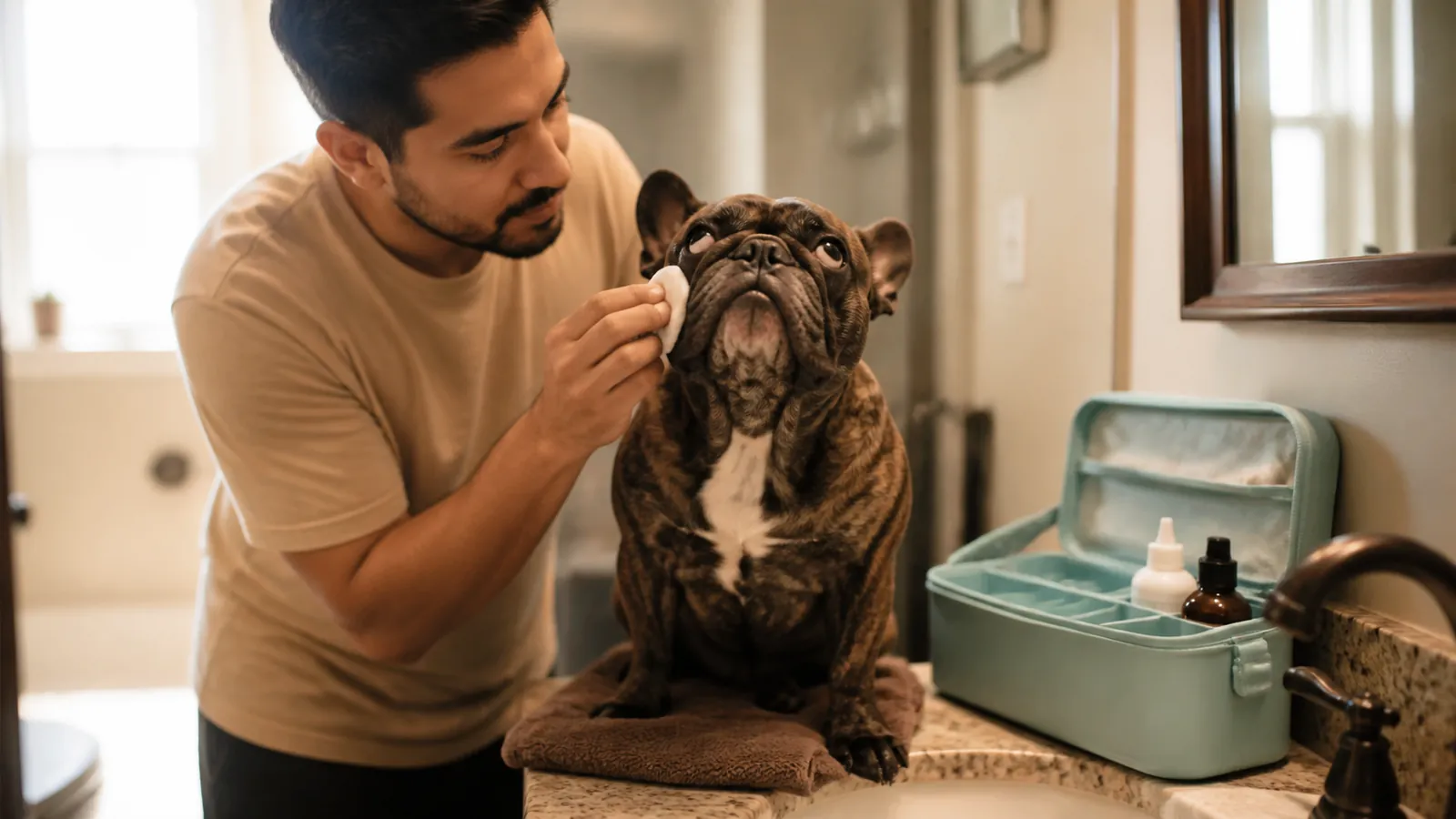
The French Bull Dog Club of America's owner guidance describes occasional brushing, regular nail trimming, and regular cleaning of the ears and the deep facial folds, and notes that a veterinarian can advise on how to care for ears, skin folds and anal sacs. Budget-wise that means consumables and a few tools rather than a haircut, and it means time: households that do this themselves spend on supplies, households that do not spend on a groomer's session fee. Either is a legitimate choice. Only one of them is free.
Food quantity follows the dog, not the breed
The same club guidance stresses keeping the dog at an appropriate weight, noting that an obese French Bulldog is at far higher risk for many of the breed's health issues, and the American College of Veterinary Surgeons notes that obesity aggravates brachycephalic breathing problems. That makes the food row a weight-driven calculation — calories per package, daily quantity for your dog, cost per day — rather than a bag price. Ask your veterinarian what your individual dog should be fed and how much.
Two label facts keep that row comparable. First, the nutritional adequacy statement is what tells you a food is complete and balanced, and the AVMA notes it is usually in small print on the back or side of the bag or can and appears on foods across a wide range of prices — "premium" is not, on its own, a nutritional claim. Second, that statement comes in more than one form, and the forms are not equivalent evidence. The Association of American Feed Control Officials sets out the standard label formats: one says a product is formulated to meet the AAFCO nutrient profiles for a stated life stage; another says animal feeding tests using AAFCO procedures substantiate that it provides complete and balanced nutrition. The first is a formulation claim, the second rests on feeding trials. Read which one your bag carries, and check that the life stage matches your dog.
Two feeding situations are outside what a page can price. A diet your veterinarian has directed for a diagnosed condition is a clinical instruction, and the cost follows the instruction rather than the other way round. And a home-prepared diet is not a budget decision at all: recipes found online are frequently incomplete, and the person qualified to formulate one is a board-certified veterinary nutritionist working from your dog's own record, reached through your veterinarian.
Climate is a real line item
The breed club advises that French Bulldogs do best in moderate temperatures, that panting or shivering both indicate excessive exposure, and that in warm or humid environments above roughly 70°F, air conditioning in the house and the car is essential. It also warns that these dogs are poor swimmers because of their front-heavy build and should never be left unattended around water, that rawhide-type chews should be avoided because they can lodge in the throat once softened, and that in warm areas a cooling pad and fresh water belong in the crate. Those are safety points first; they happen to have costs attached.
The strength of the club's wording is worth noticing: air conditioning is described as a requirement, not a comfort. If you live somewhere hot and humid, price cooling for the house and the car before you price anything else on this page. This is a breed-club position rather than a clinical guideline, and it is the most consequential single line in this budget for a household in a hot ZIP.
Two smaller costs follow from the same constraint. Hot ground is one: AAHA's Trends notes that the surface heat of asphalt, concrete, sand and metal can run 40 to 60 degrees above the air temperature, so that on a sunny 85°F day asphalt can reach 135°F — hot enough to burn a dog's paw pads within a minute — and that limping, reluctance to walk, redness or blisters on the pads, licking at the feet, or vocalizing when pressure is put on a foot are the signs to look for. Shaded routes and cooler hours cost nothing; boots are a real line item if your routes give you no choice. And a summer walk plan is itself a cost decision, because a household that cannot walk its dog outdoors for four months of the year may be paying for indoor enrichment or a daycare day instead.
What overheating looks like, and when it becomes an emergency
Heat matters more for this breed than for most, and it is the point where a comfort cost becomes a clinical one. AAHA's Trends, reporting the practice experience of Kimberly Lutz, DVM, records that brachycephalic dogs are disproportionately affected by heat and can be affected by spending only minutes outside, and that in her practice they make up the majority of heat-related cases. A short-faced dog cools itself with a less efficient version of the same mechanism every other dog uses, which is why the ordinary summer rules are not the right rules here.
The table below is a routing aid rather than a diagnosis. The signs are as AAHA's Trends sets them out for pet owners; the column telling you what to do is this page's routing, built from that guidance and from the emergency signs at the top of this page.
Heat signs — dog, French Bulldog, United States. AAHA Trends guidance read August 7, 2026.
| What you can see | How AAHA's Trends describes it | What to do |
|---|---|---|
| Seeking shade or trying to lie down, excessive panting, red tongue and gums, thick sticky saliva | Heat stress — overheating for a short period that can be cooled off without long-term consequences | End the activity, get the dog somewhere cool, offer water. If it does not settle, treat it as the next row |
| Excessive panting with drooling, listlessness, muscle tremors, vomiting, diarrhoea, confusion — or a dog that simply is not cooling down | Signs of heatstroke, or a failure to cool. AAHA's Trends describes heatstroke as an emergency | Do not wait and watch. Call your veterinarian or an emergency clinic now, say the dog is a short-faced breed that has been in the heat, and follow their instructions while you travel |
| Collapse, loss of consciousness, seizures — or struggling to breathe or a blue-tinged tongue or gums | Heatstroke, at the severe end | Go to an emergency clinic immediately, and call them on the way so they are expecting you |
Two things this page will not do. It will not print a temperature you should take at home, because taking one delays the journey and the number does not change the decision. And it will not print a cooling technique, because the clinic you are calling will tell you what to do on the way for your dog, and that instruction is better than a generic one.
Breathing is a veterinary question with budget consequences
The short face makes breathing less efficient, which the breed club connects to reduced tolerance of heat, exercise and stress, and it advises having the airway evaluated if a dog seems to overheat or become stressed too easily, with noisy breathing and sometimes spitting up foam. The Orthopedic Foundation for Animals makes a related point that matters for new owners: many people interpret noisy breathing as simply normal for the breed. It is worth raising with your veterinarian rather than assuming.
If you have never owned a short-faced dog, you may not know what normal sounds like. The OFA's Respiratory Function Grading Scheme — a screening exam for dogs, open to French Bulldogs, and not something you perform at home — draws its line at a place an owner can actually hear:
Airway screening grades — dog, French Bulldog. OFA program page read August 7, 2026.
| What a screening veterinarian hears | How the scheme grades it | What it means for you |
|---|---|---|
| No breathing noise, or mild noise audible only through a stethoscope | Grades 0 and I — clinically unaffected | Still worth mentioning at your next routine visit, particularly for a dog under two, for whom the OFA suggests an annual health check because signs can develop later |
| Stertor or stridor audible without a stethoscope, whether intermittent or continuous | Grades II and III — clinically affected | The OFA describes these dogs as having signs affecting quality of life; they should be monitored and may require veterinary treatment. Book an appointment |
| Respiratory difficulty, cyanosis or fainting at any point | Already in the Grade III range | The OFA states the exercise test is not advisable for these dogs. Treat this as urgent, and see the emergency guidance at the top of this page |
The OFA describes the noises its assessors listen for as stertor — a low-pitched vibrational noise heard above the larynx — and stridor, a higher-pitched sawing noise heard over the larynx, and lists noisy breathing, exercise and heat intolerance, regurgitation and difficulty swallowing among the clinical signs of brachycephalic obstructive airway syndrome. None of that is a diagnosis you can make from a table. It is a description of the line a trained examiner draws, offered so you know what is worth raising rather than absorbing.
Anesthesia also carries more risk in short-faced dogs, which is why the breed club advises choosing a veterinarian experienced with them — relevant whenever a routine procedure such as a spay, neuter or dental cleaning is scheduled, and a reason the quoted price at two clinics may not be describing the same thing. Discuss your dog's individual care plan, breathing, heat tolerance, exercise and travel needs with your veterinarian.
The spine is worth one exam and one conversation
The parent club also asks owners to pay attention to the spine. Like other dwarf breeds, it notes, the stocky French Bulldog may have abnormal vertebrae or premature degeneration of the intervertebral discs, and where symptomatic back problems occur they are more often due to disc disease than to abnormal vertebrae. Its practical advice is measured rather than alarming: every dog should have a thorough musculoskeletal examination by a veterinarian, and most French Bulldogs can safely take regular moderate exercise, which the club describes as essential to maintaining healthy weight and physical condition.
For a budget, that lands in two places and neither is a purchase. The musculoskeletal examination belongs inside routine veterinary care, so ask that it be part of the visit rather than treating it as an extra. And the exercise that protects weight and condition is free — though the club does advise that French Bulldogs should never run loose and should be outdoors only in a fenced yard or on a lead, which puts a lead, a harness and, if you have no fencing, a plan for where you will walk into the setup column.
Training is timed by your veterinarian
The breed club advises starting classes as soon as your veterinarian judges the puppy's immunity to be adequate, which means the training line in year one may fall later than you plan for. It is a scheduling variable more than a price one.
What you are buying is also worth a moment, because training is one of the few lines on this page where the cheapest option and the safest option can be the same one. Ask any trainer or class for the instructor's credentials and who issued them, and ask in writing what they do when a dog gets something wrong — a program that cannot answer that in plain language before you book is not one to book. For a short-faced dog, ask specifically how they manage exercise and breathing during a class, and expect harness work rather than neck pressure. And a behaviour problem is not automatically a training purchase: fear, aggression or a sudden change in how your dog behaves goes to your veterinarian first, who can look for pain or illness underneath it and refer onward to a veterinary behaviorist if the problem is behavioural after all.
Screening records tell you about a record, not about a dog's future
For French Bulldogs, the parent club requires hip, eye, patellar and cardiac evaluations for a CHIC number, and separately recommends tracheal hypoplasia, elbow, juvenile hereditary cataract, respiratory function and cystinuria testing. Two of the required tests have a cost range hidden inside them, which is worth knowing if you are reading a breeder's paperwork or pricing screening for your own dog: the club accepts either a basic cardiac exam by auscultation or an advanced echocardiogram, and these are very different procedures at very different prices, and it notes that the eye examination must be performed by a veterinary ophthalmologist with annual recertification recommended — a recurring item, not a one-off.
The OFA is explicit that a CHIC number does not imply normal results — only that every required breed-specific test was performed and the results made public. The OFA's Respiratory Function Grading Scheme is a separate, optional screening exam performed by a specially trained approved veterinarian, and as of August 7, 2026 the OFA's own program page limits certification to Pugs, Bulldogs and French Bulldogs; other brachycephalic breeds may be examined but are not eligible for certification. The minimum age is twelve months, and exams on younger dogs are treated as preliminary and are not eligible for certification. For the North American program, OFA's registration fee is $15 per exam as published on its own program page and re-checked on August 7, 2026, while the veterinary exam fee itself is set separately by the examining veterinarian and is not published centrally. Approved examiners are listed by state and coverage is uneven, so treat it as an optional, availability-dependent item rather than a routine ownership cost. None of these records predicts what a specific dog will cost, and none of them should be priced into a budget as insurance against anything.
What might a rescue adoption already include?
Paw Parent HQ is adoption-first, and this page never advertises animals, links animal marketplaces or ranks sellers. Acquisition cost is a figure you enter yourself.
What is worth verifying before you enter it is how much of year one a rescue may already have covered. One national example, verified on August 7, 2026: the French Bulldog Rescue Network states that all of its available dogs are spayed or neutered, current on vaccinations and microchipped before placement, that dogs are treated for all medical conditions of which it is aware, and that ongoing or chronic conditions, treatments and medications are described to applicants before adoption. Its published minimum adoption fees are $1,500 for healthy dogs under two, $700 for healthy dogs aged two to eight, and $400 for dogs over eight or with special needs, in US funds, alongside a $20 non-refundable fee per application. It also requires adopters to travel to complete the handover, and notes that where transport costs arise they are the adopter's responsibility.
That is one organization's published terms on one date, not a national range, and other rescues and shelters set their own fees and inclusions. Note also that the fee ladder runs the opposite way to intuition: the youngest, healthiest dogs carry the highest fee, and the fee for a senior or special-needs dog is lower precisely because the ongoing care is likely to cost more. A low adoption fee is not a cheap first year.
Use the example as a template for the questions rather than as a figure. Ask any rescue or shelter, before you enter an acquisition number:
- What veterinary care has this dog already had, and on what dates?
- Which of it is documented in writing, and can I have copies before adoption?
- What is still outstanding — spay or neuter, a vaccine in the series, a dental, a recheck?
- What recurs, and when is the next one due?
- Is there an ongoing or chronic condition, and what has it cost you to manage while the dog has been in foster care?
- Does the fee include anything beyond the veterinary work, and is anything refundable?
Ask for the records in writing, and take them to your first veterinary appointment.
If you are still weighing adoption against buying, the full comparison — process, predictability, screening, support and records — belongs to our page on adopting vs. buying a dog, not to this budget.
How do I build a low, base or high scenario?
A scenario is not a discount. It is a set of choices about sourcing and convenience, applied to the same floor of necessary care.
| Scenario | What changes | What never changes |
|---|---|---|
| Low | You do grooming, nail care and fold cleaning yourself; you buy setup items secondhand or already own them; you choose group training or self-directed training; you skip all optional services | The veterinary care your veterinarian recommends, parasite prevention, identification and licensing, and adequate food |
| Base | A mix: some tools bought new, occasional professional grooming, one training course, no ongoing optional services | The same floor |
| High | Professional grooming on a schedule, private or extended training, boarding or daycare selected, premium convenience choices on food and supplies | The same floor |
The formulas underneath are deliberately plain.
First year = acquisition + one-time setup + first-year veterinary care + annualized food + grooming + training + identification and licensing + your risk-financing line + any optional services you switched on.
Each year after = food + routine veterinary care + parasite prevention + grooming + training and enrichment + license renewal + replacement supplies + your risk-financing line + any selected optional services.
Monthly view = annual recurring total ÷ 12. Keep acquisition and one-time setup out of it, or label them separately as a cash-flow view; blending them produces a monthly figure that is wrong in both year one and year two.
Two guardrails. Low never means skipping care your veterinarian has recommended. If a scenario only balances by removing that, it is not a low scenario — it is a budget that does not yet cover this dog, and that is worth knowing early rather than late. Early is when the routes in what if I can't afford my French Bulldog's veterinary care work best, when a low-cost clinic or a payment arrangement is easiest to set up, and when you still have every option in front of you. It is a solvable problem far more often than it feels like one at the kitchen table. And a lifetime total should stay switched off unless you can see the assumptions behind it — how many years, what price growth, which categories are included and which emergencies are excluded. Without those on screen, a lifetime figure is a mood, not a number.
Which costs are optional, and how should I plan for emergencies?
Boarding, daycare, dog walking and travel are genuinely optional. They can be substantial — for some households they are the largest line after food, particularly where nobody is home during the day — but they depend entirely on working patterns and travel, so they sit outside the headline total and enter it only when you select them. Price them the way you price everything else here: a named provider, a defined service, your ZIP, a unit and a date.
An emergency reserve is a planning choice, not a forecast. It is the amount you decide to hold, not a prediction of what your dog will need, and it should never be presented as an expected cost. Set it as a monthly contribution you can sustain, keep it in a separate and accessible account, and decide in advance what counts as a trigger for using it. If you carry insurance instead, your deductible and any cost sharing still need to be reachable in cash on the day, which is a smaller version of the same reserve. What this page will not do is model a specific condition, procedure or surgery cost for French Bulldogs as a group. Individual risk is a conversation with your veterinarian about your individual dog.
If the reserve is not there when something happens, that is not the end of the road — the routes in what if I can't afford my French Bulldog's veterinary care exist for exactly that day, and they work better the earlier you use them.
How was this budget built, and what is still missing?
The Paw Parent Index is our own sampled dataset. For this page it is designed to carry standardised pet-insurance quotes for French Bulldogs at three locked ages across five locked state and ZIP pairs, held to one comparable policy design, plus dated first-year and annual cost observations by category. Every quote is intended to record its full input set and its collection timestamp; every cost row its unit, geography, source URL, inclusions and access date.
None of those rows is published yet. The ages, states, providers and policy design are still being locked, so the value cells above say Not collected rather than carrying a placeholder or an inferred figure. Where a provider cannot be quoted on comparable inputs, that row will be marked not comparable rather than forced into false equivalence, and no value will ever be copied across a state, an age, a provider, a breed or a product.
The six-field test. Every published row on this page has to state: the unit, the geography, the as-of date, the source type, what is included and excluded, and its verification status. A row that cannot fill all six is not published as a number.
Who writes this, and what that is worth. This page is written and edited by the Paw Parent HQ editorial team against the evidence standard on this page. That standard is a sourcing discipline, not a clinical credential: every clinical statement here is carried by a named veterinary specialty college, professional association, registry or breed club, linked at the point it is used, rather than by in-house veterinary judgment. No veterinarian has examined your dog, and nothing on this page is a substitute for one who has. Where this page cannot close a question — and it says so each time it cannot — your own veterinarian is the next step.
How this page is funded. Paw Parent HQ is supported by advertising and, on some pages, disclosed referral links. No provider has paid for placement, ordering, or inclusion on this page, and compensation never determines what is included or how it is ranked. If a compensated link is added to this page, it will be disclosed here. This page names no provider as preferred or approved, and treats every provider relationship as unconfirmed unless it is documented.
How sources are checked. A link that loads is not the same as a link that is current. Several organizations cited here also run older duplicate properties that are still reachable and still carry different figures. One example: a legacy page for one of the two poison-control services still shows a per-incident fee below the current one, and a legacy page for the rescue cited above still shows adoption fees roughly forty per cent under that organization's current published minimums — a figure at least one commercial cost guide published in 2026 is still repeating. Every external figure on this page is therefore taken from the source's canonical page, the address the site itself declares as authoritative, and re-checked there rather than at whichever address a search happens to return.
Editions and dates. Where a source publishes a guideline edition or revision date, this page names it at the point of use. The specialty-college, registry and breed-club pages cited here publish none, so each carries instead the date this page last opened it — August 7, 2026 — and nothing here is dated later than the day its source was actually read.
Two source conflicts, disclosed. The first: the French Bull Dog Club of America's health testing page carries a short summary paragraph naming thyroid and juvenile cataracts as its recommended additional tests, and a detailed table below it that lists tracheal hypoplasia, elbow dysplasia, juvenile hereditary cataracts, respiratory function grading and cystinuria, without thyroid. This page follows the detailed table, because it is the more specific and more recently maintained of the two. If you are reading a breeder's paperwork against the club's summary paragraph instead, that is why the lists differ.
The second is a jurisdictional one, and it catches people out. Respiratory function grading exists as a separate program in more than one country, and the eligible-breed lists are not the same. The United States and Canadian program is run by the OFA and, as of August 7, 2026, certifies Pugs, Bulldogs and French Bulldogs only. The United Kingdom scheme is run by the Royal Kennel Club with the University of Cambridge, and in February 2026 it announced an extension to a further fourteen breeds, with its own health standard update scheduled for June 2026. Both are real; they are different programs under different bodies. If a breeder's paperwork or a search result describes an eligible-breed list that does not match the one above, check which country's scheme it came from before you conclude anything.
| Date | What changed on this page | What it affected |
|---|---|---|
| 2026-07-30 | Veterinary, registry, breed-club and rescue sources re-opened and re-verified | Care guidance, screening-record wording, rescue example |
| 2026-08-07 | Full canonical-source re-verification. Rescue adoption fees corrected against the organization's canonical page; the airway-screening eligibility statement corrected and the US and UK schemes separated; poison-control access in Georgia added; heat, paw-surface, affordability, spine, breathing-grade and pet-food-label material added and sourced; a jurisdiction router added | Emergency block, climate section, screening section, affordability section, first-year section, food row, licensing routing |
Quoted prices and provider terms are reviewed every 30 to 90 days; food prices and subscription terms quarterly; state-level rules before indexing and at least semiannually thereafter; veterinary guidance on each new edition and at least annually. The earliest of those deadlines governs: the volatile fee figures on this page were verified on August 7, 2026, so the next scheduled verification is September 6, 2026.
Choosing between insurers is a separate job with its own evidence requirements, and it belongs to our hub on how to compare pet insurance providers. This page shows standardised samples and quote methodology only; it does not rank anyone.
How do I choose what to buy without guessing?
These are decision shapes, not product recommendations. Paw Parent HQ treats every provider relationship as unconfirmed unless it is documented, and this page names no insurer, food brand or service as a preferred option. Each pick below states who it fits and who it does not; the questions to ask before committing are in the table underneath.
- Best for a household still deciding whether a French Bulldog fits: buy nothing yet, and build the annual recurring column from your own local prices first — the number you can repeat every year is the one that should decide it. Not ideal for a household that has already committed to a dog arriving on a date, which needs the first-year setup column instead.
- Best for a French Bulldog puppy joining a household with no savings buffer: an accident-and-illness policy whose sample policy document publishes its waiting periods by condition type and its bilateral-condition language, quoted at your own ZIP and your dog's age. Not ideal for a dog whose records already show a condition, which will usually be treated as pre-existing and excluded.
- Best for an adult French Bulldog adopted at two or older: start from the adoption records rather than from a product, because what is already done and paid for changes year one more than any purchase will. Not ideal for a dog arriving without written records, where an examination has to establish the baseline first.
- Best for a household with savings it can genuinely leave alone: a written self-funded reserve rule instead of a premium. Not ideal for a household whose buffer would realistically be spent before the dog turns two.
- Best for any French Bulldog with noisy breathing, heat intolerance or exercise intolerance: an in-person veterinary assessment before any product decision. Your veterinarian sets the care plan, and the care plan sets the cost. Not ideal for nothing — there is no household for which a product should come first here, which is why this pick has no alternative.
- Best for a growing French Bulldog puppy's food line: a formula whose own label carries a nutritional adequacy statement for that life stage, with recurring price, shipping and cancellation terms published before you subscribe — and ask your veterinarian how much your individual dog should be fed. Not ideal for a dog on a diet your veterinarian has directed, where the clinical instruction governs and this rule does not apply.
- Best for a French Bulldog puppy or newly adopted adult that needs training: a trainer or class that publishes its instructor's credentials and its methods in writing before you book, and that works a short-faced dog in a harness rather than under neck pressure. Not ideal for a dog showing fear, aggression or a sudden change in behaviour, which goes to your veterinarian first.
| Your situation | Shortlist move | Ask before you commit |
|---|---|---|
| Puppy, first dog, no savings buffer | An accident-and-illness policy whose sample policy is published, not just marketed | What is the waiting period for each condition type? How are bilateral conditions treated? How is a pre-existing condition defined, and over what lookback? Does the premium change as the dog ages? |
| Adult rescue, two to eight, records in hand | Compare a policy and a reserve using the records you already hold | What in these records would be treated as pre-existing? Is any curable condition handled differently? Is a recent exam required to enrol? |
| Any age, savings you can leave untouched | A written reserve rule instead of a premium | Is the account separate and accessible the same day? What monthly amount will you actually transfer? What counts as a trigger for using it? What is the plan if a cost exceeds the balance? |
| Feeding a growing puppy | A complete-and-balanced formula matched to the life stage | Does the label carry a nutritional adequacy statement for this life stage, and does it rest on formulation or on feeding trials? What are the calories per cup or per package? What is the recurring price including shipping and tax? What is the cancellation term? |
| Booking training or a class | A program that publishes credentials and methods before you pay | Who issued your instructor's credentials? What do you do when a dog gets something wrong? How do you manage a short-faced dog's exercise and breathing in class? What is the refund term if the class is not right for this dog? |
| Hot or humid ZIP, any life stage | Price cooling for house and car before any other purchase, and treat it as a recurring seasonal line | What will running it actually cost in your hottest months? Does the car have working climate control? What is your plan for walks on a hot day, and for a power cut? |
| Nobody home during the working day | A named daycare, walker or sitter, priced as a defined service rather than as an occasional extra | What is the per-day or per-visit rate at your ZIP? How is a half day defined? What is the cancellation policy? How do they handle a short-faced dog on a hot day? |
| Household with young children, or with other pets already | No purchase — a supervision and introduction plan first, and your veterinarian's input on the individual dog | Where can the dog go to be undisturbed, and who keeps it that way? What does supervision mean in practice — an adult in the room and within reach, not elsewhere in the house? Does the rescue or breeder know how this dog has behaved with children or other animals? |
On that last row, one thing is worth saying plainly rather than leaving to a question: no breed is a safety guarantee in either direction, and this one is not an exception. Temperament is individual, supervision is the control that actually works, and a dog that has never met a small child is a dog whose behaviour with small children is unknown rather than good.
Score every option with the same six-field test the matrices apply to their own rows. If an option's own documentation cannot fill all six, that gap is the finding. Record it as Partial or Blocked and shortlist accordingly, rather than treating a confident marketing page as a completed row.
Questions new French Bulldog guardians ask
What does this work out to per month?
Take your annual recurring total and divide by twelve. Keep acquisition and one-time setup out of that figure, or show them separately as a first-year cash-flow view. Blending them produces a monthly number that overstates every year after the first and understates the first one, which is the single most common error in published pet budgets.
Is an adult rescue cheaper than a puppy?
Often in year one, and for a specific reason: spay or neuter, the vaccination series, microchipping and some initial veterinary work may already be completed and included in the adoption fee. Verify that from the organization's own records rather than assuming it. Note that a lower adoption fee often signals more ongoing care rather than less — senior and special-needs tiers are priced down for that reason. From year two the recurring budget is broadly the same, and senior care later on has its own schedule, which your veterinarian will set.
Is a lifetime cost estimate useful?
Only with its assumptions visible: the number of years, the price-growth assumption, which categories are counted, and which unexpected veterinary costs are deliberately excluded. Without those, a lifetime figure is a headline rather than a plan. Budget the recurring year properly and revisit it annually; that is the number that actually determines whether ownership is comfortable.
How much should I expect to spend in the first year?
We are not publishing a figure for this breed yet, because the sampled rows behind it are not complete, and a number without its sources would be worth less than no number. What decides yours: puppy or adult rescue, your ZIP, your dog's actual weight and therefore its food quantity, whether you groom and train at home or pay for it, your local license fee, and whether you carry a premium or fund a reserve. Fill those six in and you have your own figure.
How much is pet insurance for a French Bulldog?
We have no sampled premium to publish for this breed yet, and a figure without its inputs would not be usable anyway — a quote is priced on your ZIP, your dog's age at enrollment, the exact breed label the insurer's own flow uses, and the deductible, reimbursement percentage and annual limit you pick. Any of those can move the number more than the breed does. The fastest honest answer is your own: run one quote at your real ZIP and your dog's real age, and record all eleven fields in the quote-field table as you go. That takes about ten minutes and gives you a number that actually applies to your dog, which no published average can.
What health problems do French Bulldogs have, and should I budget for them?
Those are two questions and they have different answers. Your veterinarian is the only person who can tell you what your individual dog has or is likely to develop, and this page will not print a condition list, because a breed is not a diagnosis and a list read at midnight tends to become a self-diagnosis. What this page does cover is the small set of breed constraints that reliably change a budget — the skin and fold routine, weight-driven feeding, cooling in hot climates, breathing, the spine, and anesthesia risk in short-faced dogs — all of it set out under why your budget may differ. On budgeting for conditions: do not price a specific operation into a French Bulldog's year. Fund a reserve or carry a policy, and let your veterinarian's assessment of your actual dog drive everything else.
How soon will I actually know what my French Bulldog costs?
Your timeline is set by the slowest dependency, not by how fast you fill the worksheet. For the care side that is your veterinarian's assessment and the plan that follows it. For coverage it is enrollment and underwriting, whatever waiting period the policy form states for each condition type, any exam requirement, age-eligibility limits, and how that specific policy defines its pre-existing-condition lookback. For food and subscriptions it is the manufacturer's stated transition, delivery and cancellation windows.
When is something a routine cost, and when is it a veterinary emergency?
Routine means scheduled: wellness visits, parasite prevention, dental and grooming care, and non-urgent questions. Same-day veterinary contact is for anything new that worries you — and the OFA notes that owners often mistake noisy breathing for normal in these breeds, so raise it rather than absorb it. Treat struggling to breathe, a blue-tinged tongue or gums, or collapse as an emergency and go now; the heat signs that lead there are in what overheating looks like. If you think your dog has swallowed something toxic, call your veterinarian or one of the poison control services listed at the top of this page immediately; do not wait, and do not route it through a product or a membership first.
What to do next

Save your inputs: life stage, ZIP, your dog's actual weight, your acquisition figure and whether you have chosen a premium or a reserve. Then spend an hour collecting real local prices for the rows that matter most to you — food, routine veterinary care, licensing and grooming — and date each one as you go. Bring the result to your next appointment and talk through your dog's individual care plan, including breathing, heat tolerance, exercise and travel, with your veterinarian. That conversation, not this table, is what turns a budget into a plan.
Sources and last verified date
Last verified: August 7, 2026
- Brachycephalic Syndrome — American College of Veterinary Surgeons — veterinary description of the syndrome, the meaning of "brachycephalic," the signs associated with it including exercise intolerance, cyanosis and collapse, the circumstances in which they commonly appear, and the aggravating effect of obesity.
- ASPCA Animal Poison Control — ASPCA — the service's own telephone number, its round-the-clock availability, and its statement that a consultation fee may apply without publishing the amount.
- Pet Poison Helpline FAQ — Pet Poison Helpline — the service's own telephone number, its $89 per-incident fee including follow-up consultations, and its guidance not to give home antidotes or induce vomiting without professional direction.
- Pet poison hotlines impacted by new law — AAHA Trends — that both poison-control services are currently unable to assist Georgia pet owners directly following Senate Bill 105, and the reported per-incident fee for the ASPCA's centre.
- Pets and poisons — Georgia Poison Center — the state poison centre's own statement that Georgia law prevents both animal poison lines from advising pet owners directly.
- Heat safety warnings for veterinary teams and pet owners — AAHA Trends — the signs of heat stress and of heatstroke, the description of heatstroke as an emergency, the practice observation that brachycephalic dogs are disproportionately affected and can be affected within minutes, and the surface-temperature and paw-pad burn figures and signs.
- Loving your pet, managing the costs — American Veterinary Medical Association — guidance on discussing cost limits with a veterinarian, clinic payment arrangements, nonprofit and low-cost clinics, veterinary-school assistance, the AVMA's non-endorsed list of assistance organizations, breed-specific support, the timing advantage of early treatment, the location and purpose of the nutritional adequacy statement, and the advice to begin insurance before conditions become pre-existing.
- Accredited veterinary colleges — American Veterinary Medical Association — the current list of accredited veterinary colleges, used to locate teaching hospitals.
- Reading Labels — Association of American Feed Control Officials — the standard nutritional adequacy statement formats and the distinction between a formulation claim and one substantiated by animal feeding tests using AAFCO procedures.
- French Bulldog Breed Information — French Bull Dog Club of America — parent-club owner guidance on routine coat, nail, ear and facial-fold care, weight management, temperature and water safety, chew and crate safety, airway evaluation, anesthesia in short-faced breeds, spine and intervertebral disc considerations, moderate exercise and containment, the routine preventive-care list, and the timing of training classes.
- Health Testing and Registries — French Bull Dog Club of America — the breed's required CHIC tests (hip, eye by a veterinary ophthalmologist with annual recertification recommended, patella, and cardiac by auscultation or echocardiogram) and its separately recommended tests, including the Respiratory Function Grading Scheme.
- French Bulldog Rescue Organizations — French Bull Dog Club of America — the parent club's list of breed rescue organizations, used as the breed-specific route for owners needing help.
- CHIC Program — Orthopedic Foundation for Animals — what a CHIC number does and does not indicate about a dog's test results.
- Respiratory Function Grading Scheme — Orthopedic Foundation for Animals — the program's current eligible breeds and certification limits, the twelve-month minimum age and preliminary status of younger exams, the grade definitions and the stethoscope-audible threshold, the stertor and stridor descriptions, the clinical signs of brachycephalic obstructive airway syndrome, approved-examiner availability by state, the $15 OFA registration fee with the exam fee set separately, and the observation that owners often mistake noisy breathing for normal.
- Royal Kennel Club expands its Respiratory Function Grading scheme to an additional 14 breeds — The Royal Kennel Club — the February 2026 announcement of the United Kingdom scheme's extension and its June 2026 health standard update, used to distinguish the UK scheme from the North American program.
- Adoption Info — French Bulldog Rescue Network — one national rescue's current published minimum adoption fee tiers, application fee, included veterinary services, health-disclosure practice and travel requirement.
- Surrender a Dog — French Bulldog Rescue Network — one breed rescue's owner-surrender route, used for the rehoming path.
- Local governments — USAGov — the federal directory of city, town and county government websites, used to route licensing questions in every state to the reader's own governing authority.
Next review: September 6, 2026
Not sure what fits your situation?
Answer a few questions and get a shortlist matched to where you are right now.
Take the 2-minute questionnaireKeep reading
 How Pet Insurance Works: Waiting Periods and ExclusionsLearn how pet insurance premiums, deductibles, reimbursement, annual limits, waiting periods, exclusions, and claims work before comparing policies.
 Puppy Vaccine Schedule by Age: Core and Lifestyle ShotsUnderstand a puppy vaccine schedule by age, including core and lifestyle-based vaccines, timing windows, missed doses, reactions, and local rabies rules.
 First-Year Puppy Cost: A Realistic 2026 BudgetEstimate your puppy's first-year cost with a dated calculator covering adoption, vet care, food, supplies, training, insurance, and an emergency reserve.
 Is Pet Insurance Worth It? Insurance vs. SavingsCompare pet insurance with a dedicated savings fund using liquidity, policy eligibility, owner-share math, and realistic scenarios for dogs and cats.