
New Kitten Checklist

What does a new kitten need on day one?
This page is for a kitten coming home at roughly eight weeks to six months old, from a shelter, rescue, foster home, or previous caregiver. If something already looks wrong, skip the setup and go to the call-or-go table below. Before your kitten arrives, set up one quiet, kitten-proofed room that covers eight functions: safe travel, the food your kitten is already eating, water, a litter box, somewhere to hide, somewhere to rest, something to scratch, and something safe to play with. That is the eight-function test, and it is the whole shopping list. Ask whoever you are collecting your kitten from what they eat, which litter they use, what medications or parasite prevention they have had, whether there is a microchip, and what records exist. Let your kitten settle into that one room first. Book a veterinary visit within the first week at home, which is what the American Animal Hospital Association's new kitten checklist advises. Then expand access gradually, guided by whether your kitten keeps eating, drinking, resting, and using the box normally — not by a fixed number of days. If your kitten is younger than eight weeks, or is orphaned and still being bottle-fed, that is a different job — call your veterinarian before anything else.
Call a veterinarian or animal poison control right away if you see this
Two levels, and the difference matters. The two-column split below is a Paw Parent HQ arrangement of signs named by the veterinary sources cited beneath it; none of it is a diagnosis. If you cannot tell which column you are in, call. The Cornell Feline Health Center advises calling if you have any doubt at all about your cat's health.
| What you see in your kitten | What to do |
|---|---|
| Loss of appetite, or a kitten who stops eating | Call your veterinary practice the same day |
| Lethargy, or a kitten who is unusually quiet or sleeps more than seems normal | Call your veterinary practice the same day |
| Persistent vomiting or diarrhea | Call your veterinary practice the same day |
| Eye or nose discharge, sneezing, or coughing | Call your veterinary practice the same day |
| Swelling that appears quickly or keeps growing | Call your veterinary practice the same day |
| Breathing with an open mouth, breathing you can hear across the room, or a kitten whose sides or belly visibly heave with each breath | Go now — emergency clinic |
| A kitten who lowers their head, stretches their neck forward, and looks as though they are about to be sick while breathing | Go now — emergency clinic |
| Collapse, or a kitten you cannot rouse | Go now — emergency clinic |
| Straining in the litter box and producing little or nothing, crying in the box, or repeated trips to the box | Go now — emergency clinic |
| Blood in the urine | Go now — emergency clinic |
| A fall, a crush injury, or a door or recliner accident | Go now — emergency clinic |
| Any sudden severe change | Go now — emergency clinic |
Sources for this table checked August 5, 2026. Cornell lists loss of appetite, persistent vomiting or diarrhea, straining or pain when urinating, blood in the urine, difficult or rapid breathing, lethargy, and swelling that appears quickly or keeps growing among the signs that should prompt you to contact a veterinarian. The breathing rows come from Cornell's guidance on dyspnea, which describes cats in respiratory distress as breathing noticeably fast, panting noisily with an open mouth, coughing, or lowering the head and extending the body as though about to vomit — and states that any cat showing signs of breathing difficulty is at high risk of dying if the problem is not treated promptly. Cornell is explicit that this is not something to work on at home: any time there is a question about a cat's ability to breathe comfortably, get to a veterinarian right away. Straining that produces little or nothing sits in the second column for a specific reason, explained in the litter box section.
If you think your kitten has eaten, chewed, licked, or walked through something — a plant, a pill, a cleaning product, a flea product meant for a dog — call your veterinarian, an emergency clinic, or one of the two 24-hour animal poison control services:
- ASPCA Animal Poison Control at (888) 426-4435, which answers 24 hours a day, 365 days a year and states that a consultation fee may apply.
- Pet Poison Helpline at (855) 764-7661, also 24/7, which states a one-time consultation fee of $89 per incident covering all follow-up consultations (provider-stated fee, checked August 5, 2026).
Call before symptoms appear, and follow the instructions you are given rather than trying anything at home.
On this page
- What does a new kitten need on day one?
- Call a veterinarian or animal poison control right away if you see this
- Where to start, depending on your situation
- Buy now, wait, or verify first?
- How do I set up the safe room before pickup?
- How do I kitten-proof my home?
- What should I feed a new kitten in the first week?
- How do I make the litter box easy to use and easy to watch?
- What happens at the first vet visit, and what should I bring?
- What will the first year cost, and what if I can't afford it?
- How do I introduce my kitten to people and other pets?
- What daily routines should I start in week one?
- What does the first week actually look like, day by day?
- How do I choose kitten gear without guessing?
- New kitten checklist FAQ
Where to start, depending on your situation
- If your kitten is arriving from a shelter, rescue, or foster home — start with continuity. Bring home their current food and current litter, and change nothing else in week one.
- If you already have a cat — start with duplicate resources. A second full set of box, bowls, hide, and scratching surface in a separate room does more good than one upgraded set.
- If money is tight, or you are unsure — buy nothing beyond the arrival essentials. A plain box, plain bowls, a cardboard scratcher, and the food your kitten already eats meet every need this week.
- If you are considering anything with a medical purpose — a diet change, a supplement, a flea or tick product — ask your veterinarian before you buy it.
- If it is the cost of veterinary care you are worried about, not the cost of supplies — read the four routes to try before you skip an appointment before you cancel anything.
- If your kitten may have swallowed or touched something harmful, or any of the signs above appear — call your veterinarian, an emergency clinic, or animal poison control first.
Buy now, wait, or verify first?
Most kitten supplies lists are long because they are written to sell things. A shorter test works better: before pickup, buy only what your kitten needs in order to travel safely, eat their current diet, drink, use a litter box, hide, rest, scratch, and play safely. Everything else can wait until you have watched your kitten for a week and learned what they actually like. Call it the buy / wait / verify triage. The table below is a Paw Parent HQ editorial decision aid, not veterinary or safety guidance.
| Need before pickup | Can wait until you know your kitten | Verify fit, safety, or terms before buying |
|---|---|---|
| A secure carrier. AAHA suggests choosing one that doubles as a bed or opens from the top, and letting your kitten explore it long before the first appointment. | A second or nicer carrier once you know how your kitten travels. | Any carrier sold as airline- or crash-rated: check the current manufacturer specification for your kitten's size and weight. |
| The exact kitten food your kitten is eating now, in the same form — wet, dry, or both. | A different brand, formula, or feeding style, introduced gradually and after the first veterinary visit. | Any diet change, supplement, topper, or food making a health claim. That is a care decision to raise with your veterinarian first. |
| Separate food and water dishes: plain, stable, easy to clean. | A fountain, elevated dish, or slow feeder once you know whether your kitten needs one. | Check that the dish is shallow enough for a small kitten to reach comfortably. |
| One open litter box with sides low enough for a kitten to step over, plus a scoop and a bin. | A second and third box as your kitten's territory expands, and a hooded or larger box if your cat later prefers one. | Self-cleaning litter boxes: confirm the manufacturer's stated minimum cat size and age. Automation is not needed on day one. |
| The same litter your kitten is already using. | A different litter, changed one box at a time so your kitten can choose. | Litters marketed as health-monitoring or medicated: ask your veterinarian what a result would and would not mean. |
| A hiding place and a soft resting spot — a covered bed, or a box on its side with a blanket in it. | A cat tree, window perch, or heated bed once you see where your kitten chooses to sleep. | Tall or climbing furniture: check stability and the maker's weight and assembly guidance. |
| One scratching surface, plus safe toys with no loose string, ribbon, or small parts. | More scratchers in different materials and angles as preferences emerge, and toys to rotate. | Collars, tags, and any tracking device: confirm safe fit for a kitten's neck and weight with your veterinary team. |
| Enzymatic cleaner, paper towels, and a folder for records. | Grooming kit, travel gear, and enrichment extras. | Flea, tick, or worming products, pet insurance, and wellness plans. Read the label, policy form, or terms first, and for anything medical ask your veterinarian. |
Where this page cannot close a question from a source it trusts, it says so in the same words each time, and you will see all four below: ask your veterinarian for anything with a medical dimension, ask the manufacturer for a product specification, varies by kitten where no general answer exists, and not published where the figure simply is not stated anywhere authoritative. A blank cell is never a stand-in for a fact.
How do I set up the safe room before pickup?
Pick one room you can close: a spare bedroom, a home office, or a bathroom that gets some human company. It needs secure windows and intact screens, no gap behind or under furniture where a kitten could get stuck out of reach, and a door that latches. If you rent, this is also the moment to check your lease's pet rules so nothing about the setup surprises you later.
Inside that room, the arrangement matters as much as the shopping list. The Feline Veterinary Medical Association's guidance on setting up the environment for success describes cats as needing multiple, separated key resources — food, water, resting places, a toileting area, a scratching surface, and space for play — dispersed rather than clustered in one corner. Put the litter box in one part of the room and the dishes as far from it as the room allows; Cornell advises keeping food and water well away from the box to avoid contamination. Add a hiding place at floor level and, where it is safe, something raised to sit on, since hiding and climbing options are part of what lets a cat perceive a space as safe. Put the scratching surface near where your kitten rests or where you walk in. Leave the carrier open in a corner with a blanket inside so it becomes ordinary furniture rather than a signal that something is about to happen.
On arrival day, carry the closed carrier into the room, shut the door, set the carrier down, open it, and then leave it alone. Sit on the floor, talk quietly, and let your kitten come out when they choose. Do not lift a kitten out, do not gather the household to watch, and do not follow them under the bed. Some kittens explore within ten minutes and some hide for a day. Keep the first day quiet, dim, and free of visitors.
What normal looks like in the first days, and what does not
A first-time owner has no baseline, so here is one. Cornell describes a physically sound kitten as active, bright, responsive, rambunctious, and eager to join in play, and says to be wary of a cat that frequently runs away and hides, or that appears lethargic and sleeps more than seems normal. Against that picture, watch seven things over the first 48 hours and write down anything that looks off, so you can bring the notes to the first appointment.
| What to watch | The usual picture in a settling kitten | What moves it to the call-or-go table |
|---|---|---|
| Alertness and play | Bright, responsive, interested in a moving toy — though a kitten who has just moved may be quieter on day one | Lethargy, sleeping more than seems normal, or a kitten you cannot rouse |
| Hiding | Some explore in ten minutes, some hide for a day — varies by kitten; a hiding place is how a cat reads a room as safe | Hiding constantly, or hiding combined with not eating |
| Eating | Taking the food they already know, on the schedule the shelter or foster used | Loss of appetite, or a kitten who stops eating |
| Drinking | Water going down and the bowl needing refilling. A daily volume is not published for kittens generally — ask your veterinarian what to expect for yours | Not drinking, or you cannot tell whether they are |
| Breathing | Quiet, smooth, almost invisible movement of the chest while resting. Ask your veterinarian at the first visit what your kitten's normal looks like, and write it down | An open mouth, audible breathing, visibly heaving sides or belly, or a rate that is clearly faster than the baseline your veterinarian described |
| Urinating | Urine appearing in the box | Straining and producing little or nothing, no urine in the box at all since you last checked, blood, crying in the box, or repeated trips to the box |
| Stool | Stool appearing in the box | Persistent diarrhea, blood, or nothing at all |
| What this table is not | A general orientation for a settling kitten, not a standard your kitten has to meet | Not a diagnosis, and never a reason to delay a call — if you are unsure which column you are in, call |
Baseline description from Cornell, checked August 5, 2026. Individual variation is wide, so treat the middle column as orientation rather than a standard — varies by kitten is the honest label on most of it. Those functions, not the calendar, are what tell you when to open the door. Expand access one room at a time, and only when the next space has been kitten-proofed and your kitten is eating, using the box, and moving around confidently. If your kitten stops eating, hides constantly, or shows any of the signs in the table above, the next step is a phone call to your veterinarian rather than more territory. A safe room is a controlled starting point. It is not a punishment, and it is not a guarantee that adjustment will be smooth.
How do I kitten-proof my home?
Kittens climb, squeeze, chew, and swallow. AAHA's kitten health care guide puts pet-proofing first among the things to do before a kitten comes home, and names the basics: hide or cover electrical cords, tuck blind cords out of reach, store medications in a secured cabinet, and move breakables up high. Work through the house one room at a time.
Plants and flowers
The ASPCA's guidance on feline hazards in the home singles out true lilies of the Lilium species — Easter, Oriental, and Japanese lilies — along with daylilies of the Hemerocallis species. What makes them different from an ordinary houseplant worry is the consequence: the AVMA states that these lilies are highly toxic to cats and cause kidney failure even in small amounts. Every part of the plant counts, including pollen brushed onto a coat and groomed off later, and water from the vase. With a cat in the house, the safest approach is not to have them at all, including in gift bouquets. If your cat has chewed any part of a lily, or you find pollen on their face or paws, call now rather than waiting for symptoms.
Not every plant sold as a lily is one of these, and the difference is not that the others are harmless. The AVMA lists lily of the valley, oleander, yew, foxglove, and kalanchoe as plants that may cause heart problems, and sago palms as a cause of severe intestinal problems, seizures, and liver damage. So "it isn't a true lily" is a reason to describe the plant accurately to whoever you call, not a reason not to call.
Medications and supplements
The same ASPCA guidance notes that ibuprofen and naproxen can be quite toxic to cats, that acetaminophen can damage red blood cells, and that even a small amount of these medications can cause serious problems, so human medicine belongs in a closed cabinet rather than a bedside dish. Never give your kitten a human medication, including anything sold over the counter for people.
Flea and tick products
Use only products labeled for cats, at your veterinarian's direction. The ASPCA notes that permethrin, commonly found in flea and tick products for dogs and in household insecticide products, can cause drooling, coughing, vomiting, unsteadiness, tremors, and seizures in cats when swallowed or absorbed through the skin. If you also have a dog, read the label before applying anything and ask your veterinarian how to keep the animals apart afterward. If a dog product has already gone onto your cat, or your cat has been in contact with a freshly treated dog, that is a call now — not a wait-and-see.
Kitchen and bathroom
Latch cupboards holding cleaning products. Keep the toilet lid down. Check the washer and dryer before every cycle and keep the doors closed between loads.
Living room and bedroom
Bundle and cover cords. Remove string, yarn, ribbon, tinsel, hair ties, rubber bands, and anything small enough to swallow. Check reclining chairs and sofa beds before moving them. Anchor bookcases and anything a kitten can climb.
Doors, windows, and balconies
Confirm screens are intact and latched, keep balcony doors shut, and get into the habit of looking down before opening an exterior door. Block vents and gaps behind appliances.
If you think exposure has already happened. Do not wait for symptoms, and do not try a home remedy. Call your veterinarian, your nearest emergency clinic, ASPCA Animal Poison Control at (888) 426-4435, or the Pet Poison Helpline at (855) 764-7661. Both services answer around the clock and both charge a consultation fee. Have ready the product name or plant, the packaging or a photograph, roughly how much and when, and your kitten's weight if you know it. Then follow the instructions you are given.
What should I feed a new kitten in the first week?
Continuity comes first. Cornell's guidance for a new cat is to find out what the animal has been eating and, even if you intend to change it, keep feeding some of the old food while switching gradually. A move is already a large change; the food does not need to be another one. Ask the shelter, rescue, or foster for the exact brand, formula, and form, how much your kitten gets, and how often.

What the label tells you, and what it does not
When you do choose a food, the label is where the useful information is. The FDA explains that a pet food's nutritional adequacy statement is what tells you whether a product is complete and balanced — meaning it is intended to be fed as the animal's sole diet — and that AAFCO maintains separate nutrient profiles for growth and reproduction and for adult maintenance, because a growing kitten does not need what an adult cat needs. So the statement to look for on a kitten's food names growth, or all life stages. Cornell's feeding guidance makes the same point: the claim on the label should state the life stage for which the food is complete and balanced. This is settled regulatory ground, not a contested opinion — AAFCO's cat nutrient profiles were last updated in 2016, per the FDA.
The statement also tells you how the claim was substantiated, and the routes are not equivalent. For the "complete and balanced" claim, the FDA sets out two: a food can meet one of the AAFCO nutrient profiles, or it can pass a feeding trial using AAFCO procedures. A label reading "formulated to meet the AAFCO Cat Food Nutrient Profiles for growth" means the recipe was measured against a nutrient table. A label reading "animal feeding tests using AAFCO procedures substantiate that…" means cats were actually fed the food and monitored. Both are legitimate and both appear on good foods; the feeding-trial route is the higher evidence bar. The FDA also cautions that seals or endorsements from other organizations are not assurances of nutritional adequacy and may be misleading, which is worth remembering when a bag is covered in badges.
How much of it your kitten needs is a question for your veterinary team rather than a website, because it depends on your kitten's weight, growth, and the calorie content of the specific food. As a general framework, AAHA notes that at ten weeks a kitten needs about 200 kilocalories per kilogram of body weight per day, and that by ten months the requirement drops to about 80 kilocalories per kilogram per day. That is the shape of the change — a shrinking appetite relative to body size is normal as a kitten grows — not a feeding instruction for your kitten. Take the food's calorie figure and your kitten's weight to the first appointment and let your veterinarian set the amount.
Wet, dry, or grain-free?
Two format questions come up constantly and neither is answered by the format. Wet and dry kitten foods can both carry a complete-and-balanced statement for growth; the statement decides, not the texture. "Grain-free" is a formulation category, not an adequacy category, and a grain-free food is neither automatically better nor automatically complete for a kitten. Which format and formula suit your individual kitten is a question for your veterinarian, particularly if there are questions about appetite, stool, growth, or an existing condition.
Water, and changing food later
Keep fresh water available and change it daily. Cornell notes that cats may reject stale water as readily as old food, so keep the dishes clean, and keep them away from the litter box.
If you plan to change food, do it after your kitten has settled and after the first veterinary visit, and make the change gradually rather than overnight. Your veterinarian is the right person to set the amount, the schedule, and the formula for your individual kitten. If the conversation ever turns to a therapeutic diet for a diagnosed condition, or to cooking for your cat at home, the specialist route is a board-certified veterinary nutritionist — a diplomate of the American College of Veterinary Nutrition — and your veterinarian makes that referral. Words like "fresh," "natural," "human grade," and "premium" describe marketing categories rather than proven health outcomes, and none of them substitutes for the adequacy statement.
If your kitten is not eating
One thing not to wait on: a kitten that is not eating, or that suddenly becomes very quiet, needs prompt veterinary advice. Cornell lists loss of appetite and lethargy among the signs that should prompt a call. Do not file persistent appetite loss under "just settling in."
How do I make the litter box easy to use and easy to watch?
Start simple and familiar. Cornell notes that most cats prefer plain, uncovered boxes, that kittens may need sides low enough to step over easily, and that most — though not all — cats prefer unscented, fine-textured litter. Use the litter your kitten already knows if you can find out what it is. A shallow storage lid or cardboard tray works perfectly well for a small kitten in week one.
How many litter boxes, and where they go
On how many boxes, Cornell's rule is one per cat plus one extra. This is consensus guidance rather than one organization's preference — AAHA's kitten checklist states the same rule — and it holds across life stages. A single box is fine while your kitten is confined to the safe room, but as they gain access to more of the house, add boxes in separate, accessible locations rather than lining them up in one room. The Feline Veterinary Medical Association makes a related point: toileting areas and scratching surfaces are places cats leave their scent, and they work better spread through the parts of the home where the cat actually spends time.
Size is the specification most owners never hear. AAHA advises choosing a box that measures at least one and a half times your cat's body length, and notes that many manufactured boxes are too small — which is why a plain storage bin often works better than a purpose-sold box, as long as your kitten can climb in. Your kitten will outgrow the week-one box, so treat box size as something to revisit rather than settle once.
Placement prevents most avoidable problems. Keep boxes away from food and water, away from noisy appliances, and out of dead ends where a kitten could feel cornered. Scoop at least daily — Cornell notes that cats may avoid a box that is not clean, and a clean box is also how you notice changes early.
The daily scoop is a health check
That daily scoop is a health check, and it is the reason automation is not the week-one upgrade it looks like. You are looking at whether your kitten is producing urine and stool at all, and whether either looks different from yesterday. Once your cat is grown and the routine is established, a self-cleaning litter box can earn its place — our comparison covers which models preserve that daily visibility — but week one belongs to the plain box and the scoop.
Straining in the box: the sign to learn now
Learn this one now. A cat who strains in the box and produces little or nothing needs to be seen immediately — your own practice if they can take the cat now, the emergency clinic if they cannot or if it is after hours. Not in the morning. It looks like constipation, and owners routinely read it that way. The AVMA explains that straining in the litter box is more often a sign that the urethra is blocked — a urethral obstruction, the most serious form of feline lower urinary tract disease. The AVMA describes it as potentially life-threatening and requiring immediate veterinary care: once the urethra is completely blocked, urine backs up into the kidneys, and without treatment the kidneys fail and death often follows in less than 24 to 48 hours. Male cats are at greater risk than females because the urethra is longer and narrower.
Two sources scope this differently, so hold both. The AVMA states that urethral obstruction is most often found in cats between one and ten years of age rather than in kittens. AAHA's kitten checklist speaks to the animal in front of you: male kittens may strain to urinate because of a urinary blockage, the condition can become life-threatening quickly, and straining, vocalizing, or repeated trips to the box mean seeking immediate care. One describes where the condition clusters across a cat's life; the other describes what to do about a kitten showing it today. The safer reading is AAHA's — so this is both the sign to carry for the rest of your cat's life and a sign that applies to a male kitten this week. Cornell separately lists straining, painful or bloody urination, and changes in frequency among the signs to call about. Do not wait to see whether it settles.
If your kitten goes outside the box
If your kitten starts going outside the box, the answer is never punishment. The Feline Veterinary Medical Association's behavior guidance describes soiling outside the box as undesirable to people but not abnormal for the cat, with causes that include an underlying medical problem, feline idiopathic cystitis — bladder inflammation with no identifiable cause, which is common in cats and often linked to stress — or distress in the physical or social environment. Start with a veterinary visit to rule out a medical cause, then look at access, cleanliness, location, and whether another animal is blocking the route.
What happens at the first vet visit, and what should I bring?
Book the appointment before your kitten arrives, for some time in the first week, and sooner if anything looks wrong. AAHA's new kitten checklist notes that at this visit the veterinarian checks overall health, screens for parasites such as fleas and intestinal worms, may test for feline leukemia virus (FeLV) and feline immunodeficiency virus (FIV) — two infections cats can carry without looking ill — and looks for congenital concerns such as a heart murmur, hernia, or cleft palate. Cornell adds that a cat with no known health history should be tested for FeLV and FIV, and that those results matter for how your kitten should live alongside other cats.
Bring to the appointment
- Adoption, shelter, foster, or previous veterinary records — whatever exists.
- The name of the exact food and litter your kitten uses, the amount, and the schedule.
- Any medication or parasite prevention already given, with dates.
- The microchip number, if there is one.
- A stool sample only if the practice asks for one. AAHA's kitten health care guide suggests asking in advance whether to bring it.
- Your notes from the first days: what your kitten has eaten, drunk, and produced, and anything that looked unusual.
- A written list of questions.
Ask your veterinary team to build the plan rather than looking it up here. Vaccination timing, parasite prevention, testing, nutrition, dental care, follow-up visits, and when to schedule spay or neuter are individual decisions.
Sneezing, runny eyes, and the first-week cold
If your kitten arrives sneezing, or develops runny eyes a few days in, you are seeing the most common thing that happens to kittens in their first weeks home. Cornell notes that respiratory infections are common in cats, especially in high-density populations such as shelters, breeding catteries, and feral colonies, and that upper respiratory signs include clear or colored discharge from the eyes or nose, coughing, sneezing, swelling of the membranes around the eye, mouth ulcers, lethargy, and loss of appetite. Common is not the same as minor. AAHA's point is the one that matters in week one: an upper respiratory infection can stop a kitten eating, because a kitten who cannot smell food often will not eat it — and a small animal that stops eating gets into trouble quickly.
So a sneezing kitten is a same-day phone call rather than a wait-and-see, and there are two lines beyond it. If your kitten stops eating or drinking, that is the same-day call becoming urgent. If breathing changes, go now: Cornell notes that lower respiratory infections can cause difficult or rapid breathing, and states that a resting cat's breathing should not exceed 35 breaths per minute (Cornell page updated June 2018, checked August 5, 2026). Keep a kitten with any discharge away from resident cats until your veterinarian has seen them, which is already what Cornell advises for a new cat of unknown history.
One thing worth knowing early, because it saves a fright later: feline herpesvirus is close to universal. Cornell reports that up to 97% of cats are exposed in their lifetime, that the virus establishes a lifelong infection in up to 80% of those exposed, and that up to 45% of infected cats shed it periodically, usually when stressed. In practice a kitten who has one bout may have another during a later stressful stretch — a move, boarding, a new animal in the house. That is a reason to keep stress low and to mention the history at every visit, not a reason to expect a sick cat.
One purchase to leave alone until you have asked. Lysine supplements are widely sold for exactly this problem, and Cornell's assessment is that the treatment is quite controversial, with several studies suggesting lysine supplementation is not effective and may actually worsen symptoms and promote shedding of the virus. Ask your veterinarian before you buy one.
Vaccines, and why this page does not publish a schedule
A kitten vaccination schedule is not a list to copy from a website. It depends on your kitten's age, the maternal antibodies they still carry, their lifestyle, your geography, and your state's law — which is exactly why the governing document is written for your veterinarian rather than for you. That document is the 2020 AAHA/AAFP Feline Vaccination Guidelines, which replaced the 2013 report and sorts feline vaccines into core (recommended for every cat) and non-core (recommended after an individual risk assessment). Under the 2020 edition, the core vaccines for pet cats are FHV-1, FCV, FPV, rabies, and FeLV for cats under one year old. Take that framework to your appointment and let your veterinarian build the actual schedule.
Rabies is the one with a legal dimension. Rabies vaccination and pet licensing requirements for cats are set by state and, separately, by city or county — they are not uniform, and some states leave the requirement entirely to local ordinance. This page does not carry any individual state's or city's rule, so here is where each layer actually lives:
- The state layer. The CDC Public Health Law Program's dataset of state rabies vaccination laws covers all states and the District of Columbia and lets you select yours.
- The city or county layer. The same dataset is explicit that you must check your local jurisdiction separately. The fastest route is your city or county animal services or animal control department, which publishes the local licensing and rabies rules — and some municipalities also set rules this page cannot generalize, such as how many cats a household may keep.
- The person who will actually know. Your veterinary practice issues the rabies certificate and works to the local requirement every day. Ask them at the first appointment.
Do not assume a rule you read about another state applies where you live.
Spay and neuter timing
AAHA's checklist suggests scheduling spay or neuter before five months of age. That is not one organization's house view: the Veterinary Task Force on Feline Sterilization reviewed the evidence and called for sterilization of cats by five months, and AAHA reports the recommendation was endorsed by the AVMA, the American Association of Feline Practitioners, the Association of Shelter Veterinarians and others, and describes the age question in cats as settled. Worth knowing if you have also owned dogs: the live debate about early spay and neuter is a dog debate. AAHA notes there is little or no controversy about the age for these surgeries in cats. Your veterinarian still decides what is right for your individual kitten and when.
Identification
If your kitten already has a microchip, register it in your name and check the contact details today; if not, ask about having one placed. AAHA's microchipping FAQ is explicit that microchips have no GPS capability. The chip holds only an ID number, which is useful solely because a registry links it to contact details you keep current, and a chip should not replace a visible ID tag. If you want to know where your cat is in real time, that is a separate collar-mounted device — and AAHA's kitten checklist notes that tracking collars made for dogs are too heavy and not precise enough for cats, so the fit and the product both need checking with your veterinary team.
Remote care
Some questions can be handled by phone or video and some cannot. If you are weighing it up, what an online vet visit can and cannot do sets out the service and state limits. A remote service is not a substitute for a physical examination when one is indicated, and it is never the first call in an emergency.
What will the first year cost, and what if I can't afford it?
If the cost is the problem right now
This comes before the insurance paragraph deliberately, because a policy you buy today does nothing about a bill you cannot pay today. If the first-week appointment is the thing you are quietly planning to skip, there are four routes worth trying before you skip it. Each is described the same way, so you can compare them.
- Ask the practice directly. What it is: a conversation about payment at your own clinic. How fast: immediate. What it typically covers: the bill in front of you, spread over time. What to ask: what are my options, and do you offer a financing program? The AVMA's guidance for pet owners is blunt about this: if you are at a clinic and cannot afford treatment, ask the veterinarian about financial options, because veterinarians are often willing to help clients find solutions, and many clinics offer financing programs that let owners pay over time. This is a routine conversation, not an unusual one.
- Go back to the organization you adopted from. What it is: the shelter or rescue's own clinic or voucher program. How fast: usually same-day, because they already have your kitten's record. What it typically covers: vaccination, spay/neuter, and basic wellness care. What to ask: do you run a clinic, do you hold vouchers, and does my adoption include any follow-up care? The ASPCA notes that many local shelters provide resources for low- or no-cost spay/neuter surgeries and maintains an online database of low-cost programs by area.
- Look for a veterinary teaching hospital. What it is: an accredited veterinary college's clinic. How fast: usually by appointment, so better for planned care than for tonight. What it typically covers: varies by school and case. What to ask: do you see routine cases, and what is the fee structure? The AVMA notes that accredited veterinary colleges sometimes treat pets at reduced cost.
- Apply to charitable assistance funds. What it is: grant programs that pay part of a veterinary bill. How fast: slowest of the four — application and review. What it typically covers: specific treatments or emergencies, rarely routine care. What to ask: what are the eligibility rules and what documentation do you need? Best Friends Animal Society maintains a directory of financial assistance programs for pet owners, organized nationally and by state. Funds are limited and eligibility rules differ, so apply to several rather than waiting on one.
One more lever, and it is the cheapest: the ASPCA suggests comparing fees for preventive care across veterinary practices, which is easier to do before you have an emergency than during one.
None of this is a reason to feel judged. Asking about cost early is what keeps a manageable problem from becoming an emergency, and every veterinary practice has had the conversation before.
What the first year will actually cost you
Paw Parent HQ does not yet publish a first-year figure for cats, and an invented range would be worse than none. What is knowable is the shape of the bill — which lines exist, which are one-time, and where your own number comes from. Fill this in with your own quotes and you will have a real budget rather than somebody else's average.
| Cost line | One-time or recurring | What moves it up or down | Where to get your number |
|---|---|---|---|
| Adoption fee | One-time | Organization, the kitten's age, promotions; some fees already include the first vaccines, microchip, and spay/neuter | The shelter or rescue — ask what the fee already covers |
| First veterinary examination and any tests | One-time | Whether FeLV/FIV testing and a fecal test are done, and local fees | Ask your veterinarian — practices will quote a new-kitten exam over the phone |
| Vaccines and preventive care | Recurring through the first year | The core-and-non-core plan your veterinarian builds for your kitten's risk | Ask your veterinarian at the first visit |
| Spay or neuter | One-time | Practice fees, whether a shelter clinic or voucher applies | Your practice, and the organization you adopted from |
| Microchip, licensing, and registration | One-time, plus any licence renewal | Whether a chip is already placed; your city or county licence rule | Your practice, and your local animal services department |
| Food | Recurring — price per day | Calories your kitten needs, the food's calorie density, and package size | The label's calorie figure plus the daily amount your veterinarian sets |
| Litter | Recurring — price per week | Litter type, number of boxes, household size | Your own receipts after the first month |
| One-time supplies | One-time | Only the eight functions are needed on day one; the rest is optional | The buy / wait / verify triage on this page |
| Emergency reserve, or an insurance premium instead of one | Recurring | Your cash position, and what a single emergency visit would do to it | Quotes, if you compare policies — otherwise a standing transfer you set yourself |
| What this table is not | — | Not a price list, and not a prediction | Not a substitute for your own practice's quoted fees |
The last row before the note is the one first-year budgets most often leave out, and the one most likely to be needed. Whether you fund it as a savings balance or as a policy is the next question.
Insurance, honestly
If you are considering pet insurance, the timing point is useful and does not need to be dramatized: the National Association of Insurance Commissioners notes that pet policies are typically sold as accident-only, accident-and-illness, or wellness products, that most insurers exclude pre-existing and hereditary or congenital conditions, that many apply waiting periods before benefits begin, and that some will not accept pets above a certain age (page last updated April 16, 2025). Two of those terms do the most work: a waiting period is the gap between buying the policy and the point coverage actually starts, and a pre-existing condition is something already documented in your pet's record before that point — which is why what happens in your kitten's first weeks can matter later.
Buying nothing is a legitimate answer here, so there are three options below rather than two.
| What to weigh | A policy | A dedicated savings balance | Neither, for now |
|---|---|---|---|
| Best for | Households that could not absorb a large unexpected bill from savings, and want the widest coverage window before anything is on the record | Households that can fund a reserve and would rather hold the money than the exclusions | Households whose immediate problem is this month's bills, not next year's risk |
| Not ideal for | Anyone expecting it to cover something already documented, or to pay the clinic directly by default | Anyone who would not actually leave the balance alone, or who cannot build it fast enough to matter | Anyone who can afford a premium and is deferring the decision out of avoidance rather than arithmetic |
| What it does not cover | Pre-existing conditions, most hereditary and congenital conditions, and anything inside a waiting period. Wellness add-ons are sold alongside but are not insurance | Nothing beyond its own balance — it covers exactly what is in it on the day | Nothing. This option is a decision to carry the risk yourself |
| What to confirm before you commit | Waiting periods by condition type; how "pre-existing" is defined; how bilateral conditions are treated; how the premium changes at renewal and with age | Where the money sits, how much goes in per month, and what it is not allowed to be spent on | What would happen tonight if you needed an emergency visit — and which of the four cost routes you would use |
| When to revisit | At the first renewal, and whenever a new condition enters the record | Whenever the balance is drawn down, or your cash position changes | At the first veterinary visit, and again when money is less tight |
What decides it is your cash position, not a rule. No policy guarantees any outcome, and the answers live in the policy form rather than the marketing page. Our explainer on how pet insurance works covers deductibles, reimbursement, waiting periods, and exclusions, and the comparison of insurance or a pet savings fund is the right page if you would rather self-fund.
How do I introduce my kitten to people and other pets?
Go slower than feels necessary. The 2024 AAFP intercat tension guidelines, published by the Feline Veterinary Medical Association, report that tension between household cats most commonly begins when a new cat is added to the household — which is exactly why a staged introduction is worth the patience it costs.
If you have no other pets
Keep the first days quiet and let your kitten set the pace. Sit in the room and read rather than chasing interaction. Introduce family members one at a time, low to the ground, letting the kitten approach. Children can meet the kitten once it is out and settled, sitting on the floor, with a hand held out rather than reaching. Teach the rule that the kitten is left alone while sleeping, eating, or in the litter box, and make sure the kitten always has an exit and a hiding place. Supervise every interaction with young children.
Teach children the kitten's stop signals as well as the rules, because a child who can read them does not need to be corrected as often. The Feline Veterinary Medical Association's list of distress signals in cats is the one to use: ears rotated back or to the side, dilated pupils, a crouch, an arched back, raised fur, staring, hissing, or growling. A kitten trying to leave means the same thing. All of them mean hands off, let them go.
If you have a resident cat
Cornell's advice is to keep a new cat separated from resident cats until your veterinarian has examined them, especially when the health history is unknown. After that, work in stages: scent first, by swapping bedding or leaving a cloth that has been stroked on one cat's cheeks near the other; then feeding on either side of a closed door; then brief visual access through a cracked or gated door; then short supervised time in the same room. Give each cat their own dispersed set of resources — food, water, box, hiding place, resting spot, scratching surface — in separate locations, which the guidelines identify as central to preventing competition.
Move to the next stage only when both cats are relaxed at the current one. The Feline Veterinary Medical Association describes the body language that says otherwise: staring, blocking a doorway or route, hypervigilance, crouching, an arched back, raised fur, ears rotated back or to the side, dilated pupils, hissing, or growling. Also watch for a cat who stops eating, stops using the box, or disappears. Any of these means going back a stage rather than pushing through. If you are looking for something to buy that might help, this is the one week-one product with professional-body support behind it: AAHA notes there is scientific data supporting pheromone sprays and plug-ins for keeping cats calm. It is an aid to a staged introduction, not a replacement for one. Never let cats "fight it out," never hold one cat up to another, and never punish either animal.
If you have a dog
This needs secure physical separation, a leash and a person for the dog, an escape route and a high place for the kitten, and honest judgment about how your individual dog responds to a small, fast-moving animal. Sessions stay short, controlled, and supervised, and the two are separated whenever you are not there. If your dog fixates, or if you are unsure, stop and get help before going further.
Which professional to call, and when
Persistent fear, conflict, or a change in eating, elimination, or behavior in any animal in the house is a reason to call rather than wait it out — and it is worth knowing who to call, because the two options are not interchangeable.
- A certified trainer using reward-based methods is the right call for teaching skills and managing normal-but-inconvenient behavior: carrier training, play redirection, scratching in the wrong place.
- A veterinary behaviorist — a veterinarian with board certification through the American College of Veterinary Behaviorists — is the referral for fear, aggression between animals, or a behavior that is not improving. Those cases often have a medical component underneath them, and only a veterinarian can rule that out or prescribe. Your own veterinarian is the route to that referral and the right first call either way.
- If it is the whole household that is not working, rather than one behavior — weeks in, and the animals or the people still are not safe or settled — that is a conversation to have out loud rather than alone. Talk to your veterinarian, and go back to the shelter, rescue, or foster you adopted from and ask what support and return options they offer. Many have both. Raising it early, while everyone still has options, is not failing the kitten.
What daily routines should I start in week one?
Play
Kitten play is practice hunting, so give it something to chase. The Feline Veterinary Medical Association describes normal kitten play as chasing, pouncing, biting, and clawing at "prey." Keep sessions short and frequent — several across the day work better than one long one, the same cadence the association recommends for training sessions, which it puts at five to ten minutes rather than an hour block. End while your kitten is still interested rather than exhausted or frustrated. Use wand toys and thrown toys, never hands or feet; a kitten who learns that fingers are prey does not unlearn it easily. If your kitten is already biting hands, the fix is redirection rather than correction: stop moving, end the session, and restart it with a wand toy a minute later. Put away anything with string, ribbon, or small parts when you are not supervising.
Scratching
Scratching is normal maintenance and scent-marking, not misbehavior. Cats have individual preferences for material and for whether a surface is vertical, horizontal, or angled, so offer more than one and see which gets used. AAHA reports that one study found kittens and younger cats preferred rope over materials such as carpet or cardboard, that cats scratched more often on simple upright posts or on cat trees with two or more levels at least three feet high, and that narrower posts were used more often than wide-based ones — a useful starting point, though your kitten's own preference is the one that decides. Put scratchers where your kitten already rests and where you walk in, not in an unused corner.
Handling and the carrier
Practice while nothing is at stake. Leave the carrier out and open with a blanket in it, offer treats near and then inside it, and touch paws, ears, and mouth briefly during calm moments so the first veterinary visit is not the first time. Keep sessions short and reward-based. AAHA's caution is worth taking seriously: startling or rough handling can create fears that last a lifetime, so handling should be gentle and your kitten should be allowed to approach and engage on their own terms.
The socialization window, and why you have probably missed it
The socialization window — also called the sensitive period — is the early stretch when a kitten most readily learns that people, handling, and household noise are ordinary rather than threatening. Almost every kitten comes home after the best of it has passed, and that is normal rather than a problem you created.
Where the window closes is a genuine disagreement between authorities, and it is worth seeing rather than being handed one number. The 2021 AAHA/AAFP Feline Life Stage Guidelines describe it as beginning as early as two to three weeks and possibly closing by nine to ten weeks. The Merck Veterinary Manual puts the period between two and seven weeks. This page follows the AAHA framing, because it is the more recent of the two and because it says the thing that actually helps: the period is fluid, varies for each individual cat, and what matters most is the quality of the experience rather than the calendar.
That is also why the timing is not a reason for despair or for rushing. The AVMA's review of socialization in puppies and kittens notes that kittens should generally stay with the litter until at least eight weeks, and that they are often placed in a new home during or after the peak of the sensitive period — so the transition needs managing carefully. Managing it carefully looks exactly like the rest of this page: gentle handling, short positive sessions, an exit your kitten controls, and no forcing. If your kitten stays fearful of people after weeks of that, the referral in the section above is a veterinary behaviorist, not more exposure.
Nights, and whether to get two
A kitten crying at the door on the first nights is usually reacting to a new room rather than telling you something is wrong. What helps is keeping the day predictable, leaving the hiding place accessible, and running a short play session followed by food in the evening so your kitten settles rather than starts. Do not move the setup around to fix it, and do not shut a kitten out of the safe room to escape the noise. What changes the picture is crying combined with something else — not eating, straining in the box, or any sign from the call-or-go table. That is a phone call, not a settling problem.
On the two-kitten question, the practical facts are more useful than a rule. AAHA notes that kittens want to play with other kittens until about twelve weeks of age and turn toward object play after that, which is part of why littermate pairs often burn energy on each other rather than on your hands. Two kittens also mean two complete sets of resources from day one, three litter boxes once they have house access, and two of every cost line above — none of it optional or deferrable. If a shelter or rescue recommends a specific pair be adopted together, that recommendation is based on those two animals and carries more weight than any general guidance, including this page's.
Rest
Kittens sleep a great deal, and interrupted sleep makes everything else harder. Protect the quiet hours, leave the hiding place accessible, and let your kitten choose contact rather than being picked up. A kitten who retreats is not rejecting you.
What does the first week actually look like, day by day?
Gates, not dates. Treat the stages below as gates rather than a calendar. Some kittens move faster and some slower, and any sign of illness or real distress overrides the whole sequence.
| Stage | What to do | Move on when |
|---|---|---|
| Before pickup | Set up the safe room, buy the arrival essentials, book the veterinary appointment, and write down your handoff questions about food, litter, medications, records, and microchip. | The room is ready and the appointment is booked. |
| Arrival day | Carrier into the room, door closed, carrier opened, then leave your kitten to come out. Familiar food and litter, minimal noise, no visitors. | Your kitten has come out of the carrier voluntarily. |
| First 24 hours | Watch eating, drinking, urination, stool, breathing, activity, and rest. Sit in the room quietly. Note anything unusual for the veterinarian. | Basic functions look normal, or you have called your veterinarian about them. |
| Days 2 to 3 | Short play sessions, carrier practice, and the veterinary visit as scheduled. If you have a resident cat, begin scent exchange through a closed door. | Your kitten is eating, using the box, and exploring the room confidently. |
| Days 4 to 7 | Open one kitten-proofed room at a time. Move the resident-pet introduction forward one stage at a time if both animals stay relaxed. Introduce family members individually. | Each new space is being used calmly before you add another. |
| End of week | File the records, confirm the microchip registration, book follow-up appointments, and buy the optional items your kitten's behavior has now justified. | — |
How do I choose kitten gear without guessing?
By the end of week one you will know more about your kitten than any review can tell you. The picks below are Paw Parent HQ editorial guidance describing what to shortlist for, not endorsements of particular brands. Paw Parent HQ has no confirmed commercial relationship with any product, insurer, or service mentioned on this page.
- Best for a kitten arriving in the next few days: the arrival set only — everything in the left-hand column of the buy / wait / verify triage above. Not ideal if your kitten arrives with a diagnosed condition or a medication schedule; that changes the list, and your veterinarian sets it, not this page.
- Best for a first-time single-kitten home on a tight budget: buy nothing beyond that arrival set for the first seven days. Waiting is a legitimate answer, and it costs nothing to reverse. Not ideal if you are bringing home two kittens, where a second full resource set is not optional and cannot be deferred.
- Best for a home that already has a cat: a second complete set of resources in a separate location, rather than one upgraded set shared between two cats. Not ideal if the resident cat's own veterinary care is not current — sort that first, because the introduction waits on it anyway.
- Best for a kitten with an unknown or complicated health history: ask your veterinarian before buying any diet, supplement, parasite product, or wellness plan. Those are care decisions, and a product page cannot make them. Not ideal as a reason to delay the first appointment while you research; the appointment is what produces the answers.
- Best for a household worried about escape: a registered microchip with current contact details, plus visible ID once your veterinary team confirms a collar fits safely. Not ideal as a substitute for closed doors and intact screens — a chip is a recovery tool, not a prevention tool, and it has no GPS.
| Your situation | What to shortlist | Ask before you buy |
|---|---|---|
| Adopting from a shelter, rescue, or foster, with records | Continuity items: the same food in the same form, the same litter, one low-entry box, a carrier | What is the exact formula, and how much per day? Which litter? What parasite prevention was given, and when? Is there a microchip, and with which registry? |
| First cat, no resident pets, limited budget | The arrival set only, then reassess after seven days | Does the label carry a complete-and-balanced statement for growth or all life stages? Can a small kitten step into this box unaided? Does the carrier fasten securely and open from the top? |
| Resident cat or dog already at home | A duplicate resource set, a door or barrier you can secure, and a second box location | Can the safe-room door be closed reliably? Is there a second box site away from the first? Is my resident pet current on veterinary care? |
| Bringing home two kittens together | Two complete resource sets from day one, and three boxes once they have house access | Are these littermates or strangers to each other? Does the organization recommend them as a bonded pair? Is there room for two separated feeding stations? |
| Household with young children | The arrival set, plus a hide and a raised spot the kitten can reach and the children cannot | Is there a room the kitten can retreat to with the door shut? Does every child know the sleeping, eating and litter-box rule, and the stop signals? Who is supervising each interaction? |
| Away from home during the workday | A second box location before you expand access, a foraging or puzzle feeder, and only toys that are safe unsupervised | Who checks the box in the middle of the day during week one? Has every room the kitten can reach actually been kitten-proofed? Is there string, ribbon, or a small part anywhere at floor level? |
| Tempted by an automatic box, fountain, tracker, or insurance in week one | None of these on day one; ask the manufacturer and verify terms first | What is the manufacturer's stated minimum cat size or weight? What is the return window, and the recurring cost including shipping? For a policy: what are the waiting periods by condition type, the exclusions, and the pre-existing-condition definition in the policy form? |
Use the same scorecard for every option. The "verify fit, safety, or terms" column of the buy / wait / verify triage is that scorecard: if one product's own documentation answers those questions and a competitor's does not, that difference is itself the finding, not a reason to assume the quieter product is equivalent.
Who says so: veterinary guidance, label rules, product terms, and editorial aids
Four different kinds of authority get mixed together in most kitten shopping guides. Telling them apart is what protects your money and your kitten.
| Category | What it is | Who establishes it | What it changes for you |
|---|---|---|---|
| Veterinary and animal-safety guidance | Clinical direction on health, toxicity, and preventive care | Veterinary bodies such as AAHA and the Feline Veterinary Medical Association, and your own veterinarian | Only this category can direct care for your individual kitten |
| Regulated label facts | Terms with a defined meaning, such as a nutritional adequacy statement | The FDA and state feed regulators, using AAFCO nutrient profiles | Tells you whether a food is complete and balanced for growth |
| Manufacturer, provider, and policy terms | Features, prices, subscriptions, warranties, availability, coverage and exclusions | The company selling the product or the policy | True only as far as its own current documentation says so |
| Paw Parent HQ editorial aids | Decision tools such as the buy / wait / verify triage and the first-week timeline on this page | Paw Parent HQ, informed by the sources cited on this page | Helps you sequence decisions; never a substitute for veterinary judgment |
When a page calls a product "vet approved," "safe," or "verified," ask which row that claim came from and as of what date. If it cannot be traced to one, treat it as marketing.
New kitten checklist FAQ
What do I absolutely need before bringing a kitten home?
Bringing home a kitten needs eight functions covered, not a long list, so apply the eight-function test. On arrival day your kitten must be able to travel safely, eat their current food, drink, use a litter box, hide, rest, scratch, and play without hazard. Anything that does not serve one of those eight functions can wait. The table above sorts the specific items into what to buy now, what to defer, and what to check first.
How long should a new kitten stay in the safe room?
There is no universal number of days. The timeline is set by whichever dependency is slowest: your kitten's own pace, whether the next room has actually been kitten-proofed, your veterinarian's advice where the health history is unknown or a resident cat is involved, and how resident animals respond at each stage. Expand when your kitten is eating, drinking, using the box, and exploring confidently, and step back when they are not.
When should a new kitten see a veterinarian?
Within the first week at home, per AAHA's new kitten checklist, and sooner or urgently if anything is wrong. Book the appointment before pickup so the slot exists. If your kitten has no known health history, Cornell notes that testing for FeLV and FIV forms part of that first assessment, and that a new cat should be kept away from resident cats until the examination has happened.
How many litter boxes does a kitten need?
Cornell's rule, which AAHA states as well, is one box per cat plus one extra, placed in separate accessible locations. One box is enough while your kitten is confined to the safe room; add the others as their territory expands, rather than grouping them in one spot. In a two-cat home that means three boxes, spread out, which also gives a shy kitten a route to a box no resident cat is sitting near.
How do I introduce a kitten to my resident cat or dog?
In stages, with the animals separated in between, and only after your veterinarian has examined the kitten. Scent exchange first, then feeding on either side of a closed door, then brief visual access, then short supervised time together. Progress depends on both animals staying relaxed, not on a day count. The full sequence and stop signals are above.
How much does the first year with a kitten cost?
Paw Parent HQ does not yet publish a first-year figure for cats, and an invented range would be worse than none. A figure will appear here only once Paw Parent HQ has one that meets its own sourcing rules — dated, with its basis stated. What moves the number is knowable, though, so the cost-line worksheet above sets out every line, which are one-time and which recurring, and where to get your own figure for each — including the emergency reserve or insurance premium that first-year budgets most often omit.
What counts as an emergency, and when should I call poison control?
Routine care means the scheduled first visit and the follow-ups your veterinarian sets. Everything else is sorted in the call-or-go table near the top of this page, which separates the signs that warrant a same-day call from the ones that mean going now. For suspected exposure to a plant, medication, chemical, or dog flea product, call your veterinarian, ASPCA Animal Poison Control at (888) 426-4435, or the Pet Poison Helpline at (855) 764-7661 immediately, before symptoms appear.
Your next three steps
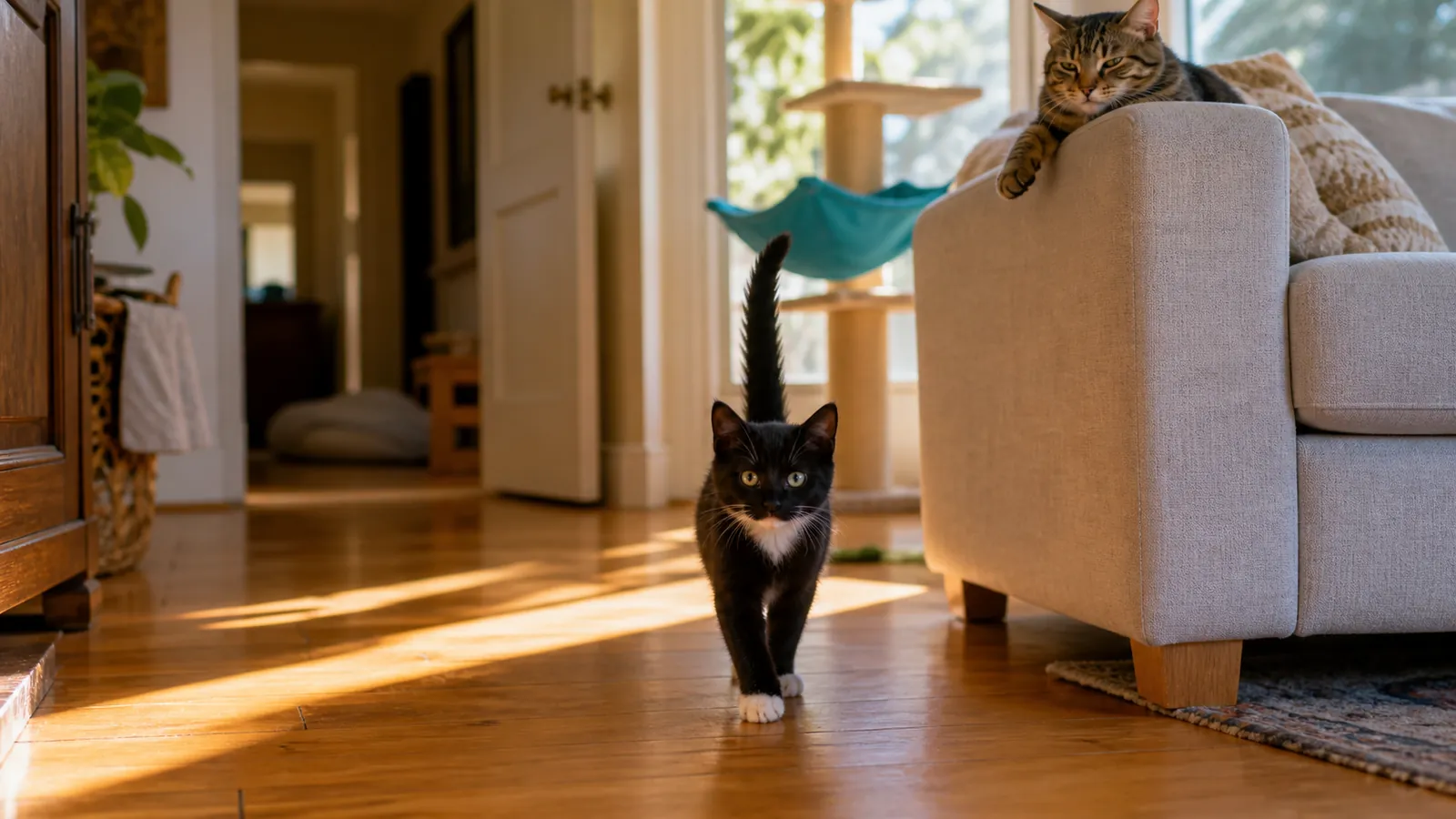
Set up the room today, even if pickup is still days away: a door that closes, the box in one corner, dishes in another, a hide, a scratcher, and the carrier left open. Confirm the veterinary appointment for the first week, and write out your handoff questions about food, litter, medications, records, and the microchip so that you actually ask them. Then save or print this page, and leave the optional purchases alone until you have watched your kitten for a week. Your kitten will tell you what they want, and it is rarely what the shopping list assumed.
About this guide
Paw Parent HQ is an independent pet-care publisher. This page is general educational information about caring for a new kitten. It is not veterinary advice, it cannot diagnose an animal, and it is not a substitute for examining your kitten — your veterinarian is the only one who can direct care for the cat in front of you.
How this page is built: every consequential claim is sourced to veterinary, regulatory, or manufacturer documentation, listed at the end with the date it was checked. Clinical and safety claims come from veterinary professional bodies and veterinary teaching hospitals — AAHA, the AVMA, the Feline Veterinary Medical Association, the Cornell Feline Health Center, and the Merck Veterinary Manual — and food-label rules come from the FDA. Where two authorities disagree, this page names the disagreement, says which reading it follows, and links both. Where a source could not close a question, the page says so rather than guessing, using the same four labels each time: ask your veterinarian, ask the manufacturer, varies by kitten, not published. Guideline editions are stated so you can tell whether you are reading current guidance. Volatile items — provider fees, policy terms, and any state or local rule — are rechecked at least every 90 days.
How this page is funded: Paw Parent HQ is supported by advertising and, on some pages, disclosed referral links. No provider has paid for placement, ordering, or inclusion on this page, and compensation never determines what is included or how it is ranked. If a compensated link is added to this page, it will be disclosed here.
This page is written and maintained by the Paw Parent HQ editorial team. Veterinary review status: not yet reviewed. When a veterinary review of this page is completed, it will be credited here by name, credential, and date.
If you find an error on this page, or a source link that no longer resolves, tell us at hello@pawparenthq.com and we will correct it and re-date the page.
Sources and last verified date
Last verified: August 5, 2026
- New Kitten Checklist: First Vet Visit, Supplies & First-Year Care — American Animal Hospital Association — First veterinary visit within the first week, carrier selection and acclimation, parasite and retrovirus screening, congenital concerns checked at the first exam, spay/neuter timing, litter-box count and minimum box size, kitten calorie requirements at 10 weeks and 10 months, scratching-surface preferences, gentle-handling caution, upper respiratory infection and appetite, urinary blockage in male kittens, and tracking-collar fit. Page updated April 29, 2026; accessed August 5, 2026.
- Kitten Health Care Guide: First-Year Vet Care & Vaccines — American Animal Hospital Association — Pet-proofing before arrival, home setup, records and questions to bring, fecal sample, follow-up planning. Accessed August 5, 2026.
- Frequently Asked Questions About Pet Microchipping — American Animal Hospital Association — Microchips store only an ID number, have no GPS capability, require current registry details, and do not replace an ID tag. Accessed August 5, 2026.
- 2020 AAHA/AAFP Feline Vaccination Guidelines — American Animal Hospital Association — 2020 edition, replacing the 2013 AAFP report: core versus non-core feline vaccines, individualized risk assessment, and the core list for pet cats. Accessed August 5, 2026.
- 2021 AAHA/AAFP Feline Life Stage Guidelines — Behavior and Environmental Needs: Kittens — American Animal Hospital Association — 2021 edition: the sensitive socialization period beginning as early as 2–3 weeks and possibly closing by 9–10 weeks, its fluidity between individual cats, and the primacy of experience quality. Accessed August 5, 2026.
- The "Fix by Five" Initiative: Feline Spay/Neuter by 5 Months of Age Becomes the Accepted Norm — American Animal Hospital Association — Veterinary Task Force on Feline Sterilization recommendation, its endorsing bodies, and the contrast with the unsettled dog question. Accessed August 5, 2026.
- Choosing and Caring for Your New Cat — Cornell Feline Health Center — Signs that warrant contacting a veterinarian, what a physically sound kitten looks like, food and water separated from the litter box, gradual diet transition, box type and count, separation from resident cats until examination, FeLV/FIV testing. Accessed August 5, 2026.
- Feeding Your Cat — Cornell Feline Health Center — Life-stage nutritional requirements and what the nutritional claim on a cat food label should state. Accessed August 5, 2026.
- Dyspnea (Difficulty Breathing) — Cornell Feline Health Center — Observable signs of feline respiratory distress, the high risk of death without prompt treatment, and the instruction to seek veterinary care rather than attempting resolution at home. Accessed August 5, 2026.
- Respiratory Infections — Cornell Feline Health Center — Prevalence in shelters and other high-density populations, upper respiratory signs, the resting respiratory rate that should not be exceeded, feline herpesvirus exposure, lifelong-infection and shedding rates, and the evidence position on lysine supplementation. Page updated June 2018; accessed August 5, 2026.
- Setting Up the Environment for Success — Feline Veterinary Medical Association — Multiple, separated and dispersed key resources; hiding and vertical space; scratching preferences; distress body language; short, frequent reward-based sessions of five to ten minutes; causes of soiling outside the box. Accessed August 5, 2026.
- 2024 AAFP Intercat Tension Guidelines: Recognition, Prevention, and Management — Feline Veterinary Medical Association — Most intercat tension begins at the introduction of a new cat; stepwise introduction and resource separation. Accessed August 5, 2026.
- Social Behavior of Cats — Merck Veterinary Manual — The alternative scoping of the feline socialization or sensitive period at 2 to 7 weeks of age. Accessed August 5, 2026.
- Socialization of Puppies and Kittens: Literature Review — American Veterinary Medical Association Animal Welfare Division — Kittens generally remaining with the litter until at least eight weeks, and placement in a new home during or after the peak of the sensitive period requiring careful management. Published September 2024; accessed August 5, 2026.
- These Harmful Feline Hazards Could Be in Your Home — ASPCA — True lilies and daylilies, human pain relievers, and permethrin in dog flea products and household insecticides. Accessed August 5, 2026.
- Household Hazards — American Veterinary Medical Association — Lilium and Hemerocallis lilies are highly toxic to cats and cause kidney failure even in small amounts; lily of the valley, oleander, yew, foxglove, and kalanchoe as cardiac hazards and sago palms as a cause of seizures and liver damage; dog permethrin products should never be used on cats. Accessed August 5, 2026.
- Feline Lower Urinary Tract Disease — American Veterinary Medical Association — Urethral obstruction as an emergency: straining with little or no urine produced, the resemblance to constipation, higher risk in male cats, the one-to-ten-year age pattern, and the 24-to-48-hour deterioration without treatment. Accessed August 5, 2026.
- Money Tips for Caring Pet Owners — American Veterinary Medical Association — Asking the veterinarian about financial options, clinic financing programs, and accredited veterinary colleges that sometimes treat pets at reduced cost. Accessed August 5, 2026.
- Cutting Pet Care Costs — ASPCA — Local shelters providing low- or no-cost spay/neuter resources, the ASPCA's low-cost program database, and comparing preventive-care fees across veterinary practices. Accessed August 5, 2026.
- Can't Afford Vet Bills? Financial Assistance Programs for Pet Owners — Best Friends Animal Society — National and state-by-state directory of veterinary financial assistance funds and payment programs. Accessed August 5, 2026.
- ASPCA Poison Control — ASPCA — 24/7/365 availability, the (888) 426-4435 number, and the consultation fee notice. Accessed August 5, 2026.
- Frequently Asked Questions — Pet Poison Helpline — 24/7 availability, the (855) 764-7661 number, and the provider-stated $89 per-incident consultation fee including follow-up consultations. Accessed August 5, 2026.
- "Complete and Balanced" Pet Food — U.S. Food and Drug Administration — Nutritional adequacy statement; AAFCO growth-and-reproduction versus adult-maintenance profiles, last updated 2016; the two substantiation routes of nutrient profile versus AAFCO feeding trial; and the caution about third-party seals. Accessed August 5, 2026.
- Pet Insurance — National Association of Insurance Commissioners — Accident-only, accident-and-illness and wellness product categories; pre-existing, hereditary and congenital exclusions; waiting periods; age limits. Page last updated April 16, 2025; accessed August 5, 2026.
- State Rabies Vaccination Laws for Domestic Dogs, Cats, and Ferrets — CDC Public Health Law Program, via LawAtlas — State-level rabies vaccination requirements for cats across all states and the District of Columbia, with the explicit instruction to check city and county rules separately. Accessed August 5, 2026.
Next review: November 3, 2026
Not sure what fits your situation?
Answer a few questions and get a shortlist matched to where you are right now.
Take the 2-minute questionnaireKeep reading
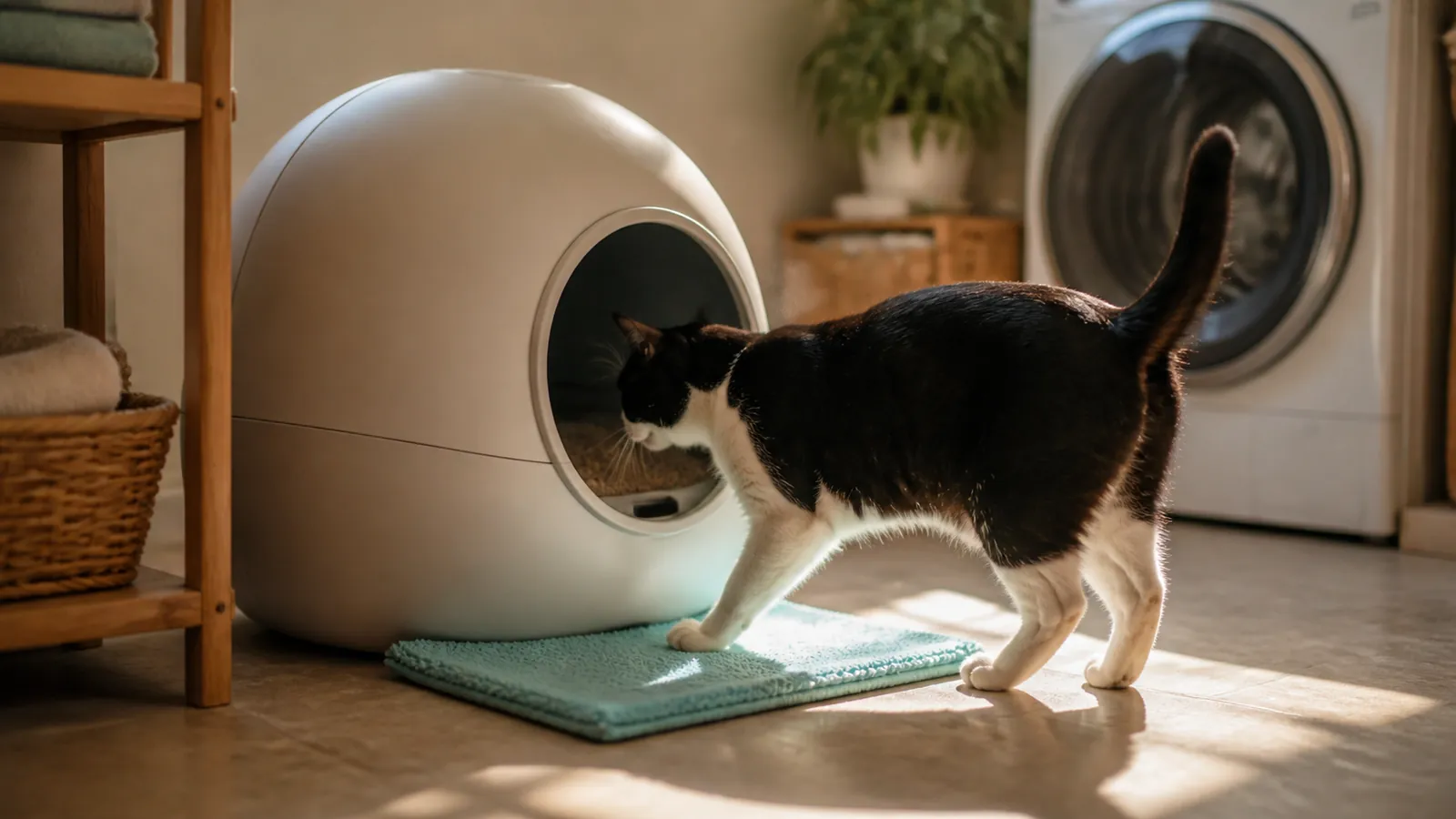 Best Self-Cleaning Litter Boxes: 6 Models ComparedCompare six self-cleaning litter boxes by cat fit, step height, safety limits, litter type, price, upkeep, warranty, and return terms before choosing.
 Renting with Pets: Fees, Lease Rules, and Next StepsCompare pet deposits, pet fees, pet rent, lease restrictions, and assistance-animal rules. Use a renter checklist before you apply, sign, or pay.
 Online Vet Visit Options: Costs, Prescriptions & FitCompare online vet visit options by price, licensed-vet access, prescriptions, state availability, follow-up, and when your pet needs in-person care.
 How Pet Insurance Works: Waiting Periods and ExclusionsLearn how pet insurance premiums, deductibles, reimbursement, annual limits, waiting periods, exclusions, and claims work before comparing policies.