
New Puppy Checklist: Your First 30 Days, in Order
The first month with a puppy has an order to it, and most of the shopping can wait. This guide is about puppies — dogs, not kittens, who need their own plan.
The first 30 days, in order:
- Make one supervised space safe, and know who to call in an emergency.
- Gather every record you have and get a veterinary appointment on the calendar.
- Make your puppy identifiable with a legible tag and a registered microchip.
- Keep the food familiar while you build a repeatable rhythm of meals, toilet trips, rest and play, and add gentle new experiences at your puppy's pace.
Optional purchases come last, and most of them can wait weeks. Nothing here is a diagnosis or a medical schedule for your individual puppy. Where symptoms, medication, nutrition or local disease risk are involved, your veterinarian's plan replaces this checklist.
Jump to: emergency signs and who to call · what to do first · the printable 30-day checklist

When should I call a veterinarian or animal poison control?
Contact details and thresholds below verified August 5, 2026.
Stop working through any checklist and get veterinary help promptly if you see any of the signs below. This is not a symptom list to diagnose from, and a sign that is not named here is not automatically safe to wait on.
| What you can see, count or time in a puppy | What normal looks like for your own puppy | What to do |
|---|---|---|
| Gasping, wheezing, noisy breathing, choking sounds, heavy pawing at the mouth, or blue-tinged lips or tongue | Quiet, easy breathing at rest — roughly 18 to 34 breaths a minute is the published resting range for dogs, and the note below the table explains how to count it. Count your own puppy's breaths while they sleep on a well day so you know their usual number | Go now |
| Gums that have turned blue, grey, white or purple | Whatever color they are when your puppy is well — look now, while nothing is wrong, so you have your own baseline. Some puppies have naturally pigmented gums | Go now |
| Repeated or ongoing vomiting, diarrhea, or both, especially with lethargy or refusal to drink. In an unvaccinated or partly vaccinated puppy these are also the signs of parvovirus, which moves fast — say so on the phone | One soft stool in a bright, playful puppy who is still eating and drinking | Go now if repeated or with lethargy |
| A single loose stool or one vomit in a puppy who is otherwise bright, eating and drinking | Occasional stomach upset happens, particularly in a week full of change | Call today |
| A seizure in a puppy lasting longer than 5 minutes, two or more seizures in 24 hours, or activity that does not stop. Time it with a watch | None | Go now |
| A single seizure that stops on its own, in a puppy who then recovers | None — a first seizure of any length is always a call | Call today, and go now if you cannot reach anyone |
| Collapse, unresponsiveness, or a weak pulse, shallow breathing, agitation and dazed eyes after an injury or a fright | A tired puppy sleeps hard but rouses and responds when you speak or touch them | Go now |
| A swollen or bloated belly, especially with retching, weakness or pale gums | A puppy's full belly after a meal is soft and settles within the hour | Go now |
| Bleeding you cannot stop, or bleeding from the nose, mouth or rectum, coughing up blood, or blood in the urine | None — any of these in a puppy is a go-now sign | Go now |
| Heavy panting or fast breathing with drooling, weakness, confusion, vomiting, or dry, sticky or oddly colored gums after heat or exertion | A puppy who has been playing pants, then settles within a few minutes in the shade with water | Go now |
| Any suspicion that your puppy has swallowed a medicine, a toxic food, a chemical, a plant or a foreign object | Nothing to compare against — treat a suspicion as real | Go now |
Anything that worries you and is not on this list is still worth a phone call. Uncertainty is a reason to go sooner, not to wait.
About the breathing row. The resting range of 18 to 34 breaths a minute for dogs comes from the Merck Veterinary Manual's resting respiratory rates table, reviewed September 2022 and modified September 2024, checked August 5, 2026. It is a species reference for dogs rather than a puppy-specific figure, and a puppy who is hot, excited or has just been playing will be higher. To count it, wait until your puppy is asleep or lying quietly, watch the chest, count one rise and fall as one breath for 30 seconds, and double it. VCA's home breathing-rate guidance is that resting or sleeping rates consistently above 30 are considered increased and worth contacting your veterinarian, and that your own animal's usual number is the more useful comparison — which is why the well-day baseline is worth writing down. A count never replaces what you can see: the signs in that row go now, whatever the number says.
These thresholds follow the AVMA's first aid guidance for pet owners — which sets the seizure, shock, bleeding and heatstroke criteria above — and AAHA's guidance on recognizing a pet emergency, which is explicit that abnormal gum color needs immediate attention and that ongoing vomiting or diarrhea is especially dangerous in puppies because of how quickly they dehydrate.
Who to call, in order. The FDA's guidance on pet emergencies is direct: your own veterinarian is the best resource because they know your pet's history, and with something like a product containing xylitol you may have only minutes. If you cannot reach your veterinarian, call your local emergency animal hospital, or either of the two animal poison control centers in the United States. The AVMA names both: ASPCA Poison Control at (888) 426-4435, available 24 hours a day, 365 days a year, which states that a consultation fee may apply without publishing an amount; and Pet Poison Helpline at (855) 764-7661, available 24/7, which publishes a fee of $89 per incident including all follow-up consultations, checked August 5, 2026. Either center can also speak directly to your veterinary team.
One state exception, checked August 5, 2026. Since Georgia's Senate Bill 105 took effect on July 1, 2025, both hotlines say they can no longer give risk assessments or treatment guidance directly to Georgia pet owners. The Georgia Poison Center states the same thing on its own pets-and-poisons page, and AAHA reported in September 2025 that both services will still advise your veterinarian on your behalf, with the Georgia Veterinary Medical Association reading the law differently — so this may change. If you are in Georgia, call your veterinarian or an emergency animal hospital first and let them make the poison-control call. Georgia is the only state where we have found this restriction as of August 5, 2026; everywhere else in the United States, both lines can advise you directly.
What to have ready when you call. The AVMA lists: your puppy's breed, age, sex and weight; the signs you are seeing; the name of the substance, roughly how much, and how long ago; and the container or packaging. If your puppy has vomited or chewed something up, collect the material in a sealed bag and take it with you.
Do not give any home remedy, and do not try to make your puppy vomit, unless a veterinarian or a poison control center tells you to. Never delay a call to compare products, sign up for anything, or finish reading a page.
On this page
- When should I call a veterinarian or animal poison control?
- What should I do first with a new puppy?
- What if I cannot afford veterinary care right now?
- Words you will hear this month
- What do I need to do before my puppy comes home?
- What should I do in the first 24 hours?
- What should I sort out in the first week: health, records and ID?
- How do I set up food, toilet breaks, sleep and time alone?
- Can my puppy meet people and other dogs before all the shots?
- What changes in weeks two to four?
- What should I buy now, and what can wait?
- What do new puppy parents most often get wrong?
- What does the whole 30-day checklist look like?
- How do I know which advice to trust?
- How do I choose supplies and services without guessing?
- New puppy questions we still get asked
What should I do first with a new puppy?
Do two things today, before anything else. First, make one page — paper or phone note — with your veterinary practice, the nearest 24-hour emergency clinic, both poison-control numbers, your puppy's microchip number and registry, and the shelter, rescue, foster or breeder you got your puppy from. Second, prepare one supervised space you can actually watch your puppy in, with clear sightlines, water, bedding and nothing dangerous within reach. Everything else in the first month builds on those two. The rest of this page follows the same clock you will: before arrival, the first 24 hours, the first week, then weeks two to four, with a supply matrix that tells you what genuinely cannot wait and a checklist you can print.
The ordering in the list at the top of this page is what we call the Four Priorities, and it runs through the whole page. The table below is the same four, expanded. It is a Paw Parent HQ editorial aid, not a veterinary protocol.
| Priority | Why it matters | Your first action | When a professional takes over |
|---|---|---|---|
| 1. A safe space and a list of who to call | Most first-month emergencies are ingestion and injury, and both are easier to prevent than to treat | Gate off one room or shared area, remove hazards, write the contact page | Any suspected ingestion, injury or worrying sign goes to a veterinarian or poison control immediately |
| 2. Records and a veterinary plan | What was already done decides what happens next; guessing creates gaps and repeated treatments | Put every document in one folder and book a prompt first appointment | Your veterinarian reconciles vaccination history, parasite protection, growth and local risk |
| 3. Identification that works | A puppy who slips out on week one is found by a tag and a current registry record | Fit a legible tag today; confirm or update the microchip registration | Your veterinary team can scan an existing chip and give you the number |
| 4. Food continuity, rhythm and gentle exposure | Sudden change is the main avoidable source of upset stomachs, stress and accidents | Keep the food your puppy already eats; set predictable meals, toilet trips, rest and play | Ask before changing formulas, and ask about local disease risk before group outings |
Where to start depends on your situation, not on a universal rule:
- Start with records and a veterinary appointment if your puppy came from a shelter, rescue, foster or rehoming situation and the history is partial or missing.
- Start with the safe space and toilet access if you live in an apartment or upper floor, where getting outside quickly is the hard part.
- Start with alone-time and midday cover if you work away from home, because the routine has to be built around who is with the puppy, not around your evenings.
- Start with quiet, water and observation if your puppy has just travelled a long distance; skip the welcome party for a day or two.
- Buy nothing beyond the buy-now essentials this week if money is tight or you are unsure about size and habits. Waiting is a legitimate choice, and most puppy gear is easier to choose once you have met the puppy.
- Call your veterinarian, an emergency clinic or an animal poison-control service now, before any of the above, if your puppy may have swallowed something dangerous or shows any of the signs in the section above.
What if I cannot afford veterinary care right now?
If money is the reason you are hesitating to call, you are in very ordinary company, and the answer is not to wait and see. A problem caught early is almost always cheaper than the same problem caught late.
Say the number out loud, early. The AVMA's guidance on veterinary costs is that if you arrive at a clinic and cannot afford treatment, you should ask the veterinarian about financial options — veterinarians are often willing to help find solutions, and many practices offer financing that lets owners pay over time. Ask before treatment begins, not after the estimate, and ask what can be staged over several visits rather than done at once.
Then widen the search. Depending on where you live, these route types exist:
- Nonprofit, humane-society and municipal low-cost clinics, which often cover puppy vaccination, parasite prevention, spay/neuter and microchipping. Most run by appointment and some have eligibility rules, so ask what proof they need before you travel.
- Teaching hospitals at accredited veterinary colleges, where care is delivered by supervised students and clinicians. Often strongest for complicated cases, and usually not the quickest route for something happening tonight.
- Charitable veterinary assistance funds for dogs and cats, many of which are condition-specific, breed-specific or region-specific. Most want a written estimate from your veterinarian before they will consider an application, so ask for one early.
- Payment plans arranged directly with your practice, or third-party medical financing. Ask what the terms actually are, including what happens at the end of any promotional period, before you sign anything at the counter.
Two national directories list local options by state and situation: Humane World for Animals' resource list for owners having trouble affording a pet and Best Friends Animal Society's list of financial assistance programs. Paw Parent HQ does not operate either directory and does not endorse individual programs listed in them; eligibility, geography and funding change often, so confirm current terms directly. The shelter or rescue you got your puppy from is also worth a call — they usually know which local clinics and funds are actually working this month.
Asking about cost is a normal part of veterinary care, not an imposition, and it is far better than not going.
Words you will hear this month
| Term | What it actually means |
|---|---|
| Nutritional adequacy statement | The line on a dog-food label that says whether the food is complete and balanced, and for which life stage. It is a regulated label fact, not a quality ranking |
| Complete and balanced | Intended as the sole diet for the dog life stage named on the label. Treats, snacks and toppers usually are not |
| Broad-spectrum parasite control | A prescribed product covering several parasite types at once — heartworm, intestinal worms, fleas and ticks — rather than one product per problem |
| Socialization | A planned, managed process of building a puppy's confidence in new situations. It is not a puppy party, and it is not the same thing as playtime |
| Parvovirus | A severe, fast-moving viral illness of unvaccinated and partly vaccinated puppies, spread through feces and contaminated ground. It is the disease the socialization timeline below is built around, which is why the question is where your puppy goes, not whether they meet the world at all |
| Bloat, or gastric dilatation-volvulus (GDV) | Sudden swelling of the stomach that can twist and become life-threatening. It is far more common in adult deep-chested dogs than in puppies, but a swollen belly with retching is an emergency at any age |
| Microchip | A permanent identification number under a dog's or cat's skin. It is not a GPS tracker and cannot show you where your puppy is |
| Pre-existing condition | In pet insurance, a condition documented before your policy starts. Most policies exclude these; how each policy defines the term is in the policy form |
| Waiting period | The gap between a pet insurance policy starting and its benefits becoming available. Different waiting periods can apply to different conditions |
| Wellness or preventive-care coverage | An add-on that pays toward routine care such as vaccines or a dental cleaning. NAIC lists it as a separate product category from insurance, so it is not the part that covers an accident or an illness |
| Deductible and reimbursement rate | In pet insurance, the amount you pay before the policy pays anything, and the percentage of the covered bill it then pays back. Both are set by the policy you are issued |
| Anthelmintic | The clinical word for a deworming medicine. Your veterinarian prescribes which one and how often, based on your puppy's age and your area |
What do I need to do before my puppy comes home?
Five things are much easier to finish before there is a puppy in the room.
Collect records and keep the source's phone number. Ask the shelter, rescue, foster, previous guardian or breeder what has been done and when: vaccinations, deworming and parasite products, any medication, feeding details, microchip number, and any surgery or health notes. AAHA's before-arrival guidance also suggests asking about early socialization and the puppy's background, agreeing the feeding plan so you can keep it consistent, and asking at what age they recommend pickup, noting that separating puppies from their mother before eight weeks of age is not recommended.
Choose your veterinarian, and know your emergency route. AAHA suggests choosing a practice on the things that will matter to you, including its approach to vaccination, how it supports new puppy parents, and whether it offers emergency services. Find out now what happens at 2 a.m., because that is not a question you want to research during an emergency. If you also want a trainer, AAHA notes that dog training is unregulated and points to recognized certifications such as CCPDT, the Pet Professional Guild or IAABC.
Get the household onto one plan. AAHA recommends a family meeting before arrival to agree on consistent feeding times, toilet breaks, play and bedtime, on house rules such as where the puppy sleeps and which furniture is off-limits, and on shared night duty so one person is not wrecked by week two. AAHA is candid that the first four to six weeks are demanding and that accidents and chewing are normal.
Build one supervised space. AAHA describes using baby gates to create a safely confined shared area — a kitchen, or a kitchen and family room — where you already spend time, kept clear and open so you can see your puppy at all times. This is management, not isolation. Before the puppy arrives, secure the obvious hazards in that space. The FDA's list of potentially dangerous items includes human and pet medicines, chocolate, xylitol-sweetened products, grapes and raisins, onions and garlic, alcohol, tobacco and e-cigarette refills, and raw yeast dough, and it separately flags items such as corn cobs and bones that can cause an obstruction. AAHA adds toxic plants, small swallowable objects, electrical cords and household chemicals. For the full room-by-room pass, use our guide to puppy-proof your home.
Buy only the essentials, and the food your puppy already eats. The matrix further down is the complete list. Nothing on it is urgent except food, water bowls, identification, a leash and collar or harness, containment and cleanup supplies.
| Before-arrival action | Why it is easier now | Who owns it | Complete by |
|---|---|---|---|
| Records and source contact collected | Nobody is chasing paperwork while a puppy cries | One adult | Pickup day |
| Veterinary practice chosen, first appointment requested | Appointments are scarce; emergencies are worse without a plan | One adult | Pickup day |
| Household rules and night duty agreed | Consistency starts on day one, not week two | Whole household | Day before |
| One gated space cleared and stocked | Hazard removal is thorough when it is not rushed | Whole household | Day before |
| Buy-now supplies and familiar food in the house | Removes the arrival-day emergency shop | One adult | Day before |
What should I do in the first 24 hours?
Arrival day is about lowering the temperature, not showing the puppy their new life. Keep it small, quiet and observable.
| Step | What to do | What to watch |
|---|---|---|
| 1. Quiet arrival | Carry your puppy to the toilet spot first, then indoors; no gathering at the door | Whether they can settle at all, or seem frantic or flat |
| 2. Water and the familiar meal | Offer water; feed the food they already know, at the times they are used to | Whether they drink at all |
| 3. One small space | Let them explore the gated area only, at their own pace | Chewing, swallowing, hiding |
| 4. Identification on | Check the collar fits and the tag is legible with a current number | A collar that is already tight |
| 5. Notes in the folder | Write down eating, drinking, urination, stools and mood | Anything that changes or stops |
| 6. A bedtime rhythm | Last toilet trip, calm settle, a plan for the night wake-up | Night waking is expected; distress that never eases is not |
Two decisions come up on the first night. The first is where your puppy sleeps. AAHA's first-days guidance is that a crate should be introduced through positive association — door open, comfortable bedding, treats left inside during the day — and never by forcing a puppy in or leaving them to cry it out, and that the door should stay open until they choose to rest inside voluntarily. If you do crate at night, AAHA suggests placing it next to your bed so your puppy can sense you and you can hear them. Our crate training a puppy guide covers the full method; on night one, positive introduction is all you need.
The second is visitors. Postpone them. Introductions to children and resident animals should be short, supervised and easy to end, and AAHA is explicit that children and puppies should never be left together unsupervised. AAHA adds two rules worth setting on day one: children play with the puppy using toys rather than hands, and children are taught to recognize when a puppy needs space. A puppy who mouths hands is not being aggressive — mouthing is how puppies explore — and the response is to swap in a toy rather than to correct. If it is not settling as the weeks pass, that is a question for a certified reward-based trainer.
Finally, do not file worrying signs under "settling in." Reduced appetite, loose stools or clinginess in a tired puppy may simply reflect a huge day, but if you are seeing the signs in the section above, or you are uneasy, call. Nobody at a veterinary practice minds a first-week phone call.
What should I sort out in the first week: health, records and ID?
Book the first veterinary appointment promptly and take everything with you.
What to bring to the first veterinary appointment
A complete folder turns a rushed visit into a plan. Bring:
- Vaccination history with dates
- Deworming and parasite-product records
- Any current medication, with the label
- The exact food and feeding amounts
- The microchip number and registry paperwork
- Spay, neuter or other surgical notes
- The adoption or purchase agreement
- Your own notes on appetite, stools, energy and behavior since arrival
Then ask your veterinarian to reconcile it. Never guess a missing dose or assume a course is finished because a form says "vaccinated." AAHA's guidance is that your veterinarian gives the best advice on your puppy's vaccination status and the health risks where you live, and the schedule detail belongs on our puppy vaccine schedule page rather than here.
What the first-year parasite plan involves
The parasite side has published checkpoints your veterinarian will work from, and it is useful to know roughly what the first year involves before you walk in.
| Checkpoint | What the guideline says | Applies to |
|---|---|---|
| Fecal examinations | At least four during the first year of life, because young animals are more susceptible to parasitic infections | Dogs, first year |
| Deworming start and interval | Anthelmintic (deworming) treatment from 2 weeks of age, repeated every 2 weeks until regular broad-spectrum control begins | Puppies |
| Ongoing parasite control | Year-round broad-spectrum control effective against heartworm, intestinal parasites, fleas and ticks | Dogs, all ages |
| Heartworm testing | Annually | Dogs |
| Preventive physical examinations | At least every 6 to 12 months | Dogs, all ages |
| Permanent identification | Microchip implantation is listed among the standard recommendations | Dogs and cats |
| If year-round control cannot be maintained | A fallback schedule exists: dewormers from 2 weeks of age, every 2 weeks until 2 months, monthly until 6 months, then quarterly | Puppies, then adult dogs |
Every row above is from the CAPC General Guidelines for Dogs and Cats, updated April 24, 2025, checked August 5, 2026. It is a general framework, not your puppy's plan. CAPC is explicit that control programs are prescribed to local parasite prevalence and to the individual pet's lifestyle, which is why the product is a prescription your veterinarian writes rather than something you pick off a shelf. The last row matters if money is tight: say so, and ask your veterinarian which schedule is realistic for you. Those rows are the canine plan; CAPC's guidance for cats differs in places, so a kitten's first-year parasite plan belongs on our new kitten checklist rather than being read across from this table.
How to make your puppy's identification actually work
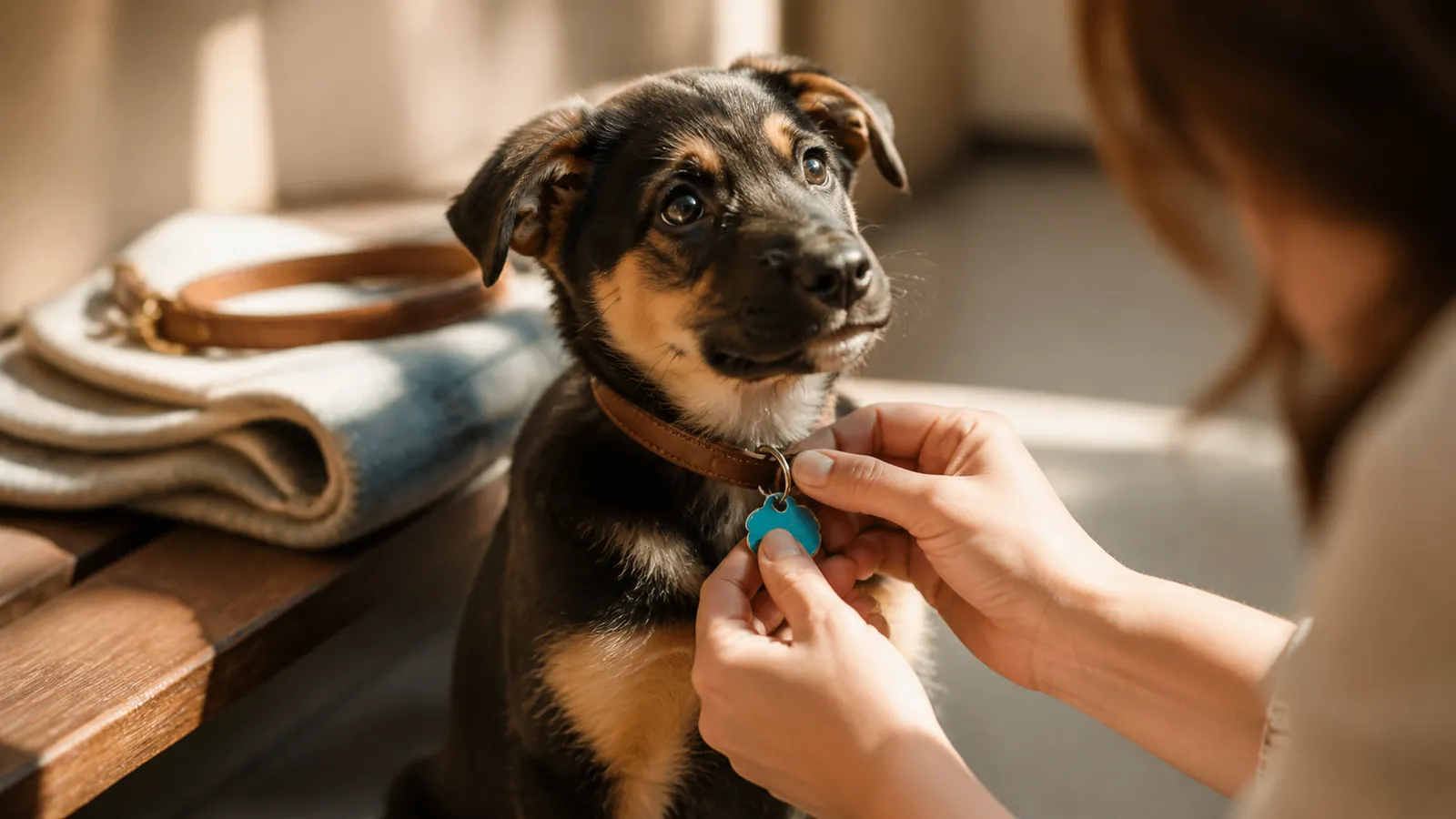
Identification is the week-one job people postpone and regret. Two things do different work. A visible tag with a current phone number gets your puppy home from a neighbor in twenty minutes. A microchip is a permanent backup — and only that. AAHA's microchipping FAQ, updated May 19, 2026, is explicit that microchips have no GPS capability and cannot track location, that the chip stores nothing but a 9-, 10- or 15-digit ID number, and that the number is only useful once it is registered with a registry holding your current contact details. The same FAQ puts typical US microchipping cost at $25 to $50, varying by location and provider and usually including implantation and registration — a figure worth knowing if budget is on your mind, though your own practice sets its own price.
The registry step is the one that decides whether any of it works. The AVMA reports that in a study of more than 7,700 stray animals entering shelters between August 2007 and March 2008, published in the Journal of the American Veterinary Medical Association in 2009, dogs without microchips were returned to their owners 21.9 percent of the time, while microchipped dogs were returned 52.2 percent of the time — and that where a microchipped animal was not returned, the usual reason was incorrect or missing owner information in the registry. If your puppy arrived already chipped, ask your veterinary team to scan them, confirm the number, and then update the registry record into your name and number. A chip registered to a previous guardian is a dead end.
A microchip identifies; it does not locate. If you also want live location, that is a separate product — a GPS collar or tracker — and our best GPS dog collars guide compares the options; none of them replaces the tag or the registered chip.
A neutral note on insurance timing
According to the NAIC's pet insurance overview, last updated April 16, 2025, products are generally sold as accident-only, accident-and-illness, or wellness coverage; most companies exclude pre-existing conditions and hereditary or congenital conditions; many apply waiting periods before benefits begin; and some will not accept pets after a certain age. That is why the timing question comes up in week one at all: anything already documented in your puppy's records may sit outside coverage later. It is not a reason to rush a purchase. If you want to understand deductibles, reimbursement and waiting periods before deciding, read how pet insurance works. Paw Parent HQ does not rank insurers on this page and has no confirmed relationship with any of them.
How do I set up food, toilet breaks, sleep and time alone?
Keep the food your puppy already eats, at least at first. Continuity removes one large variable while everything else is changing, and it is the single easiest way to avoid an avoidable stomach upset.
When you do consider a change, check the label rather than the marketing. The FDA explains that the nutritional adequacy statement is what tells you whether a food is complete and balanced, meaning it is intended as the sole diet, and that the AAFCO nutrient profiles are split into growth and reproduction versus adult maintenance — a growing puppy is in the first group. Treats, snacks and toppers are typically not complete and balanced.
The statement also tells you how that adequacy was established, and the two wordings are not the same level of evidence. AAFCO's own label guidance sets out the standard formats: "formulated to meet the nutritional levels established by the AAFCO Dog Food Nutrient Profiles for growth" means the recipe was calculated against those profiles, while "animal feeding tests using AAFCO procedures substantiate that [product] provides complete and balanced nutrition for growth" means the food was actually fed to dogs in a trial. Both satisfy the rule; the second is the stronger evidence. Neither wording is a health claim, and neither is a quality ranking — nutritional adequacy is a label fact, and whether a particular food suits your particular puppy is a veterinary question. The FDA also notes that endorsements and seals of approval from other organizations are not assurances of nutritional adequacy and may be misleading, which is why "AAFCO approved" is not a real category. These label rules reflect FDA and AAFCO consumer guidance reviewed August 5, 2026. When you are ready to compare formats rather than formulas, our fresh food vs kibble comparison owns that decision — and if fresh food wins it for your household, best fresh dog food compares the delivery services themselves.
How much to feed is a different question from what to feed, and the label answers it first. Read the feeding directions on the exact formula you have, noting whether that chart is built on your puppy's current weight or their expected adult weight, because the two are not interchangeable and the amount changes as your puppy grows either way. Then take the bag, or the exact product name, to the first appointment: ask your veterinarian to assess body condition and confirm the amount. That check, repeated at each visit, is worth more than any number you calculate at home.
The rhythm matters more than the clock. AAHA's housetraining guidance is that supervision is the single most important factor — your puppy should always be visible to someone who can get them outside in time — and that puppies typically need to toilet after eating, sleeping and playing, with consistent feeding times and regular play and rest periods. Accidents will happen and are not the puppy's fault; punishing a puppy can create anxiety around toileting and make housetraining harder. Praise calmly and quietly when they get it right.
| Moment in the loop | What usually follows | Adapt this |
|---|---|---|
| Waking up | Toilet opportunity, then breakfast | Very young or unwell puppies need more frequent trips; ask your veterinarian |
| After eating | Toilet opportunity, then short calm play | Some puppies need to go immediately; watch, do not time |
| After play | Toilet opportunity, then rest in the safe space | Overtired puppies get frantic, not sleepy |
| Before bed | Last toilet trip, calm settle, lights down | Expect at least one night wake-up for weeks |
This is an example loop, not a prescription. Do not restrict your puppy's water to reduce accidents; if overnight drinking seems excessive to you, that is a question for your veterinarian rather than a reason to take the bowl away.
Start alone-time in the same week, in seconds rather than hours. AAHA's before-arrival guidance suggests coming and going briefly and frequently through the day so each departure quietly practices separation and builds confidence, instead of the first long absence arriving as a shock. The AVSAB's puppy socialization position statement, © 2008 and listed as current on AVSAB's position statements page when checked on August 5, 2026, makes a related point: scheduling time for a puppy to play alone with a favorite toy, or nap in a safe place such as a crate or pen, teaches them to amuse themselves and may help prevent problems of over-attachment.
Can my puppy meet people and other dogs before all the shots?
This is the question with the worst advice attached to it, in both directions. Socialization is not a puppy party, and it is not something you postpone until a vaccination course is complete.
AAHA describes socialization as a planned, managed process of building confidence in new situations, where the goal is a puppy who can see other dogs and people and stay calm and engaged with you — not a wild play session.
Two bodies have said different things about the timing, and it is worth knowing which is which. AVSAB's puppy socialization position statement takes a clear position: the primary and most important period for socialization is the first three months of life, and AVSAB states that it should be the standard of care for puppies to receive that socialization before they are fully vaccinated. Its reasoning is that behavioral problems, not infectious diseases, are the leading cause of death in dogs under three years of age, and that with maternal immunity, primary vaccination and appropriate care the infection risk is relatively small by comparison. The infectious disease that timeline is built around is parvovirus, which is why the rules further down are about where your puppy goes and what ground they walk on, rather than about whether they meet the world at all. AVSAB adds specifics: puppies can generally start socialization classes from 7 to 8 weeks of age, having had at least one set of vaccines at least seven days before the first class and a first deworming, and staying up to date throughout. AAHA, writing for owners in 2026, does not contradict this but routes the decision: your veterinarian gives the best advice about vaccination status and health risks in your area, and a good trainer builds a plan respecting both the health timeline and the developmental one.
The two are also of different vintages, which is worth knowing: AVSAB's statement dates from 2008 and is still listed as current, while AAHA's owner guidance was published in 2026. We follow both, in that order. AVSAB sets the principle — do not wait for the full course — and your veterinarian sets the local application, because local disease prevalence is the one variable neither statement can decide for you. That is the conversation to have at your first appointment.
What AAHA describes as safe exposure needs no venue at all: carry your puppy or use a stroller on walks where unvaccinated dogs may have been, and let them watch people, traffic, skateboards and other animals from a distance without any pressure to interact. Introduce one new thing at home each day — a hairdryer, popcorn, a dining chair moved into the kitchen — and pair it with treats and play. Sit on the floor with your knees up so your puppy has a refuge; if they hesitate, let them choose, and if they still do not want to join in after five or ten minutes, end the session and try another day.
Watch the body language AAHA lists: pulling toward something suggests confidence, backing away suggests uncertainty, a tucked tail suggests anxiety, a loose wagging tail suggests relaxation. Use rewards only. AVSAB's Humane Dog Training position statement, issued in 2021 and reaffirmed by an AVSAB board statement in 2025, is that only reward-based methods should be used for all dog training, and that aversive tools including electronic collars, prong collars, choke chains and leash corrections should not be used under any circumstances.
| Usually fine now, for a puppy in their first weeks at home | Ask your veterinarian first | Avoid for now |
|---|---|---|
| Household sounds, surfaces, handling and gentle grooming practice | Puppy classes, and any group setting with unknown dogs | Forced greetings, or letting strangers pick your puppy up |
| Watching the world from your arms, a stroller or your own doorstep | Walking on ground used by many unknown dogs in your area | Dog parks and other shared spaces used by dogs of unknown vaccination status, which AVSAB advises avoiding |
| Meeting calm, respectful adult people in your own home, at your puppy's pace | Meeting other dogs at all, including known, healthy, vaccinated ones | Anything your puppy is actively trying to back away from |
AVSAB is also clear about what to do when exposure is not going well: owners of puppies displaying fear should seek veterinary guidance rather than pushing on.
What changes in weeks two to four?
Once the household has stopped bracing, expand capacity rather than intensity. The four lanes below progress at once, and none of them is a race.
| Week | Routine focus | Training and exposure focus | Review trigger |
|---|---|---|---|
| Week 2 | Lock in the meal, toilet, rest and play loop; keep the safe space small | Name response and a reward marker; one new household experience a day | Are accidents clustering at a predictable time? Adjust the loop, not the puppy |
| Week 3 | Slightly larger supervised area; slightly longer solo stretches | Handling practice for ears, paws, mouth and brushing; short sessions only | Is your puppy hiding or freezing? Reduce distance and duration |
| Week 4 | A routine that survives a normal working day | Controlled exposure to new people, surfaces and sounds; a class if your veterinarian agrees | Check collar and harness fit; puppies outgrow gear fast |
If you are out of the house all day, solve that before you buy anything. A puppy alone all day is a welfare and housetraining problem before it is a training problem, and no device changes that: AAHA's whole housetraining approach rests on someone being able to see the puppy and get them outside in time, which nobody can do from work. Build the solution out of people — a neighbor, a walker, a sitter, split shifts, or a few days of leave — and build duration gradually from the brief, frequent departures described above. We do not publish a maximum number of hours here, because we have not found a figure in current veterinary guidance that would be honest to print; your veterinarian can advise for your puppy's age and health. AVSAB notes that continuing to offer a dog a wide variety of experiences through the first year is also helpful in preventing separation-related behavior.
Some admin belongs in this window too. Recheck the fit of the collar or harness every week or two, because a puppy who fitted a collar on day one may not on day twenty. And review what your puppy actually uses before you buy anything else; four weeks of evidence beats four weeks of guessing.
Licensing, registration and rabies: how to find your own rule
There is no national rule on any of this, and we do not publish a state-by-state table on this page, because the requirement that binds you is set by state statute and local ordinance and both change. Here is how to find yours.
- Dog licensing and registration are municipal. The route is your city or county clerk's office or animal services page — searching for your city or county name with "dog license" usually lands on it — and your veterinary practice will normally know the local rule. Some municipalities also require microchipping; the same offices hold that rule.
- Rabies vaccination is a legal requirement in many US jurisdictions, set by state law and local ordinance rather than by any veterinary body. The AVMA's rabies vaccination policy supports vaccinating all dogs, cats and ferrets and refers to jurisdictions where vaccination is legally required. The authorities on your own requirement are your state public health or animal health agency, your local animal control department, and your veterinarian.
- A note on the 50-state datasets you will find online. The most complete is the CDC Public Health Law Program's state rabies vaccination laws dataset, covering all 50 states and the District of Columbia. Its own page says it is valid only through March 9, 2018 and captures state-level law only. It is useful background on how these rules are built. It is not your current requirement — confirm that with the offices above.
- Timing — which vaccine at which age — sits on our puppy vaccine schedule page, not here.
What should I buy now, and what can wait?
This matrix is the complete supply list for this page, and we call the rule behind it the Buy-Now Test: buy it now only if the first week genuinely fails without it. Nothing here names a brand, quotes a price or claims a product is best, because none of that can be verified for your puppy, your home and today's prices at the same time.
| Category | Buy now | Can wait | Situation-dependent | Size, fit and replacement | Why |
|---|---|---|---|---|---|
| Food and feeding | The food your puppy already eats; two bowls | A month's stock of anything; a second brand to "try" | A slow feeder or puzzle feeder if your puppy eats very fast — not if your puppy guards food or resources, where a veterinarian or certified trainer comes first | Not size-dependent | Buying in bulk before you know the plan wastes money and food |
| Identification and walking | Adjustable collar, legible tag, standard leash, correctly fitted harness | Spare sets, decorative collars | Long line for recall practice in a safe area — not in a crowded or fenced-off space, where it tangles and trips | Adjustable — check fit weekly; buy new and correctly fitted, since safety depends on it | Identification is the one thing that cannot be improvised later |
| Containment and rest | One containment option — crate, pen or gates — and simple washable bedding | A second bed for every room; upgraded furniture-style beds | Exercise pen if you cannot gate a room; stairs or ramp only on veterinary advice | Will be outgrown — buy once, or buy adult-sized with a divider | Puppies grow, chew and have accidents |
| Cleanup and hygiene | Enzymatic cleaner, waste bags, paper towels | Bulk supplies of anything scented or specialized | Indoor toilet pads for apartments, upper floors or limited outdoor access — not ideal if you can reach ground level quickly, since they add a step to unlearn | Not size-dependent | Fast, complete cleanup does more for housetraining than any gadget |
| Play and chewing | A few size-appropriate toys, including something safe to chew | A toy box; subscription boxes | Frozen or stuffable toys for settling and crate practice | Will be outgrown — recheck toy size as your puppy grows | Watch what your puppy actually uses, then buy more of that |
| Grooming | Brush suited to the coat; nail clipper or grinder | Full grooming kit, clippers, dryers | Coat-specific tools once you know the adult coat | Not size-dependent | Handling practice matters more than equipment in month one |
| Travel and outdoors | A safe way to travel home | Car seat covers, strollers, carriers "for later" | Crash-tested restraint or secured carrier if you drive often; a coat for genuinely cold climates | Will be outgrown — buy new and correctly fitted, since safety depends on it | Buy for the journeys you actually make |
| Comfort extras | Nothing | Clothing, cameras, automated feeders and dispensers | A camera if you must leave your puppy briefly and want to review the footage — not as a way to extend how long they are alone | Not size-dependent | These solve problems you may not have |
Only one line in that matrix asks you to choose between things rather than to buy or wait, so here are the three options side by side.
| Option | Best for | Not ideal for | Space, cost and replacement | Check before you buy |
|---|---|---|---|---|
| Crate | Households who want one place that also works for car journeys and veterinary visits | A puppy already distressed by confinement; a bedroom with no floor space beside the bed; and never as a way to cover a full working day | One-time purchase, plus washable bedding. Buy adult-sized with a divider, or plan for one replacement | Will it fit beside your bed for the first weeks? Adult-sized with a divider, or are you buying twice? Is it secured or crash-tested if you will use it in the car? |
| Pen | Households who need more floor space than a crate and cannot gate a room | A puppy who climbs or tips panels; a room with no clear flat area to put it | One-time purchase. Usually outlasts a crate, since it expands rather than being outgrown | Does it stay put on your floor surface? Can you open and close it one-handed while holding a puppy? |
| Gates | Households who would rather the puppy be loose in the room they are already in | A doorway a gate will not fit; an open-plan room with no pinch points; a puppy who climbs | One-time purchase per doorway. Not outgrown, but recheck the height as your puppy grows | Will it fit and hold in your doorway? Does the manufacturer's instruction permit the mounting you plan, including anywhere near stairs? |
Any of the three satisfies the buy-now row, and whichever you choose, the introduction rule from the first night applies: positive association, never force. The method for introducing a crate is on our crate training a puppy page.
The size column has three values: not size-dependent means one purchase lasts, adjustable means it fits across a range but needs checking as your puppy grows, and will be outgrown means plan for one replacement. Where a cell says to buy new and correctly fitted, the item's safety depends on fit — those are the ones not to borrow or buy second-hand, and for those, follow the manufacturer's instructions for that exact model rather than general advice.
Buy for the puppy in front of you, not the dog they will become. For the full picture of what the first year costs and how those costs are distributed, see our first-year puppy cost guide.
What do new puppy parents most often get wrong?
Every one of these is normal, recoverable, and not a verdict on you.
| Mistake | Why it backfires | The smallest reset |
|---|---|---|
| Buying everything before pickup | Wrong sizes, unused gear and a budget spent before the real costs appear | Return what is unopened; work from the buy-now column only |
| Giving too much house too soon | Supervision fails, accidents and chewing increase, and the puppy learns the wrong habits | Shrink the space to one gated area you can watch, and rebuild from there |
| Changing food immediately | An unsettled stomach on top of an unsettled week, with no way to tell what caused it | Go back to the familiar food; discuss any change with your veterinarian |
| Punishing accidents | Punishment can create anxiety around toileting and make housetraining harder | Reward the successes and get ahead of the timing with more toilet opportunities |
| Pushing your puppy to say hello | Forced interaction teaches avoidance, not confidence | Increase distance, let them observe, and let them choose when to approach |
| Waiting for the full vaccine course before any socialization | The primary socialization window is closing while you wait | Start the safe exposures above today, and agree the outing plan with your veterinarian |
| Leaving records and the microchip until later | The chip and the folder are exactly what you need on the day something goes wrong | One folder, one contact page, one registry update — an evening's work |
What does the whole 30-day checklist look like?
Print or save this and tick as you go. It covers a dog's first 30 days at home, follows the same order as the page above, and is a Paw Parent HQ planning aid — it contains no medical instructions for your individual puppy.
Before arrival
| Action | Who does it | Professional input? |
|---|---|---|
| Collect records and the source's contact details | One adult | No |
| Choose a veterinary practice; confirm the after-hours route | One adult | Yes, when you book |
| Agree routine, house rules and night duty | Whole household | No |
| Clear and gate one supervised space | Whole household | No |
| Secure medicines, foods, chemicals, cords and small objects | Whole household | No |
| Buy the buy-now essentials and the familiar food | One adult | No |
| Arrange midday cover if the household is out all day | One adult | No |
Day 1
| Action | Who does it | Professional input? |
|---|---|---|
| Quiet arrival, toilet opportunity, water and a familiar meal | One adult | No |
| Fit the collar and legible tag | One adult | No |
| Start the observation notes: eating, drinking, toileting, mood | Whole household | No |
| Introduce the crate or pen positively, door open | One adult | No |
| Set the bedtime and night-toilet plan | Whole household | No |
Days 2 to 7
| Action | Who does it | Professional input? |
|---|---|---|
| Attend the first veterinary appointment with the full folder | One adult | Yes |
| Ask about vaccination status, parasite plan, growth and local risk | One adult | Yes |
| Agree the socialization and outing plan for the next month | One adult | Yes |
| Confirm the microchip number and update the registry record | One adult | Scan by veterinary team |
| Keep the food consistent; ask before any change | One adult | Yes, before changing |
| Begin brief, frequent departures | Whole household | No |
| Begin home-based socialization and daily novelty | Whole household | Ask about outings |
Weeks 2 to 4
| Action | Who does it | Professional input? |
|---|---|---|
| Expand the routine and supervised space gradually | Whole household | No |
| Short reward-based training and handling practice | Whole household | Trainer optional |
| Recheck collar and harness fit | One adult | No |
| Check local licensing, registration and rabies requirements | One adult | Yes, for rabies timing |
| Decide your emergency-money plan — insurance, a dedicated savings line, or both — and write the number down | One adult | No |
| Review what is actually used before buying more | One adult | No |
| Book any follow-up care your veterinarian recommended | One adult | Yes |
How do I know which advice to trust?
You will be given a great deal of confident puppy advice this month, from packaging, from the internet and from people who love you. Sorting it is easier when you can name who is behind each claim. We call this the Who-Says-So Test.
Who says so: veterinary guidance, label rules, insurer terms and editorial advice
| Category | What it is | Who establishes it | How settled is it | What it changes for you |
|---|---|---|---|---|
| Veterinary and professional guidance | Evidence-based recommendations on health, behavior and preventive care | Bodies such as AAHA, AVMA, AVSAB and CAPC, applied by your own veterinarian | Consensus guideline, revised on a published schedule | Governs medical, safety and training decisions; individual advice still comes from your veterinarian |
| Association owner education | Client-facing articles from a professional body, sometimes quoting an individual specialist | AAHA, AVMA and similar, writing for owners | Association guidance — reliable, but not the same thing as a published guideline | Good general direction; check the named guideline when the stakes are high |
| Regulatory and label facts | What a term legally means on a package, such as the nutritional adequacy statement | FDA, and AAFCO nutrient profiles adopted through state feed law | Contract or label fact — verifiable on the package | Tells you what a food is verified to be; "premium" and outside seals verify nothing |
| Insurance rules and policy terms | Coverage categories, exclusions, waiting periods, deductibles and limits | State insurance regulators, and the insurer's own policy form | Contract fact — only the issued form governs | Only the policy form you are actually issued decides what is paid |
| Manufacturer and product claims | Specifications, sizing, warranty, subscription and care instructions | The manufacturer, for its own current product | Vendor claim about its own product | Reliable for specifications and fit; not evidence of a health outcome |
| Paw Parent HQ editorial aids | The Four Priorities, the timeline, the Buy-Now Test and the checklist | Paw Parent HQ | Editorial aid — our sequencing, not a clinical standard | Helps you sequence and decide; never a substitute for veterinary judgment |
"Current," "approved," "vet-recommended" and "best" mean nothing on their own. Ask who says so, on what date, and for which species, life stage and product version.
How do I choose supplies and services without guessing?
Paw Parent HQ treats every provider and affiliate relationship as unconfirmed, so this section describes what to shortlist for rather than who to buy from. Use it after the checklist, not instead of it.
- Best for the first four weeks, for most households: buying nothing beyond the buy-now column. Waiting is a real option and it costs nothing. Not ideal if you have no containment at all and no way to borrow one before pickup day.
- Best for a puppy whose current food you cannot source locally: a formula whose nutritional adequacy statement names growth or all life stages, with feeding directions published on the label. Ask your veterinarian before switching if your puppy has any digestive or medical history. Not ideal if the switch would land in the same week as arrival, travel or a vaccination visit — change one thing at a time.
- Best for a household with children or resident animals: a containment setup you can open and close one-handed, with published size and weight guidance, so supervision never depends on a free hand. Not ideal if it cannot be closed quickly from either side, which is the moment you will actually need it.
- Best for a fast-growing puppy: gear sold with a published size range and adjustment span, rather than a single stated size. Not ideal if fit is the safety property — a restraint, harness or carrier is bought new and correctly fitted for the size your puppy is now, not sized up to grow into.
- Best for anything medical — parasite prevention, supplements, prescription diets, symptom advice: your veterinarian first. These are care decisions, not shopping decisions, and no product page substitutes for an examination. For a homemade, therapeutic or condition-specific diet in particular, the right specialist is a board-certified veterinary nutritionist — a diplomate of the American College of Veterinary Nutrition — working with your veterinarian, not a formula you assemble from a website. Not ideal ever: treating any of these as a purchase you make first and mention at the next appointment.
| Your situation | Shortlist move | Not ideal when | Ask before you buy |
|---|---|---|---|
| Rescue puppy, partial records | Nothing until after the first appointment, except identification | Your puppy has an active symptom — that is a call, not a shopping decision | What does the record actually show? What does my veterinarian want done first? |
| Apartment or upper floor | One containment option plus fast-access cleanup supplies | You can reach ground level in under two minutes, where indoor pads add a habit to unlearn | Can I operate this alone at 3 a.m.? Is it washable? |
| Children or resident pets at home | Gates and a separable space before extras | The space cannot be closed from both sides, or an adult cannot see both animals at once | Can an adult always see both animals? Can the space be closed quickly? |
| Out of the house a full working day | Midday cover arranged before any gear purchase | Cover is not actually arranged — no camera, feeder or crate substitutes for a person | Who is with the puppy at hour four? What happens on the first day nobody can be? |
| Tight budget this month | Buy-now column only; borrow or buy second-hand where safe | The item is safety-critical and fit-dependent, where second-hand is the wrong saving | Which items are safety-critical and must be bought new and correctly sized? |
Score every option the same way, using the Who-Says-So Test above: who says so, on what date, and for which species, life stage and product version. Add one practical test — can you return it or stop it if it does not suit your puppy? An option that cannot answer those does not go on the shortlist, whatever the reviews say.
New puppy questions we still get asked
What if my puppy came with no records at all?
Write down what you do know — approximate age, where they came from, any treatment you were told about — and take that to the first appointment. Never assume a course was completed. Your veterinarian will assess your puppy, decide what needs restarting or repeating, and build a plan around local risk. Uncertainty is common, and it is a reason to go sooner, not to wait.
How long until my puppy settles in?
There is no universal timeline, and anyone promising one is guessing. The pace is set by the slowest dependency: your puppy's age and health, your veterinarian's direction, and how consistent the household can actually be. AAHA notes that housetraining depends on supervision and routine and that reliably holding through the night can take several months. Progress is rarely a straight line.
How much should I plan to spend in the first month?
We do not publish a first-month figure on this page, because the honest answer depends on inputs only you have: whether your puppy arrives already vaccinated, chipped and neutered, what your local veterinary fees are, your food choice and quantity, and whether you take on insurance or a savings buffer. Our first-year puppy cost guide holds the dated cost work and the assumptions behind it.
When should I look at pet insurance?
Earlier is generally simpler than later, but the calendar is not the only factor. NAIC notes that most policies exclude pre-existing conditions and hereditary or congenital conditions, that many apply waiting periods before benefits begin, and that some insurers set age limits. Your own timeline depends on enrollment and any examination the insurer requires, each waiting period as the policy form states it, and how that form defines a pre-existing condition. A policy is not the only answer to the same problem: for some households a dedicated emergency savings line does more than a policy would, and for others the reverse is clearly true, with the deciding factors being your cash position, your puppy's age and what a policy would exclude. Our is pet insurance worth it guide works through that comparison honestly. Whichever way you go, decide the number in the first month rather than during an emergency.
What counts as routine care, a same-day call, and an emergency?
Routine covers wellness visits, the parasite and vaccination plan and growth checks. A same-day call is right when something has changed and you are unsure — one loose stool or one vomit in an otherwise bright puppy, a dip in appetite or energy, a limp, a sore ear. Emergency means going now, and the thresholds are in the table at the top of this page: breathing trouble, abnormal gum color, repeated vomiting or diarrhea with lethargy, seizure, collapse, a bloated belly, uncontrolled bleeding, heatstroke signs, or a suspected toxin.
Do I have to use a crate?
A crate has real uses: AAHA's first-days guidance describes it as providing safety during car rides and veterinary visits, and AVSAB notes that a puppy used to a crate is less stressed if they later need to be hospitalized or confined for travel. That same AAHA guidance also carries puppy specialist Kathy Callahan's view that crating overnight is not absolutely necessary. Either way, confinement should be introduced through positive association rather than force, never by leaving a puppy to cry it out, and your puppy needs a safe place to rest where they can sense you. Our crate training a puppy guide covers the method, including what a crate does not fix — it is not a substitute for supervision, not a solution to being out all day, and not a treatment for separation distress. If distress does not ease over the first nights, ask your veterinarian before persisting.
What if this is not working and I am thinking about rehoming?
Changing your mind is not a moral failure, and thinking about it out loud is better than waiting until you are desperate. Call the shelter, rescue or breeder you got your puppy from first — many have return commitments written into the adoption or purchase agreement, and most would far rather help than have the puppy passed on privately. If behavior is the reason, get a veterinary opinion before any decision, because pain and illness look like behavior problems more often than people expect, and a veterinary behaviorist may see a path that is not obvious from inside the house. If cost is the reason, the routes above are worth working through first.
Pick one next step
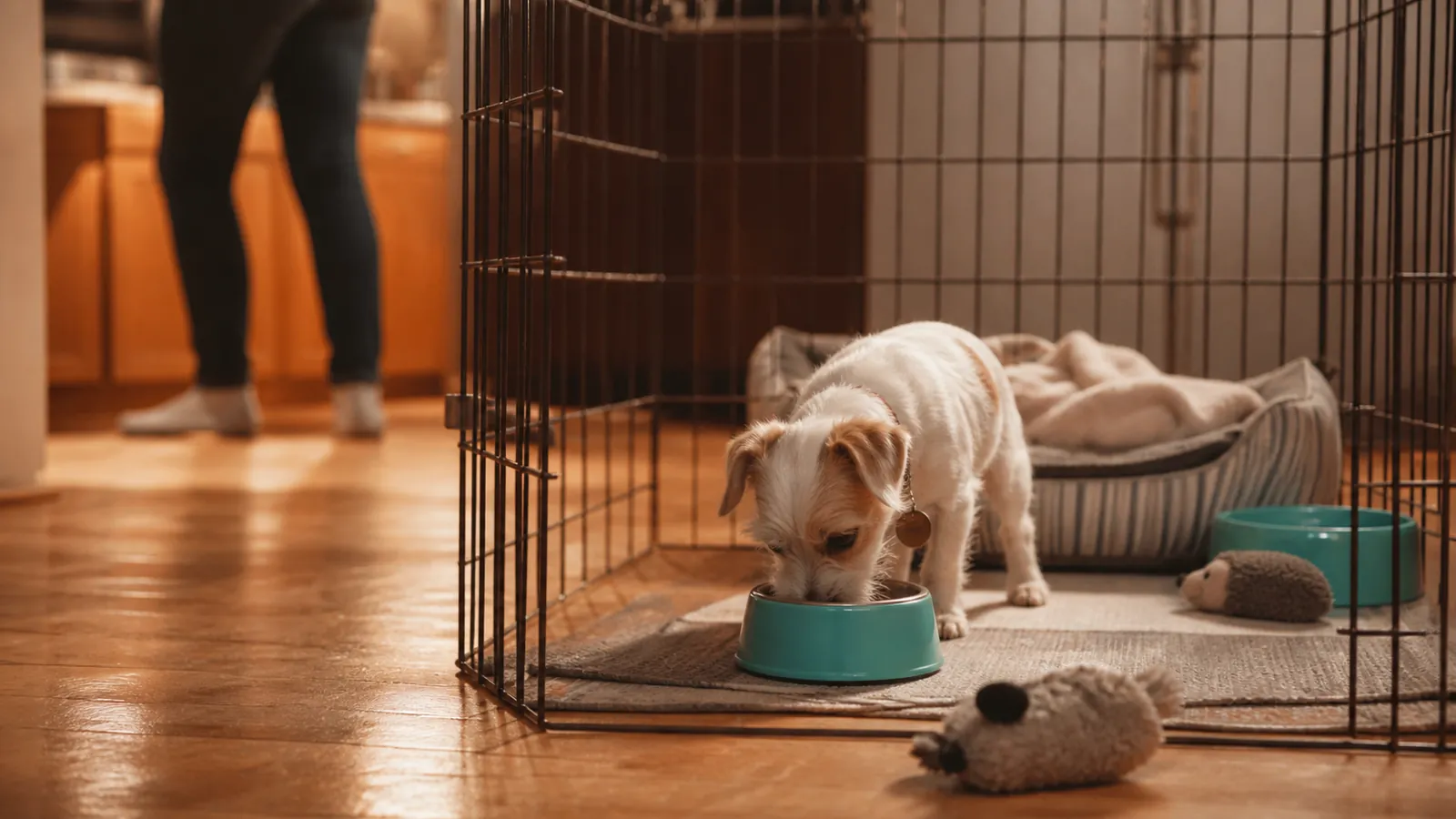
You do not have to finish this page today. Print the 30-day checklist, complete the records-and-contacts page, and stop there if that is what today allows. When you are ready for the next task, choose the guide that matches it: puppy-proof your home before arrival, crate training a puppy if nights are the hard part, or the puppy vaccine schedule before your first veterinary appointment. A calm, well-identified puppy in a small safe space, eating familiar food, with an appointment booked, is a first month going well.
How this guide is made and funded
Paw Parent HQ is an independent educational publisher. This guide is written and maintained by the Paw Parent HQ editorial team. Veterinary review status: not yet reviewed. When a veterinary review of this page is completed, it will be credited here by name, credential, and date. This guide is not veterinary advice and is not a substitute for examining your puppy; where it and your veterinarian differ, follow your veterinarian. Every consequential claim above is sourced to a named professional body, regulator or manufacturer document, with the edition and the date we checked it.
How this page is funded: Paw Parent HQ is supported by advertising and, on some pages, disclosed referral links. No provider has paid for placement, ordering, or inclusion on this page, and compensation never determines what is included or how it is ranked. If a compensated link is added to this page, it will be disclosed here. Volatile items here — poison-control details and fees, prices, and insurance terms — are rechecked at least every 90 days, and guideline-based items on each new edition and at least annually. If you find an error, tell us at hello@pawparenthq.com, and we will correct the page and change the date below rather than edit it quietly.
Sources and last verified date
Last verified: August 5, 2026
- First aid tips for pet owners — American Veterinary Medical Association — checked August 5, 2026; seizure, shock, internal-bleeding, choking and heatstroke criteria; both animal poison control numbers; what information to have ready when calling.
- Help! Is This a Pet Emergency? — American Animal Hospital Association — checked August 5, 2026; respiratory-distress and abnormal gum-color signs; ongoing vomiting and diarrhea as an emergency, with puppies at particular risk; sudden abdominal swelling.
- Resting Respiratory Rates — Merck Veterinary Manual — reviewed September 2022, modified September 2024, checked August 5, 2026; resting respiratory rate range of 18–34 breaths per minute for dogs.
- Home Breathing Rate Evaluation — VCA Animal Hospitals — checked August 5, 2026; how to count a resting or sleeping breathing rate at home, and that rates consistently above 30 are considered increased.
- Who Do You Call if You Have a Pet Emergency? — U.S. Food and Drug Administration — checked August 5, 2026; emergency contact order: veterinarian, emergency animal hospital, then an animal poison control center.
- ASPCA Poison Control — ASPCA — checked August 5, 2026; 24/7/365 animal poison-control line, (888) 426-4435; a consultation fee may apply, amount not published.
- Frequently asked questions — Pet Poison Helpline — checked August 5, 2026; 24/7 animal poison-control line, (855) 764-7661; $89 per incident, covering the initial consultation and all follow-ups for the duration of the case.
- Pet poison hotlines impacted by new law — AAHA Trends — published September 2025, checked August 5, 2026; both hotlines unable to assist Georgia pet owners directly under Senate Bill 105, able to assist through the owner's veterinarian, and the Georgia Veterinary Medical Association's contrary reading.
- Pets & Poisons — Georgia Poison Center — checked August 5, 2026; Georgia law prevents both national pet poison lines from advising Georgia pet owners directly as of July 1, 2025.
- Potentially Dangerous Items for Your Pet — U.S. Food and Drug Administration — checked August 5, 2026; representative household edible, non-edible and obstruction hazards.
- What to do before you bring home a new puppy — American Animal Hospital Association — published June 5, 2026; before-arrival care team, questions for the shelter, rescue or breeder, household agreement, gated safe spaces, and brief frequent departures.
- What to do when you first bring home a new puppy — American Animal Hospital Association — published June 5, 2026; positive crate introduction, socialization definition and timing, supervision, housetraining, children, and Kathy Callahan's quoted views.
- Frequently Asked Questions About Pet Microchipping — American Animal Hospital Association — updated May 19, 2026; microchips are identification only, not GPS, require current registry details, and typically cost $25 to $50 in the US.
- Pet owners, shelters, and clinics: Check the chip — American Veterinary Medical Association — checked August 5, 2026; return-to-owner rates for microchipped and unchipped dogs, from a study of more than 7,700 stray animals published in JAVMA in 2009.
- General Guidelines for Dogs and Cats — Companion Animal Parasite Council — updated April 24, 2025; first-year fecal examination count, anthelmintic start and interval, year-round broad-spectrum control, heartworm testing, preventive examination interval, and permanent identification.
- Puppy Socialization Position Statement — American Veterinary Society of Animal Behavior — © 2008; first three months as the primary socialization period, socialization before full vaccination as the standard of care, class-entry conditions, avoidance of unsanitized shared spaces, scheduled alone-play, and fear as a reason to seek veterinary guidance.
- Humane Dog Training Position Statement — American Veterinary Society of Animal Behavior — 2021, reaffirmed by AVSAB board statement 2025; reward-based methods only, and named aversive tools not to be used.
- "Complete and Balanced" Pet Food — U.S. Food and Drug Administration — checked August 5, 2026; nutritional adequacy statement, growth versus adult maintenance profiles, the two substantiation routes, and the limits of outside seals.
- Reading Labels — Association of American Feed Control Officials — checked August 5, 2026; the standard nutritional adequacy statement formats, including formulated-to-meet versus animal feeding tests.
- Money tips for caring pet owners — American Veterinary Medical Association — checked August 5, 2026; asking the veterinarian about financial options, and practice financing programs.
- Having trouble affording your pet? — Humane World for Animals — checked August 5, 2026; directory of free and low-cost veterinary care and pet food resources by location.
- Financial assistance programs for pet owners — Best Friends Animal Society — checked August 5, 2026; directory of national and state veterinary financial assistance programs.
- Annual rabies vaccination waiver — American Veterinary Medical Association — checked August 5, 2026; AVMA support for vaccinating all dogs, cats and ferrets, and reference to jurisdictions where rabies vaccination is required by law.
- State Rabies Vaccination Laws for Domestic Dogs, Cats, and Ferrets — CDC Public Health Law Program, via LawAtlas — 51 jurisdictions, valid through March 9, 2018, checked August 5, 2026; state-level rabies vaccination law structure, cited with its currency limitation and not as a live requirement.
- Pet Insurance — National Association of Insurance Commissioners — last updated April 16, 2025; coverage categories, exclusions, waiting periods and age limits.
Next review: November 3, 2026
Not sure what fits your situation?
Answer a few questions and get a shortlist matched to where you are right now.
Take the 2-minute questionnaireKeep reading
 New Kitten Checklist: First Week, Supplies & SetupUse this new kitten checklist to set up a safe room, choose essential supplies, plan the first vet visit, and guide a calm first week at home.
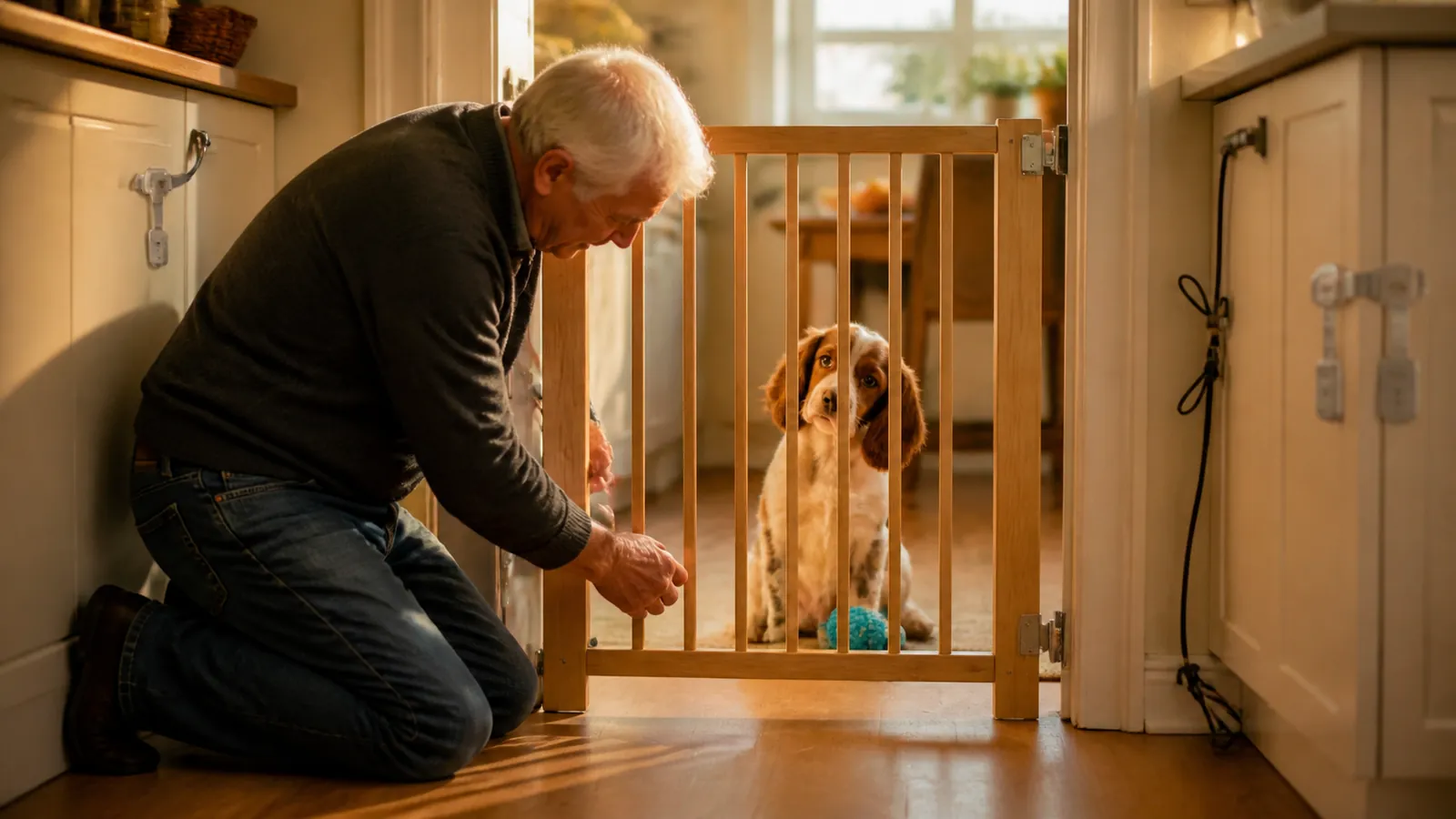 Puppy-Proofing Your Home: Room-by-Room ChecklistUse this room-by-room puppy safety checklist to secure toxic foods, medications, plants, cords, trash, yard hazards and emergency contacts.
 How to Crate Train a Puppy: A Gentle Step-by-Step GuideLearn how to crate train a puppy with positive steps, a flexible day-and-night schedule, potty timing, distress signs, and common mistakes to avoid.
 Puppy Vaccine Schedule by Age: Core and Lifestyle ShotsUnderstand a puppy vaccine schedule by age, including core and lifestyle-based vaccines, timing windows, missed doses, reactions, and local rabies rules.