
How to Crate Train a Puppy
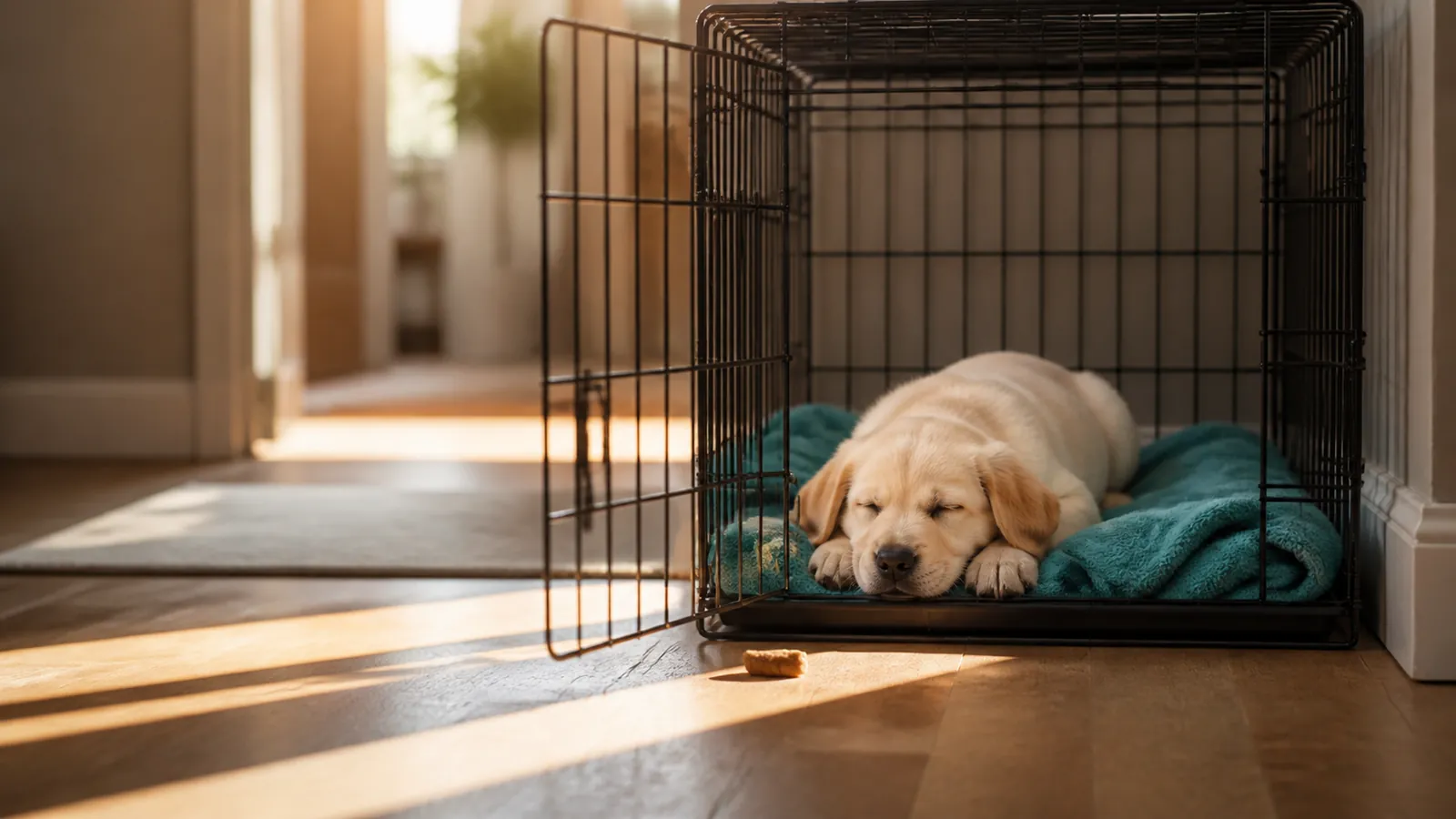
What is crate training a puppy, and how do you start?
The short version. Crate training a puppy means teaching your puppy that a crate is a calm, comfortable place to rest, in small reward-based steps. It is not a test your puppy passes by being shut in until the crying stops. Everything on this page is written for dogs, and specifically for puppies and young dogs settling into a new home; none of it transfers to cats or to confinement your veterinarian has prescribed after surgery. Start with a correctly sized crate or pen in a safe spot, leave the door open, and reward your puppy for choosing to go in. Close the door only for a few calm seconds while you sit beside it, then add time and distance gradually, and only while your puppy stays relaxed. Build the practice around waking, meals, water, play, potty trips, naps, and bedtime rather than a fixed hours-by-age formula. If you are setting up for a kitten rather than a puppy, start with our new kitten checklist instead.
Two boundaries hold the whole method together. First, only reward-based training belongs in this work: the American Veterinary Society of Animal Behavior's position statement on humane dog training advises that aversive methods, which rely on force, pain, or emotional or physical discomfort, should not be used in dog training. Never push or pull a puppy into a crate, and never use it as punishment or as all-day storage. Second, confinement does not suit every dog. VCA Animal Hospitals' guidance on crate training and confinement for puppies and dogs advises consulting your veterinarian before continuing with a training plan if your puppy salivates, vocalizes persistently, tries to escape, or does not settle. A pen or a puppy-proofed room may fit your puppy better, and choosing one is not a failure.
Your first action today: set the space up, remove anything that can snag, take your puppy out to toilet, and run one short open-door treat session.
Start here, depending on where you are right now
- Start with open-door sessions and meals fed just inside the crate if your puppy is meeting a crate for the first time, and do not close the door at all on day one.
- Choose an exercise pen or a gated, puppy-proofed room instead of a crate if your puppy needs a separate toileting area, or if a planned absence is longer than the stretch your puppy currently settles through calmly.
- Step back to seconds rather than minutes if your puppy is relaxed with the door open but starts to fuss the moment it closes, and check the potty, rest, and setup basics before you try again.
- Buy nothing else yet if you already have a crate your puppy can stand, turn around, and stretch out in; run the fit and safety check below first, because most first-week problems are routine problems rather than equipment problems.
- Work from the stretch your puppy already settles through calmly if you need a number today, and treat three to four hours as an outer ceiling rather than a target: Humane World for Animals advises that puppies under six months should not stay in a crate for more than three or four hours at a time, because they cannot control their bladders and bowels for that long.
- Call your veterinarian before you continue the plan if your puppy shows vocalizing that keeps building, panting, salivating, pacing, cowering, frantic escape attempts, biting at the bars, self-injury, or an inability to settle at any step.
- Go straight to an emergency veterinary hospital instead, without finishing the session, if there is blood, a broken tooth, breathing difficulty, collapse, a collar or harness that has caught and tightened, or a puppy who may have swallowed part of the bedding or the crate.
On this page
- What is crate training a puppy, and how do you start?
- What should you check before you close the crate door?
- What are the steps to crate train a puppy?
- What does a crate training schedule look like?
- How do you crate train a puppy at night?
- Should you let a puppy cry in the crate?
- How do you teach a puppy to be alone?
- What if crate training is not working?
- Is a pen or a puppy-proofed room a better fit?
- What should your first week of practice look like?
- Where does this guidance come from?
- How do you choose a crate or pen without guessing?
- Common questions about crate training a puppy
- What to do next
- Sources and last verified date
What should you check before you close the crate door?
Run this check once, before the first session, and again whenever your puppy grows or the setup moves. It takes a few minutes and it prevents most of the problems that later get blamed on the puppy.
Crate fit and safety check
| Check | What a pass looks like | Why it matters |
|---|---|---|
| Size | Your puppy can stand without ducking, turn around, lie down, and stretch out. The UK's RSPCA crate guidance uses those four movements as the standard. | A crate bought for the adult dog needs a divider so today's resting space is right. |
| Placement | A room the family actually uses during the day, and near your bed for the first nights. Humane World for Animals suggests an area of the house where the family spends a lot of time, and a calm part of the home rather than a constantly noisy one. | Isolation makes confinement harder and stops you hearing a genuine need. |
| Temperature and stability | Out of direct sun, away from radiators, heat vents, and drafts, on level ground, with nothing that can fall onto or against it. If you use a cover, leave sides open: Cornell's Riney Canine Health Center suggests covering a wire crate while still leaving one or two sides open. | Your puppy cannot move away from heat or a draft once the door is shut, and a cover holds heat in. Dogs shed heat mainly by panting, and Cornell notes that short-muzzle, or brachycephalic, breeds are at higher risk of heatstroke — if yours is one, ask your veterinarian what covering, if any, suits your puppy before you use one. |
| Collar and harness | Removed before the door closes. VCA's collar and harness guidance warns that serious injury can occur if a collar becomes entangled and twisted tightly, giving a crate or kennel as one example. | Entanglement is silent and fast. Keep identification current by other means. |
| Hardware | Latch closes and holds; the door can be secured fully open for early sessions; no broken wire, sharp edge, or gap that could trap a paw or a jaw. | A swinging door that startles your puppy can undo days of work. |
| Bedding, cover, water, chews | Tested with your individual puppy while you are watching, and matched to the manufacturer's own instructions. | Chewing, ingestion, overheating under a cover, and spills vary by puppy and product. No item is automatically safe unattended. |
| Alternative gate | If your puppy cannot get comfortable at any step, or the plan needs a separate toilet area, switch tools. VCA lists exercise pens, baby-gated areas, and puppy-proofed rooms as alternatives. | Comfort and toileting capacity decide the tool, not the other way around. |
Paw Parent HQ setup checklist, built from the veterinary and welfare guidance cited below.
The crate area is only the part of your home covered on this page. Before your puppy has any unsupervised freedom outside it, work through the whole-home hazards in our puppy-proofing guide.
What are the steps to crate train a puppy?
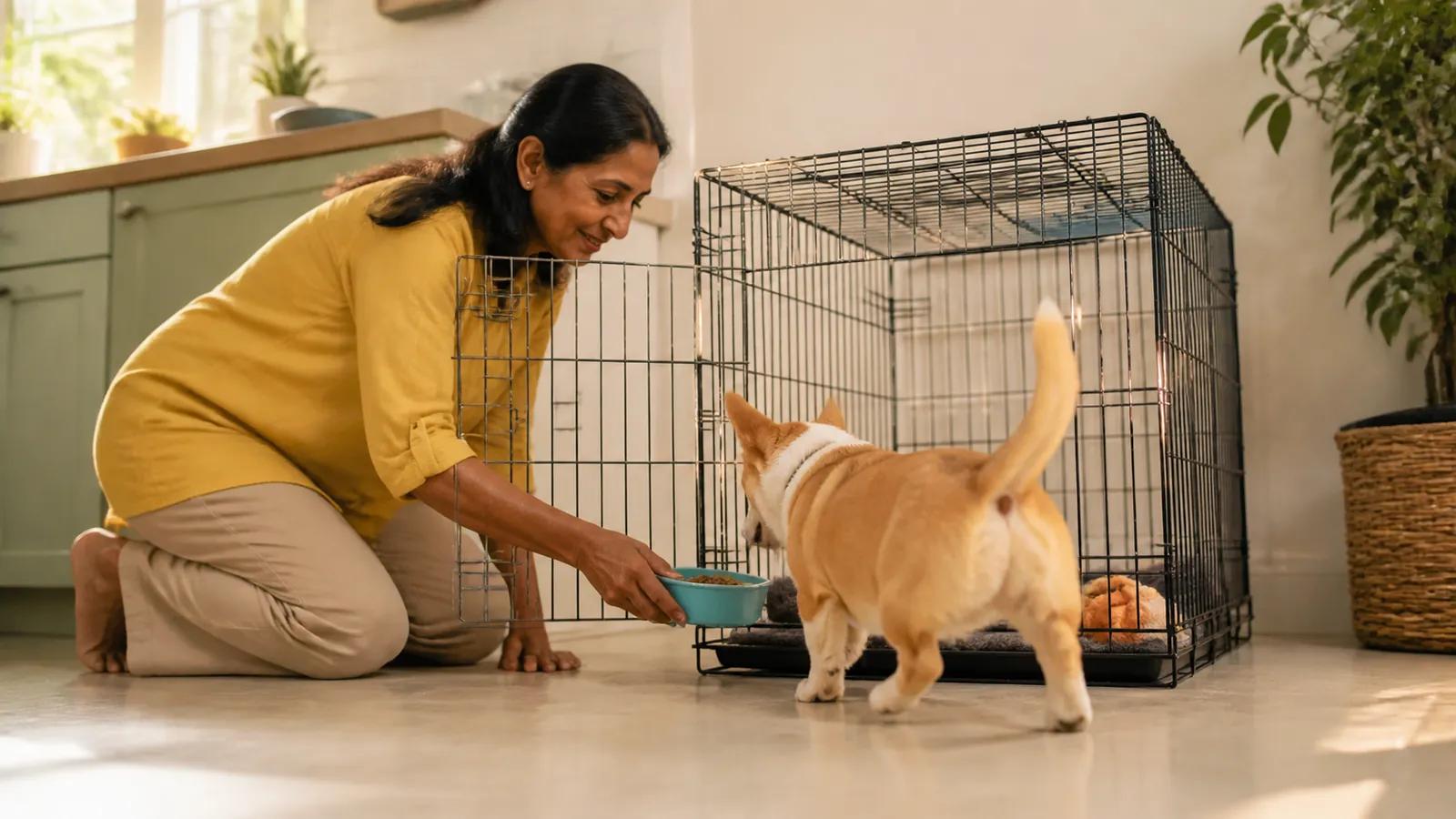
There is one progression, and it runs from an open door to a short departure. Each step has a signal for moving on, a signal for backing up, and a signal for stopping. Work at the pace your puppy sets: some puppies clear two or three steps in a day, others sit on step two for a week, and neither pattern predicts anything about the dog they become.
Seven-step positive progression
| Step | What you do | Move on when | Step back or stop when |
|---|---|---|---|
| 1. Open door | Secure the door fully open. Sit nearby and reward looking at, approaching, and stepping into the crate. Let your puppy come and go. | Your puppy walks in willingly and can turn and leave calmly. | Freezing, backing away, or refusing: reduce pressure, move rewards to the entrance, and never push or lift your puppy in. |
| 2. Meals and rewards | Feed a meal, or deliver a food toy, at whatever depth your puppy chooses. | Your puppy stays inside to eat or chew without scanning for the exit. | Eating and immediately leaving: place food closer to the opening next time. |
| 3. Add a cue | Say a short cue ("crate," "bed") just before an entry that is already happening reliably. | Your puppy enters eagerly when cued. | The cue makes your puppy hesitate: drop it and rebuild the habit first. |
| 4. Door movement | Touch or swing the door a little while your puppy is occupied, then reward and leave it open. | Your puppy stays loose and relaxed while the door moves. | A startle or a rush for the exit: use a smaller movement. |
| 5. Short closure, you beside it | Close the door for a few seconds while you sit next to the crate. Open it during a calm moment, not during a rising complaint. | Body stays loose; your puppy can eat, rest, or look around calmly. | Escalating vocalization, panting, salivation, or escape attempts: open the door, end the session safely, and see the crying section below. |
| 6. Add distance | Stand, take a step away, sit back down. Then leave the room for a moment and come back before your puppy needs you to. | Your puppy settles through repeated brief absences at the current distance. | Your puppy cannot recover at that distance: shorten it rather than waiting it out. |
| 7. Short departure | Only after calm success indoors, leave the house briefly. Keep the goodbye and the return low-key, and watch the first few trials. | Your puppy stays calm before, during, and after the food toy is finished. | Any significant distress: end the trial safely and review the plan with your veterinarian before repeating it. |
Paw Parent HQ process for dogs — puppies and young dogs — built from AVSAB, VCA, Cornell, Humane World for Animals, and RSPCA guidance.
The sequence matters less than two habits around it. End every session while your puppy is still comfortable, so the last thing they learn is that the crate ends well. And keep the door open between sessions, so the crate stays a place your puppy can choose rather than a place that only exists when it closes.
What does a crate training schedule look like?
A useful puppy schedule is built from events, not from a clock. The repeating loop is: wake, potty, food or water, play or training, potty again, calm rest in the crate or pen, and potty on waking. AVSAB's housetraining guidance is the reason the potty trips bracket everything: reward each success outside immediately, keep your puppy with you indoors so accidents can be interrupted, and do not punish accidents, because punishment tends to teach puppies to hide rather than to hold on.
Event-triggered routine
| Event | Do this first | Crate or pen use | What to log |
|---|---|---|---|
| Waking up | Potty opportunity before anything else | Return only once needs are met | Time, whether they went, anything unusual |
| Meal or water | Potty soon after, on your puppy's own pattern | A meal is a good open-door or briefly-closed rep | Food and water timing, comfort in the crate |
| Play or training | Potty after energetic activity | Short settle when your puppy is ready to sleep | Activity, how wound up they were, time to settle |
| Nap | Offer the crate at the current successful step | Do not turn sleep into a waking-duration test | Start and end, calm or not, any vocalizing |
| Before you go out | Potty, a little activity, calm setup | Only the duration your puppy already manages; arrange cover for anything longer | Departure and return time, camera notes |
| Bedtime | Potty, low light, low stimulation | Near-bed setup and the night sequence below | Wake and cry times, potty result, settling |
Paw Parent HQ planning tool for dogs — puppies and young dogs. It is not a bladder prescription. This table covers what triggers what on any given day; the first-week plan below covers what to attempt on which day.
A sample day is useful as a starting shape, so long as you treat the times as editable placeholders rather than promises: 7:00 wake and potty; 7:15 breakfast in the crate with the door open; 7:45 potty; 8:00 play and short training; 8:30 potty, then a nap at the current crate step; 10:30 wake, potty, and repeat the loop; 12:30 lunch; afternoon repeats of the same cycle with one short absence practice; 6:00 dinner; 8:00 wind-down; 10:00 last potty and bed. Shift every slot to fit your household, and expect a young puppy to need breaks between them.
Write down what actually happens as you go. The first-week tracker below sets out the fields and shows a filled-in example; your own notes will tell you what to do next far more reliably than the sample day above.
How long can a puppy be crated, and why this page will not give you a formula
This page publishes no universal maximum-hours table, and it does not use the "age in months plus one hour" rule. That formula is genuinely widespread rather than fringe: the Animal Humane Society publishes it, Texas A&M's College of Veterinary Medicine publishes a version of it, and Humane World for Animals publishes it in the FAQ of the same page this article cites for its outer limit. If you have read it three times this week, that is why.
We follow the outer limit instead. The formula converts a rough bladder estimate into a permission slip for confinement, when how long a puppy should be shut in is a welfare question rather than a plumbing one. It also accounts for none of the things that actually change the answer for your puppy: individual health, size, whether they are asleep or awake, training history, and your veterinarian's advice. Where our sources disagree, this page takes the more cautious of the two and tells you that is what it has done.
The outer limit is this. Humane World for Animals advises that puppies under six months of age should not stay in a crate for more than three or four hours at a time, because they cannot control their bladders and bowels for that long, and that a dog crated all day and night does not get enough exercise or human interaction and can become depressed or anxious. Cornell's Riney Canine Health Center puts the same principle in behavioral terms: a dog should never be left alone in a crate for an extended period without the chance to relieve themselves, play or exercise, and perform other natural behaviors.
What the three-to-four-hour limit is and is not
| Aspect | Three to four hours, puppies under six months |
|---|---|
| What it is | A welfare ceiling published by Humane World for Animals, checked August 6, 2026, for dogs under six months of age. |
| What it is not | Not a measure of bladder capacity, not a duration to build up to, not a figure to plan a workday around, and not advice about your individual puppy. |
| What to use instead | The stretch your puppy currently settles through calmly, with frequent breaks, adjusted for age, health, sleeping or waking state, and anything your veterinarian has advised. |
| Where it stops applying | It does not cover adult dogs, dogs on veterinarian-prescribed crate rest, or any puppy showing the signs in the distress or emergency rows of the crying triage below. |
Treat that as a ceiling you stay well below, not a target. If a real absence will run longer than the stretch your puppy currently settles through, arrange a person, a sitter, daycare, or a pen or gated room with a separate toileting surface. For the wider first-week routine around feeding, socialization, and appointments, use our new puppy checklist; this page keeps only the crate-specific parts.
How do you crate train a puppy at night?
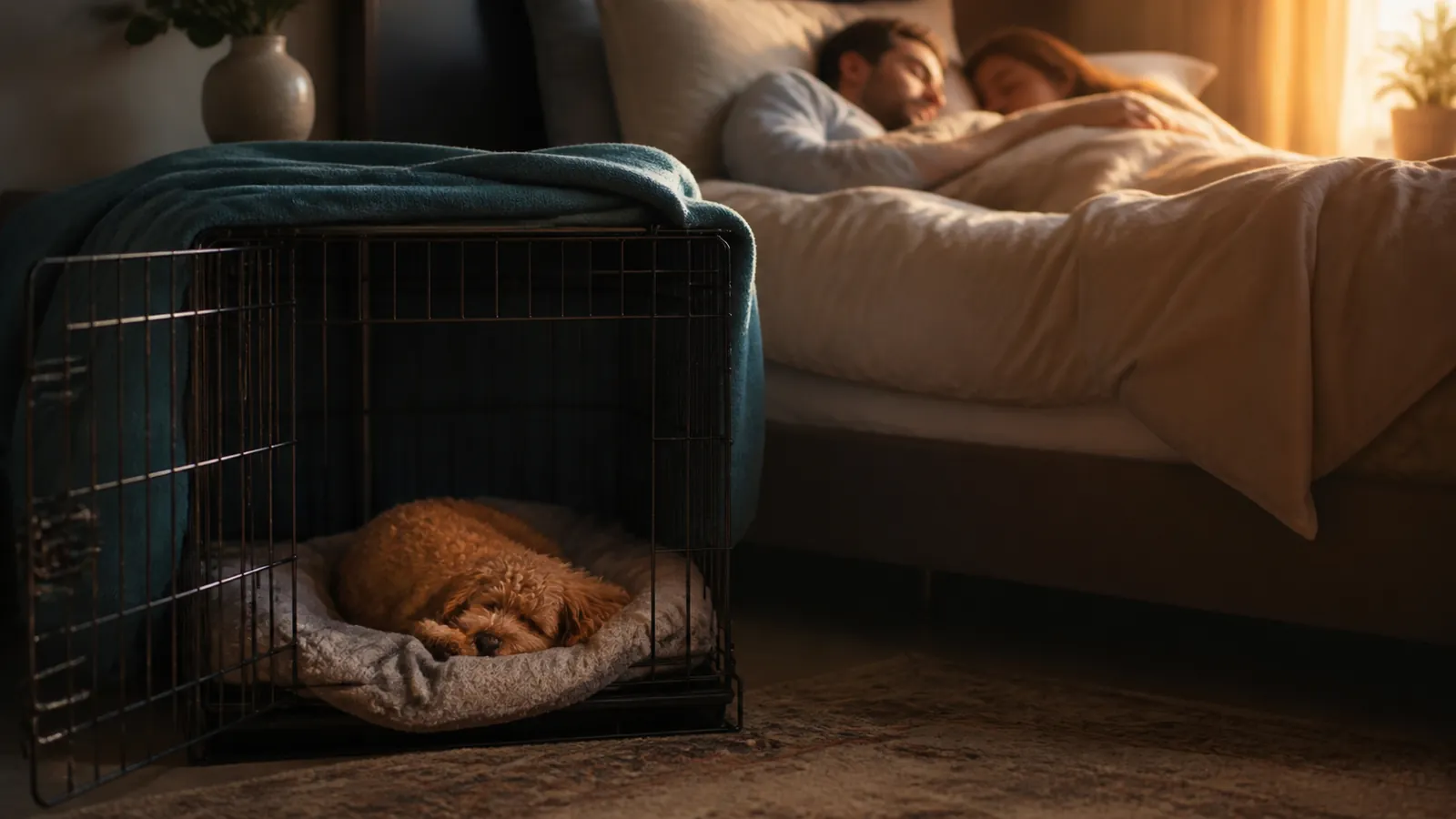
Put the crate or pen where you can hear and see your puppy for the first nights. Humane World for Animals suggests that it may be a good idea to place the crate in your bedroom or nearby in a hallway, especially with a puppy. That is not spoiling anything. It means you can tell the difference between a puppy who is settling and a puppy who needs to go out, and it means your puppy is not spending their first nights in a new home alone in a dark room.
Build a wind-down. In the last hour, drop the stimulation: no roughhousing, no new visitors, no exciting toys. Offer a real potty opportunity as the last thing before bed, in the same spot you use during the day, and reward it quietly. Have the sleeping space ready before your puppy is overtired, because an exhausted puppy often looks like a wired one.
When a puppy who has been asleep wakes and starts to vocalize, the first question is whether they need to toilet. Very young puppies usually do, and the RSPCA notes that puppies cannot hold their bladders and bowels for as long as adult dogs, which is exactly why an overnight break is normal rather than a training failure. Take them out on a lead, go straight to the toilet spot, wait, reward the result quietly, and bring them straight back. No play, no food, no chat, no scolding, no lights on if you can avoid it. The trip is business, and the boredom of it is part of what teaches your puppy that night is night.
If the vocalizing is not a potty need, work through the four paths in the next section rather than deciding in advance to ignore it. There is no ignore-everything rule here, and there is no age at which a puppy is supposed to sleep through. Some do it within a couple of weeks; some take much longer; some go backward for a week during a growth spurt or after a change at home. None of that is disobedience.
Move the crate toward its long-term spot only after your puppy is settling comfortably where it is, and move it in stages rather than in one jump: across the bedroom, then to the doorway, then out. Keep it somewhere you can still hear a genuine need. If a relocation triggers crying that had already stopped, put the crate back where it was for a few nights and try again more slowly.
Should you let a puppy cry in the crate?
Not as a rule, and not without asking what the crying means. "Only open the door when the puppy is quiet" is reasonable advice for mild grumbling about a closed door. It is the wrong advice when a puppy needs to toilet, and it is the wrong advice when a puppy is genuinely distressed. Both of those need action, not endurance.
Most new owners meet two other pieces of advice long before they reach this page, and both are worth naming. One is to let a puppy cry until they stop, so they do not "win." The other is that a puppy who resists the crate is challenging you and needs to be shown who is in charge. AVSAB's position statement on the use of dominance theory addresses the second directly: it states that dominance theory should not be used as a general guide for behavior modification, and warns that because fear and anxiety are common causes of problem behavior — including behavior that mimics resource guarding — punishment can make the problem worse by increasing the animal's fear or anxiety. A puppy crying behind a door they have not yet learned to trust is not competing with you for rank. They are telling you the step was too big.
This is also a place where our own sources disagree, and it is worth saying so plainly. Humane World for Animals advises trying to ignore the whining once you are satisfied your puppy does not need to go out, and Texas A&M's College of Veterinary Medicine gives the same instruction. We take the more cautious line here, as we do on the hours question, and we split the question rather than answering it once: ignoring is reasonable for grumbling that is already fading, and it is the wrong response to a potty need or to distress.
It also helps to know what settling actually looks like, because a first-time owner has no baseline for it. A puppy who is going to settle usually complains, then rearranges — a position change, a shuffle, a sigh, a head going down — and the sound thins out rather than sharpening, often within a minute or two. A puppy who is not settling gets louder, faster, and more physical, and the body stays tight instead of loosening. The table below sorts what you are hearing into a path with an action attached.
Four-path crying triage
| What you are seeing | Likely category | What to do now | What to change next session |
|---|---|---|---|
| Your puppy has been asleep, has just woken, or is due a break on their usual pattern | Potty need | Quiet lead-on trip to the toilet spot; reward the result; return calmly | Shorten the interval, or plan an earlier break |
| Brief whining or fidgeting that is fading rather than building | Settling noise | Stay nearby and neutral; open on a calm moment; do not turn it into a game | Repeat the same step, or make it slightly easier; do not jump the duration |
| Restlessness after intense play, a missed potty trip, hunger, an uncomfortable setup, or a step you advanced quickly | Unmet routine need | Fix the need, open the door safely, and reset once your puppy is calm | Rerun the fit and safety check and the event routine before adding time |
| Blood, a broken tooth, a bleeding mouth, breathing difficulty, collapse, a collar or harness that has caught and tightened, or a puppy who may have swallowed part of the bedding or crate | Veterinary emergency | Stop and go. Call your emergency veterinary hospital now, or your own practice if it is open. This is not a training question | Nothing. Do not run another session until a veterinarian has seen your puppy |
| Vocalizing that keeps building, panting, salivating, pacing, cowering, frantic escape attempts, biting at the bars, or a puppy who simply cannot settle — and, as a Paw Parent HQ rule of thumb rather than a veterinary threshold, noise still building about two minutes after you last changed anything | Significant distress | Stop. Open the door, prevent injury, and contact your veterinarian before continuing; ask whether a referral to a veterinary behaviorist is appropriate | Do not repeat at that intensity. Expect the plan to change, and consider a pen or safe room |
Paw Parent HQ decision aid. None of these rows is a diagnosis. The distress and emergency signs are taken from the veterinary sources cited above and below; the two-minute rule of thumb is ours.
That bottom row is the one that matters most, and it is not rare. Writing in an AVSAB article, board-certified veterinary behaviorist Meredith Stepita describes how most of her patients with separation anxiety do not improve when placed in a crate because they often have concurrent confinement anxiety: the dog pants, salivates, whines, howls, barks, urinates, defecates, or is destructive when confined, and may injure themself, including breaking teeth and cutting the skin and mouth, trying to escape. What counts as confinement varies by individual dog. Some are anxious in a whole room; others only in a small crate.
Cornell's Riney Canine Health Center reaches the same conclusion from the other direction: dogs should never be forced to remain crated alone if they are excessively barking, vocalizing, pacing, panting, eliminating, or drooling, and those dogs may do better with a larger space such as a pet-proof exercise pen, or with a person to keep them company.
This is why nobody should try to outlast those signs. A crate is a management tool, and management tools that frighten an animal are the wrong tool, not a challenge. It is also why this page cannot tell you what is happening with your puppy. Panting, salivation, and inability to settle can come from fear, from pain, from illness, or from a medical cause of house-soiling. Sorting that out is a veterinary job.
If it is safe to do so, a short phone video of what happens after you close the door, or after you leave, is genuinely useful to a veterinarian or veterinary behaviorist, because they can see body language you may not notice while you are worried. Stepita's approach to telling confinement anxiety apart from separation anxiety starts by recording the dog home alone outside the crate. Never prolong a distressing session to capture better footage. Stop first, film another time.
How do you teach a puppy to be alone?
Crate comfort and alone-time comfort are two different skills, and puppies who only ever meet the crate as you pick up your keys learn to dread both. Practice crate time while you are home, at ordinary moments, so the closed door does not reliably predict that everyone leaves.
Build distance in the smallest increments you can be bothered to make. Stand up and sit back down. Walk to the kitchen and back. Step out of the room for five seconds and return before your puppy has to wonder. VCA's crate guidance describes practicing from further and further distances until the dog will happily go to the crate from anywhere in the home; the same logic applies to your absences. The measure of success is not how long you were away, it is whether your puppy was still relaxed when you came back.
Only after that goes well indoors should you leave the house at all, and the first departures should be short enough to feel almost pointless: out the door, around the block, back. Keep hellos and goodbyes low-key. That does not mean withholding affection or ignoring your puppy when you get home; it means the emotional temperature of arrivals and departures stays flat, so they stop being events.
A camera helps, if you have one, so watch the first few departures rather than guessing. But a camera is an observation tool and nothing more: it tells you what your puppy is doing, not that your puppy is comfortable, and no camera or app substitutes for a veterinary assessment when what you see on the screen is distress.
Be clear about what alone-time practice is not. Crate training does not prevent or treat separation anxiety, and, as the AVSAB article above sets out, confinement can make things worse for a dog who has it. If your puppy is fine when you are home and only falls apart when you leave, or is fine loose in a room and only panics behind a barrier, that pattern is worth a conversation with your veterinarian, who can rule out medical causes and refer you on if a behavior plan is needed.
Finally, the workday question. A full day in a crate is not a plan for a puppy, and Humane World for Animals is direct that a dog crated all day and night does not get enough exercise or human interaction; their suggested responses include changing your schedule, hiring a pet sitter, or using daycare. A pen or gated, puppy-proofed room with a separate resting area and a separate toileting surface is the other honest answer. Decide which before the workday arrives, not during it.
What if crate training is not working?
Almost every setback belongs to one of a few patterns, and almost none of them are fixed by pushing harder. Find the closest row, make the one change, and give it several sessions before you judge it.
Troubleshooting matrix
| What is happening | Most likely category | First change to make | When to get help |
|---|---|---|---|
| Refuses to go in at all | Too much pressure, or the crate feels wrong | Secure the door open, move rewards to the entrance, try a different surface or spot, and let your puppy choose | If refusal comes with trembling, hiding, or panic rather than hesitation |
| Cries the second the door closes | Step advanced too fast | Go back to door movement and single seconds; stay beside the crate; check potty and rest needs first | If the crying escalates rather than settling, at any duration |
| Toilets in the crate | Interval too long, space too large for the resting area, or a health issue | Shorten the interval, add a divider or a separate toileting area, clean thoroughly, and never scold | Repeated accidents, or a sudden change in a puppy who was reliable: contact your veterinarian the same day |
| Bites the bars or tries to force a way out | Distress, frustration, fear, or pain | Stop the session and switch to a pen or gated room while you get advice | Straight away — use the distress and emergency rows of the crying triage above. Do not respond by buying a sturdier crate |
| Was doing well, now is not | Illness, a change at home, a frightening event, adolescence, or the crate now predicting long absences | Drop back two steps, shorten absences, and look at what changed in the household | Any regression alongside appetite, toileting, mobility, or mood changes |
| Adopted or rehomed puppy with unknown history | Prior experience you cannot see | Assume nothing. Start below the point that worries them, and treat a pen or safe room as an equally good destination | If a barrier of any kind triggers panic |
| Children or visitors keep disturbing the crate | Household management | Set the crate as a no-disturb rest zone using the household rules below, including for guests | If your puppy has started guarding the space or resisting handling |
Paw Parent HQ decision aid for dogs — puppies and young dogs. None of these rows is a diagnosis.
Whatever the row says, two things stay true. Do not punish a puppy for crying, for an accident, or for refusing, because none of those are disobedience and punishment makes each harder to fix. And do not treat equipment as the answer to a behavior problem: a stronger crate for a puppy trying to escape solves the property damage and leaves the fear exactly where it was.
If the problem is a training question rather than a distress or medical one, this is the point to look for structured help. Any trainer you consider should use reward-based methods only, should describe their scope and credentials plainly, and should tell you when something belongs with a veterinarian instead. Our guide to online dog training options covers how those programs compare. Distress, self-injury, pain, and sudden house-soiling changes are not training questions, and they go to your veterinarian first.
Who to call, and what the words mean
These words get used loosely, including by people selling services, and the differences between them change who you should be talking to.
| Term | What it describes | Who it points you to |
|---|---|---|
| Separation anxiety | Distress that appears when your puppy is left alone, whether or not they are confined | Your veterinarian first, to rule out medical causes, then a behavior plan |
| Confinement anxiety | Distress triggered by the barrier itself; the dog may be calm loose in the house and panic in a crate or pen | Your veterinarian, plus the video-outside-the-crate check described above |
| Barrier frustration | Noise or scrabbling at a barrier that looks like anxiety but stops once you are out of sight and hearing, as the AVSAB article cited above describes | Usually a management change; raise it at your next appointment if you are unsure |
| Resource guarding | Stiffening, freezing, or growling over food, a chew, a toy, or a resting place | Your veterinarian, before any further crate work and before children are near the crate again |
| Veterinary behaviorist | A veterinarian who is board certified in behavior, written after their name as DACVB. Can examine, diagnose, and prescribe | Referral through your own veterinarian |
| Dog trainer | Not a veterinarian, and cannot diagnose or prescribe. Certifications vary and are not equivalent to one another | Training questions only, and only where methods are reward-based |
Paw Parent HQ plain-language guide. None of these is a diagnosis, and only a veterinarian can tell you which, if any, fits your puppy.
One caution about credentials, from the body whose training standard this page follows: AVSAB states that it has not issued any statement endorsing or opposing trainers from any specific organization, and that its role is science-based guidance rather than certifying or promoting individual trainers or credentialing bodies. A certification logo on a website is not a veterinary endorsement. Ask what methods the person uses, what they will not do, and at what point they refer to a veterinarian.
Is a pen or a puppy-proofed room a better fit?
Often, yes, and the choice is about space, duration, and toileting rather than about how well the training went. VCA lists exercise pens, baby-gated areas, and whole puppy-proofed rooms as alternatives to a crate, and the RSPCA describes a crate as a safe, secure area a dog can go into for short periods rather than somewhere a dog spends long stretches. Use the comparisons below to pick the tool that fits the job in front of you.
Crate, pen, and gated room compared
| Compare on | Crate | Exercise pen | Gated, puppy-proofed room |
|---|---|---|---|
| Best suited to | Short rests, naps, nights, travel, and vet or grooming visits | Longer daytime management with room to move | Longer absences, larger puppies, and households short on floor space |
| Not ideal for | A puppy who needs a separate toileting area, and any absence longer than the stretch your puppy settles through calmly | A puppy who climbs or tips panels, and very small rooms | A room that has not been fully puppy-proofed, or one you cannot keep at a comfortable temperature |
| Toileting | No separate area; the interval has to fit the puppy | A separate surface can sit away from the bed | Easiest to set up with a clear toilet area |
| Rest quality | Usually the quietest and most den-like | Good if the bed is in one defined corner | Depends entirely on how calm the room is |
| Main risks | Too small, too long, or too soon | Climbing, tipping, and chewing panels | Everything in the room becomes reachable |
| What it does not do | Extend how long a puppy can be left, or prevent or treat separation anxiety | Extend how long a puppy can be left; Humane World for Animals is direct that a dog crated all day and night does not get enough exercise or human interaction | Remove the need for supervision, or for a person to arrive |
| Setup effort | Low | Low to medium | Highest, because the whole room has to be safe |
| Cost basis | One-time purchase, plus a divider if it is sized for the adult dog | One-time purchase, plus washable flooring and a toileting surface with consumables | Usually gates only, if the room already exists |
| Evidence status | Verified. Sizing from the RSPCA; short-period use, distress limits, and alternatives from Cornell's Riney Canine Health Center and VCA. All checked August 6, 2026 | Verified with limitation. Named as an alternative by VCA and as the larger space a stressed dog may do better in by Cornell, both checked August 6, 2026. Panel height, climb resistance, and anchoring are not published in those sources; verify per product | Verified. Named as an alternative by VCA, checked August 6, 2026. Room-by-room hazards are not covered on this page; see our puppy-proofing guide |
| Confirm before you commit | What are the interior dimensions at each divider position? Does the divider lock? Is there a gap at the tray edge that could trap a paw? What is the return window? | How tall are the panels, and can the pen be anchored or weighted? Is there a ceiling panel? Any gap at a joint that could trap a paw? What is the return window? | Are cords, cleaning products, plants, and small objects dealt with? Does the gate fix without leaving a gap or a climbing point? Can the room be kept cool through the afternoon? |
| When to stop and call your veterinarian | Any distress sign in the triage above, repeated or sudden house-soiling, or self-injury. Do not respond by buying a sturdier crate | The same distress signs, plus climbing that risks a fall, or a puppy who panics behind any barrier | The same distress signs, plus destructive chewing that could mean something was swallowed |
Paw Parent HQ decision aid for dogs — puppies and young dogs. Prices are not published on this page; for the wider budget see our first-year puppy cost guide.
When an enclosure is not the answer on its own
| Compare on | Tether | Human cover: schedule change, sitter, or daycare |
|---|---|---|
| Best suited to | Keeping a puppy near you in the same room while you are awake and present | Any real absence longer than the stretch your puppy settles through calmly |
| Not ideal for | Any unsupervised stretch, including while you are asleep | Any absence you cannot book in advance, or any arrangement whose cancellation terms you have not read |
| Toileting | No provision at all; the usual interval still applies | The person arriving is the toileting plan |
| Rest quality | Fine for a settle beside you; not a sleeping arrangement | Depends on the enclosure your puppy rests in between visits |
| Main risks | Entanglement, and being treated as a substitute for a safe enclosure | Little to the puppy; the risk is arranging it too late to be useful |
| What it does not do | Provide a safe enclosure, a toileting area, or a substitute for supervision | Replace the enclosure your puppy rests in between visits |
| Setup effort | Low | Medium, because it has to be booked before the day, not during it |
| Cost basis | One-time purchase | Recurring, per visit or per day; check the cancellation terms before you rely on it |
| Evidence status | Partial — our sources conflict. Humane World for Animals suggests an overnight bedroom tether; VCA's collar and harness guidance warns of entanglement injury, giving a crate or kennel as an example. Both checked August 6, 2026. Paw Parent HQ publishes the more cautious position — see the note below | Verified with limitation. Humane World for Animals names a schedule change, a pet sitter, or daycare as the responses to a dog spending too long confined, checked August 6, 2026. Provider terms and staffing are not published in that source; ask each provider |
| Confirm before you commit | Is the line short enough that it cannot wrap, and clipped to something that cannot fall or be dragged? Are you in the room and awake for every minute of it? Is anything within reach that could snag? | What does the provider require — vaccination records, an assessment visit, a minimum age? What is the cancellation policy? Who is present, and what are their credentials? What happens if your puppy does not settle? |
| When to stop and call your veterinarian | Any tangle, any struggle against the line, or any distress. Stop the same session | A puppy who does not settle between visits, or whose behavior changes once cover starts |
Paw Parent HQ decision aid for dogs — puppies and young dogs, using the same fields as the table above so the options compare directly.
A tether is a supervised-management option only. It can keep a puppy near you while you are in the room and awake, and it must never create an entanglement risk or be used as a substitute for a safe enclosure while you are asleep or out. That last part is a deliberate departure from one of our sources: Humane World for Animals suggests a bedroom tether so a puppy can move about a small space but cannot wander off while you sleep. We take the more cautious line, because the collar-entanglement risk VCA describes does not depend on your being awake to notice it.
Children and the crate
A puppy behind a closed door cannot move away from anything, and that is what makes handling around a crate different from handling anywhere else in the house. Set the rule before the first session and supervise it rather than trusting it: a child too young to be relied on stays in the same room as an adult whenever the puppy is crated.
The specifics below apply to everyone in the household, and to guests. Humane World for Animals asks households to teach everyone, especially children, not to poke fingers through the crate bars, tap on the sides, or disturb a dog who is inside, because the crate is the dog's safe zone.
- No hands or faces through the bars, and no fingers through a pen panel.
- Nobody reaches in for a chew, a toy, or a bowl while your puppy has it.
- Nobody wakes a sleeping puppy, and only an adult opens or closes the door.
- If your puppy goes in on their own, that is a request to be left alone, and it gets granted.
Stiffening, freezing over an item, a hard stare, a lifted lip, or a growl near the crate means stop, give your puppy space, and book a veterinary appointment before any further crate work. A growl is information, not misbehavior, and punishing it removes the warning without changing how your puppy feels — the AVSAB dominance statement above is explicit that punishment can increase the fear or anxiety underneath behavior of this kind. No breed is safe enough to skip these rules, and no breed needs stricter ones.
If you go the gated-room route, the room has to be genuinely prepared: cords, cleaning products, plants, small objects, and anything chewable need dealing with first. Work through our puppy-proofing guide before the first unsupervised stretch, not after.
Graduation is a behavior milestone, not a birthday. Increase freedom in stages when your puppy is reliably calm, is reliably clean indoors, and has stopped treating unattended objects as chew toys, and go back a stage without drama if any of that slips. Plenty of adult dogs keep an open crate as a bed for life, which is a good sign rather than a sign that training never finished.
What should your first week of practice look like?
This is the practice plan behind everything above, in the order you would actually run it. It is a Paw Parent HQ tool, not a veterinary prescription, and no puppy is behind if they take three weeks to reach a step listed on day four.
First-week crate practice and tracking plan
| When | Practice | Every session |
|---|---|---|
| Days 1–2 | Fit and safety check. Open-door sessions only. Meals in the crate. No door closing, no departures. | Potty before and after; keep it short; end on calm |
| Days 2–3 | Add the cue if entry is already reliable. Move the door, then close it for a few seconds while you sit beside it. | Open on a calm moment; end while your puppy is still comfortable |
| Days 3–5 | Add small distances and brief out-of-sight moments. Use the crying triage rather than a stopwatch. | Return before your puppy needs you to; log what settled them |
| Days 4–7 | Short departures, but only if the earlier steps are calm. Arrange cover for any real absence. | Low-key exits and returns; watch the first few on camera if you can |
| Every day | Normal play, training, rest, and human company alongside the crate work. | Potty before and after every confinement; watch for distress signs |
Record repeat, step back, or stop and call against every session in the tracker below.
First-week crate tracker
Copy these fields into a notebook or a phone note and fill one line per session. It takes under a minute, and it is the closest thing to evidence you will have about your own puppy.
| Field | What to write | Example entry |
|---|---|---|
| Last potty and result | The time out, and whether they went | 7:42, yes |
| Food and water | What and when | Breakfast 7:15, water topped up |
| Activity before | What happened in the half hour before | Ten minutes of tug, then a chew |
| Step practiced | The numbered step from the progression above | Step 5, door closed |
| Time calm | How long before anything changed | 40 seconds |
| Signs seen | Anything from the crying triage, in its own words | Brief whine, faded |
| Accident | Yes or no, and where | No |
| Status | Repeat, step back, or stop and call | Repeat |
| One change for next time | The single thing you will do differently | Same duration again, earlier in the day |
Use the three-way status honestly. Repeat means it went well and you run the same step again. Step back means something wobbled, so you make the next rep easier; this is the most common entry in a real log and it is not a setback. Stop and call means you saw a sign from the distress or emergency row of the crying triage, and the next thing you do is contact a veterinarian rather than schedule another session.
Where does this guidance come from?
The training method, the distress signs, and the safety limits here come from veterinary-behavior, veterinary-teaching-hospital, and animal-welfare sources, reopened and checked on the date shown at the end of this article. Other pet-care pages were reviewed only to see how the question is usually answered; none were used as evidence. The schedule, triage table, first-week plan, tracker, and selection questions are Paw Parent HQ tools built from those sources, labeled as such wherever they appear.
Who says what on this page
| Type of statement | Who establishes it | What it changes for you and your puppy |
|---|---|---|
| Veterinary and veterinary-behavior guidance | Veterinary professional bodies and board-certified veterinary behaviorists | Sets the training method and the point at which you stop and seek help. It overrides anything on this page. |
| Animal-welfare guidance | Welfare organizations such as Humane World for Animals and the RSPCA | Sets humane limits: no punishment, no all-day confinement, and alternatives as legitimate choices rather than failures. |
| Manufacturer or retailer claim | The company selling the crate, pen, bedding, chew, or camera | Establishes dimensions, materials, warranty, and return terms only. It is never a safety verdict for your individual puppy. |
| Paw Parent HQ editorial aid | Paw Parent HQ | Planning tools you can edit: the sample day, the tracker, the triage table, the selection questions. Not a prescription. |
| Owner-reported experience | Other guardians, forums, and reviews | Useful for knowing what a hard first week feels like. Never evidence for a safety, medical, or training rule. |
When this page says a fact was verified, it means the named source was opened on the review date below. Where the sources could not settle a question, such as whether a particular bed, cover, or chew is safe for your puppy unattended, we say so rather than filling the gap with a guess. Where two sources we rely on disagree — as they do on the hours question and on overnight tethering — we publish the more cautious position and show you the disagreement rather than quietly picking a side.
Guidance sources checked
Every source named on this page was opened and read on August 6, 2026: AVSAB's 2021 position statement on humane dog training and its 2008 position statement on the use of dominance theory; a 2015 AVSAB article by Meredith Stepita, DVM, DACVB; AVSAB's housetraining guidance; VCA Animal Hospitals' current crate-training and collar-and-harness handouts; Cornell's Riney Canine Health Center pages on dog crates and on heatstroke; Humane World for Animals' crate-training and pet-affordability resources; the RSPCA's crate guidance; and the crate-time guidance published by the Animal Humane Society and Texas A&M's College of Veterinary Medicine. Several of these publish no revision date of their own, so the access date is the only date we can honestly give you, and we give it rather than implying a guideline edition that does not exist.
A few things here are widely used training practice rather than findings from any cited source: ending a session while your puppy is still comfortable, keeping night potty trips boring, and keeping arrivals and departures low-key. We have not dressed them up as evidence. None of them are safety instructions, and nothing on this page turns on them.
We recheck this page against its sources at least once a year, and sooner if the guidance behind it changes. The date at the end of the article is when that was last done.
Paw Parent HQ is an educational publisher, not a veterinary practice. This page ranks no crate, pen, camera, or training brand and carries no product links, so nothing on it changes depending on what you buy. It is written and maintained by the Paw Parent HQ editorial team. Veterinary review status: not yet reviewed. When a veterinary review of this page is completed, it will be credited here by name, credential, and date. Nothing on this page is a diagnosis, a prescription, or a substitute for examining your individual puppy, and where this page and your veterinarian disagree, your veterinarian is right.
How do you choose a crate or pen without guessing?
Paw Parent HQ does not rank crate brands, trainers, cameras, or daycare programs. What follows is how to shortlist by documented characteristics, so you can apply it to whatever is available to you.
- Best for a puppy meeting confinement for the first time: any enclosure that lets your puppy stand, turn, and stretch out at today's size, placed in a room the household uses. The open-door practice matters far more than the product.
- Best for a household out longer than the puppy's settled interval: a pen or gated room with a defined resting corner and a separate toileting surface, rather than a bigger crate.
- Best for an adopted or rehomed puppy with unknown history: an open setup with no barrier at first, and a published return window on anything you buy, because you may need to change tools.
- Best for a puppy who chews or scratches at soft materials: a rigid enclosure you can inspect, nothing soft left in unsupervised, and the manufacturer's own supervision restrictions read first.
- Buy nothing else yet if: the crate you already own passes the fit and safety check. Most first-week trouble is pacing and routine, not equipment.
- Ask your veterinarian before buying or changing anything if: your puppy shows any of the distress signs above, has repeated or sudden house-soiling, or if you are considering a calming supplement or product.
Owner-profile shortlist
| Your situation | Shortlist move | Confirm for your situation |
|---|---|---|
| Young puppy, someone home most of the day | A correctly sized crate or pen in a family room, with a divider if the crate is sized for the adult dog | Is the spot a room the household actually uses through the day, and out of direct sun? Can you fit three or four short sessions around your own routine? Has everyone in the house been told the crate rules above? |
| Both guardians out for part of the workday | A pen or gated room with a resting area and a separate toileting surface, plus arranged break cover | What is the longest gap between visits, and is it shorter than the stretch your puppy settles through? What does a sitter or daycare require, and what is their cancellation policy? Who has a key, and what do they do if your puppy is unsettled? |
| Puppy already resists the closed door, or has unknown history | Do not upgrade the crate. Step back to open-door work and book a veterinary appointment before continuing | Has a veterinarian ruled out pain or a medical cause? Does any trainer you are considering use reward-based methods only? What is their referral path to a veterinary behaviorist? |
| Young children in the household | A crate or pen sited where an adult is present, with the household rules above in force from day one | Is the spot out of the main run of child traffic? Can the door be secured so a child cannot open it? Is there a second rest option in a quieter room for busy days? |
| Flat-faced breed, or a warm home | A well-ventilated enclosure in the coolest room, uncovered or with sides left open | What does your veterinarian advise about covering this breed? Is there airflow on all sides? Can the room be kept cool through the afternoon? |
| A resident dog or cat already in the house | The same enclosure, sited where the resident pet cannot crowd or stare at it, plus a second rest spot so the two are not competing for one | Can the resident pet be kept out of the crate area during sessions? Are meals and chews always given with the door open and nobody else nearby? Has either animal stiffened, frozen, or stared near the crate? |
| Apartment, or a building with shared walls | The same progression, with the crate away from the shared wall, and night potty trips planned in advance rather than improvised | Is the crate away from the shared wall and the front door? Can you get out for a night potty trip in under a minute? Have you told your neighbors that the first fortnight may be noisy? |
| Cost is the binding constraint | Whatever you already own, a shelter crate loan, or gates and a prepared room | Does your local shelter rent or trade up crates? What is the return window if it does not suit your puppy? Which low-cost clinic does your shelter refer to? |
Score every option against the same standard rather than against its own marketing: run the fit and safety check at the top of this page as your scorecard, item by item, for each crate, pen, or room you are weighing up. Anything a seller cannot answer from its own documentation stays unverified, and unverified is a reason to keep looking rather than to assume.
Common questions about crate training a puppy
Is crate training cruel?
Used the way this page describes, no. Used badly, it can be. The difference is not the crate itself; it is whether your puppy chooses to go in, how long the door stays shut, and whether anyone notices when it is not working. The RSPCA is clear that crates must never be used as punishment or to stop unwanted behavior such as chewing furniture, and Humane World for Animals is equally clear that for some dogs a crate will not be an option at all. If yours is one of those dogs, a pen or a prepared room is not second best. It is the right tool.
How long does crate training a puppy take?
It takes as long as the slowest dependency, so nobody can promise you a number. The pace is set by your individual puppy's comfort at the current step, by your household's routine, by anything your veterinarian has advised, and by the return or exchange window on equipment you may need to swap. Some puppies are settling with the door closed within days; others need weeks, and a few never suit a crate at all.
How long can a puppy stay in a crate?
There is no safe universal number, which is why this page does not publish one. Use the stretch your puppy currently settles through calmly, with frequent breaks, and stay well below the three-to-four-hour ceiling set out above — including the part explaining why this page follows that ceiling rather than the "age in months plus one hour" formula. All-day confinement is never appropriate.
Should the crate be in my bedroom?
For the first nights, usually yes. It lets you hear a genuine potty need, keeps a new puppy from being isolated overnight, and Humane World for Animals suggests the bedroom or a nearby hallway as a good starting place for a puppy. Move it toward its long-term spot in stages once your puppy is settling comfortably, and move it back for a few nights if the crying restarts.
What if my puppy cries every single time I close the door?
Work through the paths above before changing anything else: rule out a potty need, then the routine and setup basics, then the pace of the step you are on. Most consistent door-closing crying means the jump from open to closed was too big, so rebuild it in seconds. If the crying escalates rather than fading, stop and contact your veterinarian.
When can I stop using the crate?
When freedom is earned by behavior rather than by age, on the graduation criteria above. Many dogs keep the crate for life as an open, optional bed.
How much does a crate setup cost?
Paw Parent HQ does not publish crate prices on this page, because they move constantly and depend on what you buy. Your total is driven by size at adult weight, whether you buy one adult-sized crate with a divider or replace it as your puppy grows, whether you also need a pen or gates, and any bedding, covers, or break cover such as a sitter or daycare. Our first-year puppy cost guide covers the wider budget.
What if I can't afford a crate, or the help this page keeps recommending?
You have real options, and none of them require keeping a puppy in a setup that is not working. Humane World for Animals notes that your local animal shelter may rent out crates, and that renting lets you trade up as your puppy grows. A pen, a couple of baby gates, or a prepared room is a legitimate substitute rather than a downgrade. For the veterinary steps this page keeps sending you to, ask your own practice about a payment plan, check whether an accredited veterinary college near you runs a low-cost or teaching clinic, and work through Humane World's directory of free and low-cost pet food, veterinary care, and assistance funds. Cost is a reason to ask for help sooner, not a reason to wait.
When should I call the vet about crate behavior?
Routine questions about pacing or setup can wait for your next appointment. Contact your veterinarian the same day for repeated or sudden house-soiling, or crate behavior that changes alongside appetite, mobility, or mood. Go to an emergency veterinary hospital for self-injury, bleeding, breathing difficulty, collapse, a collar or harness that has caught and tightened, or a puppy who may have swallowed part of the bedding or crate. If a toxin may have been eaten, call your veterinarian, the ASPCA Animal Poison Control Center on (888) 426-4435, or the Pet Poison Helpline on (855) 764-7661 straight away; both run around the clock, and both may charge a consultation fee.
What to do next
Do one thing today, and keep it small. After a potty trip, secure the crate door fully open, sit down beside it, and spend two minutes rewarding your puppy for going anywhere near it. Then write down what happened.
Tomorrow, that note tells you which of three things to do. Continue if your puppy was relaxed: run the same step again, then move on. Step back or change the setup if anything wobbled: make the next rep shorter and easier, or rerun the fit and safety check. Contact your veterinarian or a qualified behavior professional if you saw distress rather than grumbling, if house-soiling is repeated or sudden, or if your puppy hurt themself trying to get out.
One more thing, because the first two weeks are when people think it and do not say it. If you are wondering whether you can do this at all, that is a normal thought at 3am and it is not a verdict on you or on your puppy. Talk to your veterinarian, or to the shelter or rescue you adopted from, before you decide anything — both would far rather have that conversation early than late.
Nights are the hardest part of the first two weeks, and for most families they do get easier. If you want the wider routine that surrounds this one, our new puppy checklist sets out the whole first month.
Sources and last verified date
Last verified: August 6, 2026
- Position Statement on Humane Dog Training (2021) — American Veterinary Society of Animal Behavior — Supports the reward-based training method and the exclusion of aversive tools and techniques.
- Position Statement on the Use of Dominance Theory in Behavior Modification of Animals (2008 edition) — American Veterinary Society of Animal Behavior — Supports the correction of dominance framing and the finding that punishment can increase the fear or anxiety underlying problem behavior, including behavior that mimics resource guarding.
- Separation Anxiety: The Great Imitator, Part 2 (2015) — Meredith Stepita, DVM, DACVB, article hosted by the American Veterinary Society of Animal Behavior — Supports confinement anxiety, the signs of significant distress including self-injury, the fact that confinement can worsen anxiety, and video observation outside the crate. A clinician's article rather than an AVSAB position statement.
- Position Statements and Handouts — American Veterinary Society of Animal Behavior — Supports the statement that AVSAB does not endorse or oppose trainers from any specific organization or credentialing body, and confirms the 2021 humane dog training statement as its current position.
- Housetraining Tips — American Veterinary Society of Animal Behavior — Supports immediate reinforcement of outdoor toileting, supervision indoors, and the case against punishing accidents.
- Life Skills for Pets: Crate Training and Confinement for Puppies and Dogs — VCA Animal Hospitals — Supports confinement as a management tool, distance practice, the alternatives to a crate, and the distress signs that require veterinary consultation.
- Collar and Harness Options for Dogs — VCA Animal Hospitals — Supports the collar entanglement risk in a crate or kennel and the need for supervision when equipment is worn.
- Dog crates: when to use them and how to pick one — Cornell Richard P. Riney Canine Health Center — Supports the signs that mean a dog should not be forced to stay crated, the exercise-pen and pet-sitter alternatives, the limit on extended confinement, and leaving sides of a covered wire crate open.
- Heatstroke: a medical emergency — Cornell Richard P. Riney Canine Health Center — Supports the higher heatstroke risk in short-muzzle breeds and the fact that dogs shed heat mainly by panting.
- How to crate train your dog or puppy — Humane World for Animals — Supports the three-to-four-hour outer limit for puppies under six months, the harm of all-day and all-night confinement, bedroom placement for early nights, sitter or daycare cover, shelter crate rental, the household rules about children and the crate, the advice to ignore whining that this page departs from, and the "age in months plus one hour" formula this page declines to follow.
- Are you having trouble affording your pet? — Humane World for Animals — Supports the routes to low-cost veterinary care, payment plans, and assistance funds.
- Accredited veterinary colleges — American Veterinary Medical Association — Supports the teaching-hospital and veterinary-college route for lower-cost care.
- How to crate train a puppy: crates and playpens — RSPCA — Supports the stand, turn, lie down and stretch sizing standard, the ban on crates as punishment, short-term use, and the shorter toileting capacity of puppies. UK welfare guidance; the sizing standard is not jurisdiction-specific.
- Crate training your dog or puppy — Animal Humane Society — Cited as one publisher of the "age in months plus one hour" formula this page declines to follow.
- The Benefits of Crate Training (January 31, 2019) — Texas A&M College of Veterinary Medicine — Cited as a second publisher of a one-hour-per-month-of-age crate limit, and as a second source advising that a whining dog be ignored. The piece quotes an infection control coordinator rather than a veterinarian.
- ASPCA Animal Poison Control Center — ASPCA — Supports the 24-hour poison-control contact number and the note that a consultation fee may apply.
- Pet Poison Helpline — Supports the second 24-hour poison-control contact number.
Next review: August 6, 2027
Not sure what fits your situation?
Answer a few questions and get a shortlist matched to where you are right now.
Take the 2-minute questionnaireKeep reading
 New Kitten Checklist: First Week, Supplies & SetupUse this new kitten checklist to set up a safe room, choose essential supplies, plan the first vet visit, and guide a calm first week at home.
 Puppy-Proofing Your Home: Room-by-Room ChecklistUse this room-by-room puppy safety checklist to secure toxic foods, medications, plants, cords, trash, yard hazards and emergency contacts.
 New Puppy Checklist: Your First 30 Days, in OrderFollow a practical new puppy checklist for the first 30 days, from home setup and vet records to routines, safe socialization, ID, and what can wait.
 Best Online Dog Training: Live and Self-Paced PicksCompare live classes, self-paced courses and expert support by price, methods, credentials and fit. See when online training is not the right next step.