
Puppy-Proofing Your Home: A Room-by-Room Safety Checklist
By the Paw Parent HQ editorial team. Every safety, toxicity and emergency claim below is sourced to a government agency, a veterinary professional body, or an animal poison control service, and dated. Last verified August 6, 2026. For who we are and our veterinary-review status, see how this guide was made.
If your puppy may already have gotten into something, call now
The trigger to act is suspected exposure — swallowed, chewed, licked, inhaled, or got it on the skin or in the eyes — not visible illness. Do not wait to see whether your puppy seems unwell.
Go now — do not wait for a phone call. Drive to the nearest emergency animal hospital, and have someone call ahead if a second person can, so the clinic is ready. AVMA's first aid guidance for pet owners routes each of these, in a dog or puppy, to immediate veterinary care rather than to anything you do at home:
- Unconscious, or losing consciousness.
- Seizing — any seizure that will not stop, one lasting more than five minutes, or two or more in twenty-four hours.
- Struggling to breathe — choking sounds, hard pawing at the mouth, or blue-tinged lips or tongue.
- Collapse, or the signs AVMA associates with internal bleeding — pale gums, bleeding from the nose, mouth or rectum, coughing up blood, or blood in the urine.
- Bleeding you cannot slow with firm pressure through a clean cloth.
- Trying to vomit and bringing nothing up, particularly alongside restlessness or a swollen, tight belly. AAHA lists unproductive retching among the early signs of bloat, or gastric dilatation-volvulus, which it treats as a medical emergency; Cornell notes that large, deep-chested dogs are most at risk.
- Overheating — heavy panting, heavy drooling, weakness, drowsiness or confusion, vomiting, and gums that look abnormally colored, dry or sticky. Move into shade or a cool room and drive; AVMA warns against putting an overheating dog in cool or cold water, which can worsen it.
Call now — any suspected exposure or swallowed object, whatever your puppy looks like. FDA guidance for pet emergencies (FDA, February 2024) is to call your own veterinarian first, because they know your dog's history. If you cannot reach them, call a local emergency animal hospital, or one of the two US animal poison control centers, which the FDA lists as available 24 hours a day, 365 days a year and charging a consultation fee:
- ASPCA Animal Poison Control Center — 888-426-4435
- Pet Poison Helpline — 855-764-7661
- A person who swallowed a pet medicine or household product — Poison Control, 1-800-222-1222. If someone is injured, call 911 first.
Call the same day, even if nothing looks wrong, after a chewed live power cord or a cord loop around the neck.
Have ready: the package, label or a photo of the plant; your puppy's weight; roughly how much; and the time. Do not give food, milk, hydrogen peroxide or any home remedy, and do not induce vomiting, unless a veterinary professional tells you to. If you find your puppy with a bag over their head, remove it carefully and call straight away — the FDA warns that pets can suffocate in under five minutes inside a snack, cereal or food-storage bag (FDA, February 2024). Cost should never delay a call; if paying for treatment is the barrier, the routes are in the emergency plan below.
Numbers, availability and fee wording verified against FDA Center for Veterinary Medicine pages on August 6, 2026. Emergency signs verified against AVMA first aid guidance on August 6, 2026.
Most people reading this page are preparing, not reacting. If that is you, the rest is the calm version.
On this page
- If your puppy may already have gotten into something, call now
- How do I puppy-proof my home in the first 15 minutes?
- Should I start with one safe zone or the whole house?
- What do I check in each room?
- Which control should I use for which hazard?
- What household items are actually dangerous to a puppy?
- What about the yard, balcony, garage, car and visitors?
- When do I need to puppy-proof again?
- What should my emergency plan include?
- How do I choose puppy-proofing gear without overbuying?
- Puppy-proofing questions new owners ask
- How this guide was made
How do I puppy-proof my home in the first 15 minutes?
Puppy-proofing your house is not a shopping trip. It is four repeatable moves: limit where the puppy can go, remove or secure what can hurt them, supervise and redirect what is left, and re-check whenever the puppy grows or learns something new.
There is no such thing as a finished, permanently puppy-proof home. The American Animal Hospital Association's pet-proofing guidance is direct about it: however carefully you prepare, your pet will find something you missed, and the answer is prevention, supervision and redirection rather than punishment. That is a relief, not a failure. The goal is not a perfect house. The goal is a house where the mistakes a puppy makes are the survivable kind.
If pickup is today, you do not need the whole house. You need one closed room, a clear floor at puppy eye level, food and medication behind a latch, and your veterinarian's number saved in your phone.
This page is about dogs and puppies. Cats are not small dogs: several hazards work differently for them — true lilies and acetaminophen are two the FDA singles out as feline-specific dangers — so if a cat lives here too, work through our new kitten checklist separately rather than assuming this page covers them.
Every hazard in a home belongs to one of four classes. They matter because they need different fixes, and because retail checklists tend to blur them together:
- Poisoning and toxic exposure. Foods, human and pet medications, nicotine and cannabis products, cleaners, pesticides, antifreeze, and some plants. The FDA's list of potentially dangerous items for pets (FDA, February 2023) notes that how toxic something is depends on the species that ate it, how much they ate, and — for plants — which part. The fix is secure storage, not height.
- Swallowing and suffocation. Socks, small toys, batteries, bones, corn cobs, and fruit pits including cherry, peach and plum stones. AAHA notes that swallowed shoes, socks and similar items can cause an intestinal obstruction — a blockage in the digestive tract that stops food and fluid moving through. Separately, the FDA warns that pets can suffocate in under five minutes with their head inside a snack, cereal or food-storage bag. The fix is a clear floor and bags cut open before they go in the trash. A swallowed object is a call to your veterinarian, not a wait-and-see, however well the puppy seems.
- Electrical injury, strangulation and trauma. Chewed power cords, which AAHA notes can cause a shock or a fire; blind and curtain cords; unstable furniture and decor a clumsy young dog can pull down; open or slippery stairs. The fix is to unplug, reroute, cover or block. A puppy who has chewed a live cord or been caught in a cord loop needs a veterinarian the same day, even with no visible injury.
- Escape, heat and water. Doors during handoffs, gaps under gates and fences, balconies, pools, tubs and parked vehicles. The fix is to control the threshold rather than relying on the puppy's judgment.
Batteries sit inside that second class but behave differently enough to name on their own. The ASPCA Animal Poison Control Center warns that a chewed or punctured battery leaks a caustic substance that can burn a pet's mouth, esophagus or stomach, that a swallowed battery can also cause an obstruction, and that while burns may begin within one to two hours, the full extent of the injury may not show for a full day. Pet Poison Helpline adds that disc and lithium batteries can injure tissue too, and that a dog who has swallowed one should not be made to vomit, because the corrosive contents can do further damage on the way back up. So a chewed or missing battery — the coin cells in remotes, key fobs, hearing aids, watches and children's toys most of all — is a call straight away rather than a pick-it-up-and-see. Take the packaging or a matching battery with you.
Start here, depending on your situation. There is no right order; pick the line that describes your house today:
- Start with one closed, low-clutter room if your puppy arrives today and you have less than an hour.
- Start at the doors, the balcony and the shared trash room if you live in an apartment without a yard.
- Start with bags, backpacks and floor-level clutter if children live in or visit the home.
- Start by separating every medication — yours, the children's and the other pets' — if another animal already lives here.
- Buy nothing yet if the hazard disappears when you move the item, close the door or change where it is stored; that solves most of a first sweep.
- Call your veterinarian, an emergency clinic or an animal poison control service now, before doing any of the above, if you think your puppy has already been exposed to something.
The 15-minute sweep below is a Paw Parent HQ editorial framework — our way of ordering the work, not a veterinary protocol. It assumes an average home and one person working alone. If two of you are home, split the rooms.
| Minute | Action |
|---|---|
| 0–2 | Close the door or gate off every room you have not checked. Unchecked rooms are off-limits, not "probably fine." |
| 2–5 | Clear the floor and every reachable low surface: bags, shoes, socks, small toys, batteries, hair ties, coins, sharp items, loose cords. |
| 5–8 | Lock away or relocate food, gum, medications, supplements, nicotine and e-cigarette refills, cannabis products, cleaners and other chemicals — including the other pets' medications. |
| 8–11 | Secure trash and recycling, close toilet lids, shut the washer and dryer, tie up blind cords, and steady anything that can be pulled over. |
| 11–13 | Check plants, balcony and yard access, gate gaps, garage items and any standing water. |
| 13–15 | Set up one supervised starter zone with water, a bed and a safe chew, and save your veterinary and poison-control numbers in your phone. |
Fifteen minutes will not make a house safe. It makes one part of it safe enough to bring a puppy into while you finish the rest, and it means that if something does happen, you already know who to call. Create one safe zone before you open up the rest of the home.
Should I start with one safe zone or the whole house?
Start with one zone. Trying to secure an entire home before the puppy arrives is how people end up exhausted, overspending, and still missing the open closet with the shoes in it.
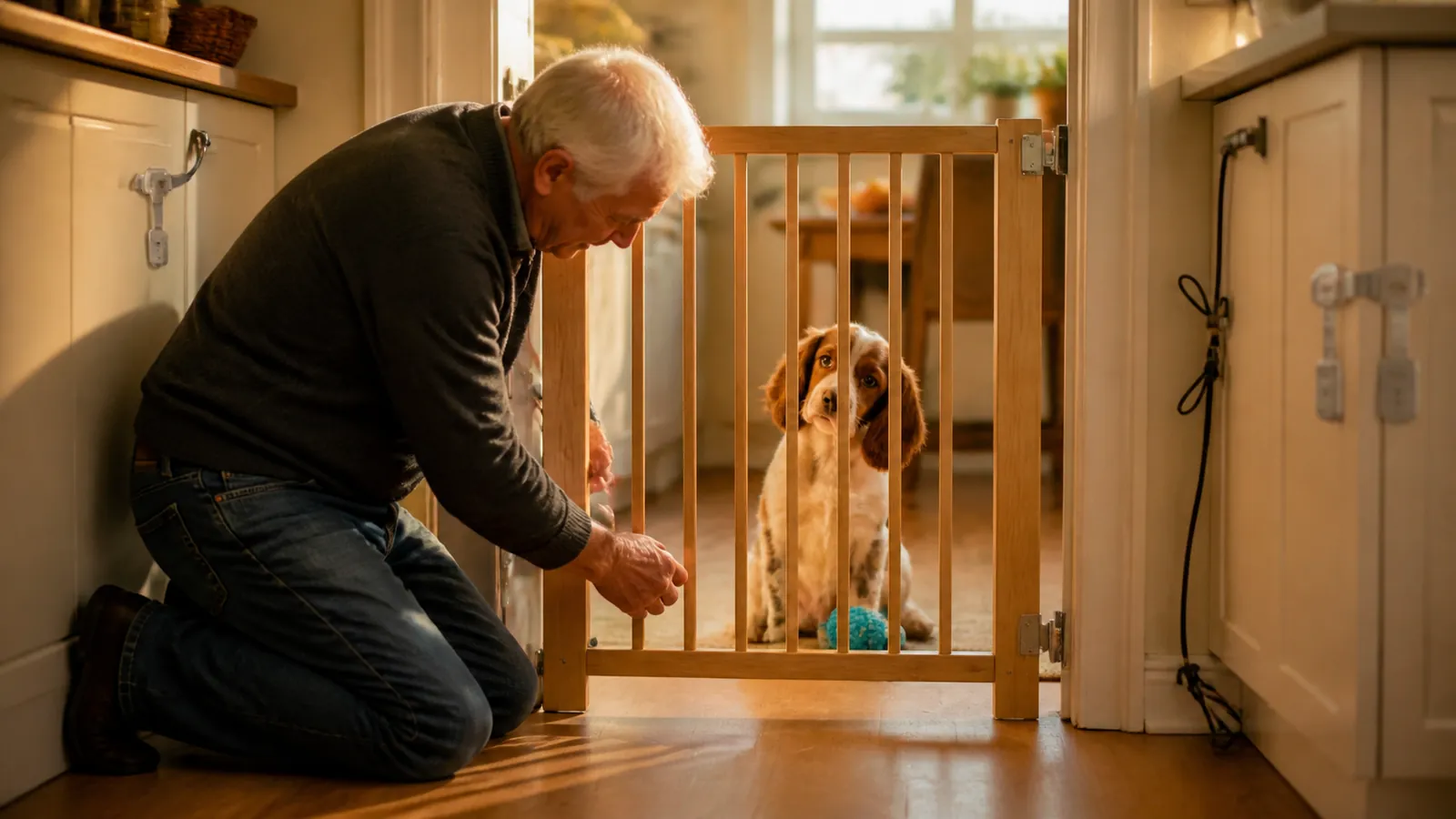
AAHA recommends deciding where your pet is allowed first, then doing the hazard removal inside that space — and making other rooms off-limits initially, with walk-through gates as a temporary measure, gradually increasing access as the dog learns the house rules. That sequence is the whole method. It works because it shrinks the surface area you have to get right on day one.
Pick the starter zone by clutter, not by size. A kitchen with a latched pantry and a tile floor is usually a better first zone than a large living room with a rug, three lamps and a coffee table of small objects. Look for: few reachable cords, a door or gateable doorway, a floor you can clear completely, and access to a route outside for toileting.
Get down to puppy eye level before you call it done. AAHA's first tip is to look at the space from your pet's point of view — what is interesting, what smells like food, what could be harmful. From twelve inches off the floor you will see the phone charger behind the nightstand, the gap beside the dishwasher and the trash can that swings open.
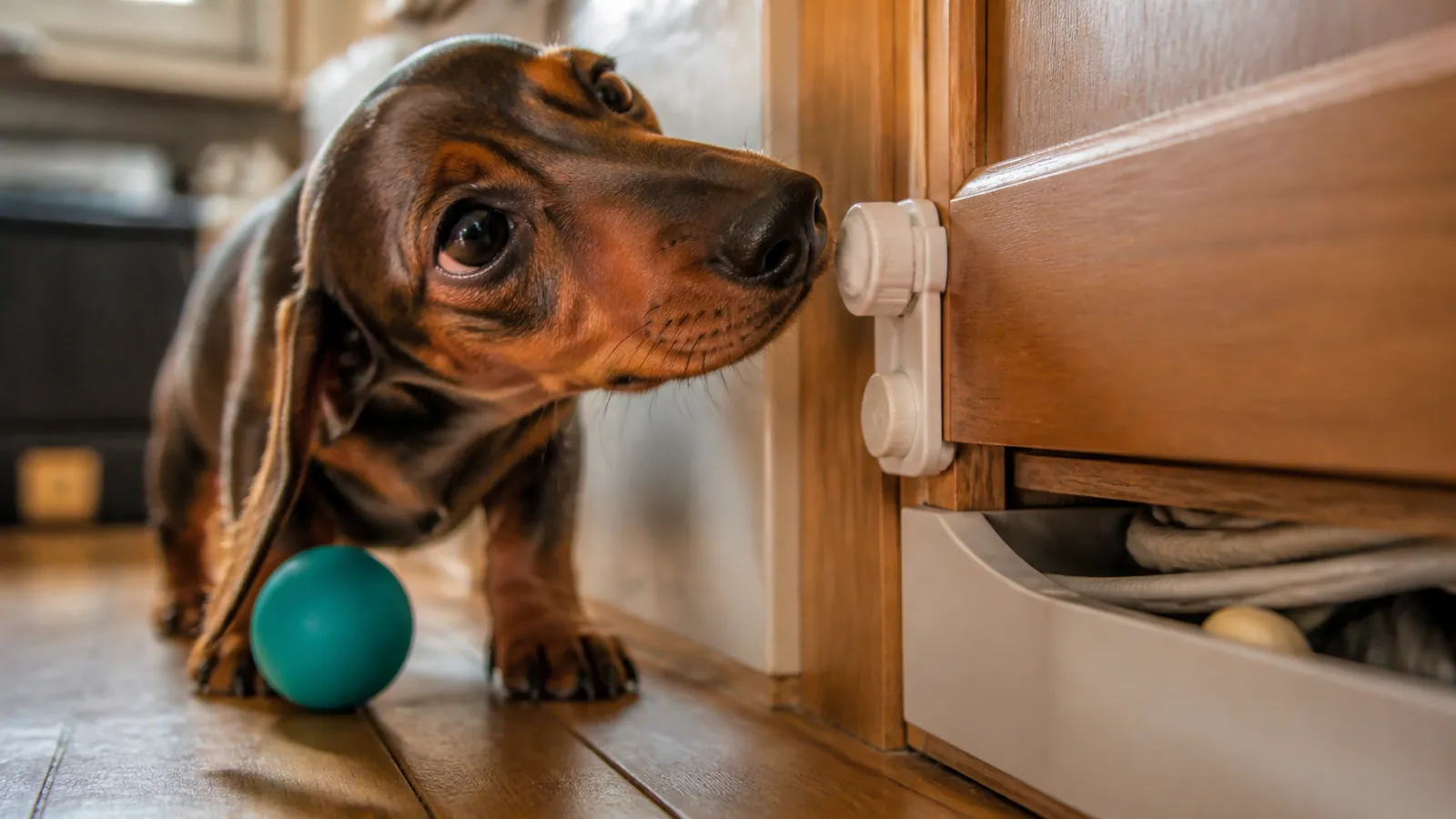
Then set the zone up: water, a bed, two or three safe chew items to redirect chewing toward, and a containment option — a crate, a pen, or simply a closed door. Containment is a management tool, not a substitute for company, exercise, toileting or training; a puppy left alone behind a gate all day is contained, not cared for. For how to introduce the crate so the puppy actually likes it, and how long a young puppy can reasonably be shut in one, see our guide to crate training a puppy.
Expand access when — and only when — the puppy shows you it is safe to. Add one new room at a time, supervised, and watch what they do with it for a few sessions before leaving them there unattended. Things worth watching for: what they chew, what they pick up and carry, whether they counter-surf, whether they climb, and whether they try to slip past you at doorways. Each of those behaviors changes which hazards apply to your home, and none of them are predictable from breed or age alone.
When management is not the answer. If your puppy panics behind a barrier, injures themselves trying to get out, or cannot settle when confined — or if chewing continues at the same intensity despite a cleared floor, safe chews and redirection — that is a conversation with your veterinarian rather than a hardware problem. They can rule out a medical cause and, if needed, refer you to a veterinary behaviorist or a credentialed trainer. Distress does not respond to a better latch.
And if the honest problem turns out to be bigger than the house — the puppy is not a fit for your household, your health, your hours or your circumstances — that is a conversation to have early and out loud, with your veterinarian and with the shelter or rescue you got them from. They are the right people to raise it with, and raising it early gives everyone more options than raising it late. Asking is not failing the dog.
What do I check in each room?
The room matrix below is the working part of this room-by-room puppy safety checklist. Each row names the hazard class that dominates the room, the action that removes the risk, the physical check that tells you it worked, and the event that should send you back to that room. Rows are commands, not descriptions — you should be able to work through them with the article closed.
One note before you start: no room becomes "safe"; rooms become safer, and only while the setup holds.
| Zone | Main hazard class | Remove or secure | Verify | Re-check when |
|---|---|---|---|---|
| Kitchen and dining | Poison; swallowing and suffocation | Move food, gum, supplements and cleaners into latched cabinets or high closed storage; put the trash can inside a cabinet or use a lidded one; cut open snack, cereal and food-storage bags before they go in the trash; clear counters and table edges of anything a dog could reach | Nose the trash-can lid and pull the cabinet doors — they should not open; no bag, wrapper, cooked bone, corn cob or fruit pit is within the puppy's reach; nothing edible sits within a paw's reach of the counter edge | Puppy grows tall enough to reach counters, learns to open a cabinet, or someone new does the cooking |
| Living room and home office | Electrical, strangulation and trauma | Unplug what is unused; route cords behind or under furniture or into cord covers; tie up blind and curtain cords; secure wobbly lamps, shelves and decor a young dog could pull over; box up remotes, chargers, cables, coins, small toys and every loose battery, coin cells especially | Tug each cord run — nothing dangles or is loose at puppy height; no loop hangs low enough to catch a puppy's neck; furniture does not rock when nudged; no battery is loose in a drawer the puppy can open, on a side table, or inside a chewable remote | New device or cable is added, the room is rearranged, or the puppy starts chewing a new material |
| Bedrooms | Poison; swallowing | Move medications and supplements out of nightstands into secure storage away from the other pets' and children's medicines; put shoes, socks, hair ties and jewelry inside closed drawers or closets; keep handbags and backpacks off the floor and off low beds; collect hearing-aid and watch batteries into closed storage | Nightstand and dresser hold nothing a puppy could swallow; closet door latches; no bag is reachable from the floor or a low chair | Anyone moves in, a new prescription arrives, or the puppy learns to jump onto the bed |
| Bathroom | Poison; water | Store medicines, toothpaste, mouthwash, sunscreen, cosmetics and cleaners in a closed cabinet; keep the toilet lid down; move the trash can somewhere enclosed; never leave a full tub unattended with a puppy in the room | Cabinet stays shut when pushed; lid is down; the puppy cannot nose the trash can open; floor is clear of razors, floss, wrappers and cotton swabs | A guest brings toiletries, a new medication enters the house, or the puppy starts following you in |
| Laundry | Poison; suffocation; trauma | Store detergent, pods, dryer sheets and fabric softener in a closed cabinet; keep washer and dryer doors shut; keep the puppy out of the room while machines are open or running | Doors are closed and latched; no pod, sheet or spilled powder is on the floor; the puppy cannot enter unnoticed | Laundry day routine changes, a new product is bought, or the puppy starts opening doors |
| Stairs and hallways | Trauma; escape | Gate the top and bottom of stairs while the puppy is small; add rugs or runners on slippery flooring; clear shoes, bags and deliveries from the entry; establish a door routine for everyone in the house | Gate holds against a shove; footing is not slippery under a running puppy; nothing chewable sits by the front door; the door cannot be opened without someone holding the puppy | Puppy starts climbing or jumping the gate, deliveries increase, or you move house |
| Garage, basement and workshop | Poison; trauma | Treat as off-limits to the dog by default; store antifreeze, ice melt, fertilizers, pesticides, rodent bait, paints and pool chemicals in closed, latched cabinets; sweep up spills; lift tools, screws and blades off the floor | Door to the space is closed and latched; no container is on the floor; no bait station or spill is within a puppy's reach; no puddle under the car | You start a project, a season changes, or a new chemical or bait comes into the house |
Read the "Verify" column as the real test. It is easy to feel finished after moving things around and much harder to fail a physical check. Pull the cabinet. Push the trash can. Shove the gate. If it opens, it is not secure yet.
The verify column also protects you against the most common false assumption in puppy-proofing, which is that height equals safety. The FDA's guidance on storing medications safely around pets (FDA, June 2024) says this plainly: what you think is out of reach may not be, because some pets jump or climb, and counters, shelves and other high places may not be secure enough. A tube knocked off a bedside table lands on the floor. Assume the floor is where anything unsecured ends up.
Finally, a note on rooms you cannot fix today. That is fine, and it is what the door is for. A closed door is a legitimate, free, immediate control. If the garage cannot be sorted this week, the garage is closed this week. The room matrix does not need to be completed in one pass — it needs to be honest about which rooms are actually done.
Which control should I use for which hazard?
The room matrix tells you where to work. This one tells you what to reach for, and — more usefully — what each control leaves unsolved. Every row is a Paw Parent HQ editorial comparison rather than a product recommendation.
| Control | What it controls | What it does not control | Cost and effort | How you verify | Evidence status | When to re-check or escalate |
|---|---|---|---|---|---|---|
| Dogs and puppies — move it or throw it away | The hazard itself — it is no longer in the room | Nothing, if the new location is also reachable; the item's return when someone puts it back | Free; minutes | Stand at puppy eye level and confirm the item is genuinely gone, not relocated to a lower shelf | Paw Parent HQ editorial judgment, applying AAHA's access-control principle | Anyone new brings the same item into the house |
| Dogs and puppies — close the door | Access to an entire room you have not finished | Anything inside a room the puppy is allowed into; a door someone props open | Free; immediate | Push the door — it latches and does not swing open under weight | Veterinary professional guidance — AAHA recommends off-limits rooms while a pet learns the house | Puppy learns to open lever handles, or household traffic props the door |
| Dogs and puppies — latched or enclosed storage | Food, medication and chemicals inside cabinets, drawers and bins | Items left out on counters; a latch fitted to the wrong door style; contents still at floor level | Low; fitting time varies by door and drawer type | Pull hard on the door or drawer with the latch engaged — it should not open far enough for a nose | Veterinary and federal guidance — AAHA recommends latches on doors and drawers; FDA states height alone is not secure storage | Puppy defeats one latch, or a new prescription or product arrives |
| Dogs and puppies — walk-through barrier (gate) | Which rooms and stairs the puppy can enter | Everything inside the gated space with them; escape at the front door; counter reach | Low to moderate; one unit per doorway, mounting depends on width and wall type | Shove the gate at puppy height — it holds, and there is no gap under or beside it | Veterinary professional guidance — AAHA describes gates as a temporary measure. Height, width, gap spacing and mounting limits: manufacturer's instructions only; we have verified no models | Puppy climbs, jumps or squeezes past it, or grows tall enough to lean over it |
| Dogs and puppies — crate or pen | Where the puppy is when you cannot supervise, for defined periods | Loneliness, toileting needs, exercise, training; those needs stay yours to meet | Moderate; introduction takes days, not minutes | The puppy enters willingly and settles; nothing chewable or swallowable is inside with them | Veterinary professional guidance on welfare framing — AAHA pairs the crate as a resting place with supervision and redirection, never punishment | Puppy panics, self-injures or cannot settle — that is a veterinary conversation, not a bigger crate |
| Dogs and puppies — cord cover or reroute | Chewing access to a cord run that cannot be unplugged | A determined chewer; cords added later; the appliance the cord belongs to being pulled down | Low; sized to the cable run | Tug the run — nothing dangles at puppy height and the cover stays seated | Veterinary guidance on the hazard — AAHA states chewed cords can cause a shock or fire. Durability of any cover: manufacturer's claim only | Puppy starts chewing a new material, or a new device is added |
| Dogs and puppies — supervision and redirection | Everything the hardware missed, in the moment | Anything happening in another room, or while you sleep or work away from home | Free, but it is the most expensive in attention | You can say what your puppy did in the last ten minutes | Veterinary professional guidance — AAHA's stated method is prevention, supervision and redirection | You cannot supervise for a stretch — then a control above has to cover that window |
AAHA and FDA guidance cited in the evidence column checked August 6, 2026.
Two rows carry welfare weight, not just safety weight. Containment and supervision decide how a puppy spends the day, not only what they can reach: a crate used well is a resting place the dog chooses, while a crate covering an eight-hour supervision gap is not a safety control at all.
The pattern across the rest of the table is the one the room matrix shows: hardware manages access, and only access. A latch on a cabinet that still holds the acetaminophen at floor level has not fixed anything, and a gate around a room full of cords buys time rather than safety.
What household items are actually dangerous to a puppy?
Everything in this section is dog-specific. Toxicity is not transferable between species: something tolerable for a dog can be dangerous for a cat or a bird, and vice versa. If you have another species in the house, check that species separately.
Nobody can hand you a complete list, and any page that implies otherwise is overselling. Use the short, high-salience list below to prioritize your sweep, and use the official databases for anything specific.
Which foods are dangerous to dogs?
The FDA's dangerous-items page names alcohol, caffeine, chocolate, grapes and raisins, macadamia nuts, onions, garlic, salt, fatty foods, raw yeast dough, cannabis, and tobacco products including e-cigarettes and their refills. It separately flags items that may not be toxic but can cause a gastrointestinal obstruction, including bones, corn cobs, avocado pits, and the pits of Prunus fruits such as cherries, peaches and plums. The ASPCA's people-foods list adds detail on why: grapes and raisins are linked to kidney damage in dogs, which the ASPCA now attributes to tartaric acid that dogs cannot process; onions and garlic to red blood cell damage; and raw yeast dough to painful bloating plus alcohol production in the stomach. If your puppy eats any of them, the ASPCA's instruction is to note how much and contact your veterinarian or poison control.
Chocolate is the one people most often try to assess themselves. How much matters, and so does the type: the FDA's chocolate guidance for dog owners explains that the toxic compound is theobromine, that the darker the chocolate the more theobromine it contains, and that whether a dog is affected depends on the amount, the type, the dog's size and that individual dog's sensitivity. Working out whether a particular amount is a problem for a particular dog is the call you are making when you ring, not a calculation to do first. Note the type, the weight of what was eaten and your dog's weight, then call.
Why xylitol is different
The FDA's xylitol warning (FDA, February 2025) is dog-specific and unusually blunt: xylitol poisoning can begin within twenty minutes and can kill a dog. It appears in sugar-free gum, candy and mints, sugar-free desserts, sugar-free jams and nut butters, mouthwash and toothpaste, cough syrups and liquid medicines, nasal sprays, and dietary supplements such as fiber gummies and sleep aids — and it may be labeled as wood sugar, birch sugar or birch bark extract. The practical move is to treat every sugar-free product and every liquid medicine in the house as a locked-storage item, and to read the label on any nut butter before it goes in a food toy.
This one really is species-specific rather than merely dog-scoped by our choice: the FDA's consumer update on xylitol reports that cats appear to be spared, at least partly because they are indifferent to sweet things, while ferrets can develop low blood sugar and seizures much as dogs do. It is a clean example of why a hazard list written for one species should never be read across to another.
If you did not see it happen
Suspected exposure is the trigger to call, and you do not need symptoms to justify it. But puppies get into things unobserved, so it helps to know what would make you call anyway.
The FDA's xylitol page lists the signs of xylitol poisoning in dogs as vomiting, decreased activity level, weakness and collapse, difficulty walking or standing, shaking or seizures, coma, liver failure and bleeding problems. Those are specific to xylitol; different substances produce different signs, and some produce none at all for hours. Read them as examples of the kind of change that warrants a call, not as a checklist that rules anything in or out.
Two things follow from that. A puppy who seems fine has not been cleared — if you know or suspect something was eaten, call regardless. And a puppy who is behaving oddly with no known exposure still needs a veterinarian, because this page cannot tell you what is causing it and neither can a symptom list. Only an examination can.
What normal looks like, and what would make you call
A first-time owner has no baseline, which makes "seems off" almost impossible to judge. Build the baseline now, while your puppy is well, so you have something to compare against later.
Normal, for your puppy specifically. Watch them breathe while they are asleep or resting quietly, and count: VCA's client guidance on home breathing rates puts a normal resting rate at 15 to 30 breaths per minute for healthy dogs and cats, and treats a resting or sleeping rate consistently above 30 as abnormal. Count for fifteen seconds and multiply by four, on a few different evenings, and you will know your own dog's usual number. Look at their gums while they are well, so you know their ordinary color — some dogs have naturally dark or spotted patches, and you want to have seen that before a stressful night. Note roughly how much they eat and drink, how often they urinate, and what their stool normally looks like. Hard play followed by hard sleep is the usual puppy rhythm.
Reasons to call your veterinarian even without a known exposure. These are the changes AVMA's first aid guidance associates with situations needing veterinary attention, and any one of them is worth a phone call rather than a wait:
- Repeated vomiting or diarrhea.
- Gums that look pale, white, blue-tinged, or unusually dry or sticky.
- Breathing that is fast, noisy or effortful while your puppy is resting.
- Drooling heavily, or pawing at the mouth.
- Unsteadiness, wobbliness, weakness, drowsiness that is out of character, or apparent confusion.
- Blood anywhere it should not be — in urine, in stool, from the nose or mouth, or coughed up.
- A sudden unwillingness or inability to stand or walk.
None of this is a diagnosis, and this list cannot rule anything out. It is a list of reasons to pick up the phone. Anything in the go-now block at the top of this page is different — those are reasons to drive rather than to phone.
Human and pet medications
The FDA's medication-storage guidance reports that nearly half the calls to one animal poison control service involve pets that have eaten medications intended for people, with over-the-counter anti-inflammatories such as ibuprofen and naproxen at the top of that service's list. The rest of that guidance is worth following exactly: keep medications in their original containers with legible labels, store each person's and each pet's medicines separately to prevent mix-ups, keep pet medications away from children, and remember that child-resistant packaging is not pet-resistant — dogs chew through vials, boxes and blister packs. Flavored pet medications are the ones most likely to be hunted down. Dispose of unused medicines through a take-back program rather than the household trash, since dogs raid the garbage.
Household and yard chemicals
The FDA's non-edible list includes antifreeze, ice-melting products, insecticides and pesticides, lawn fertilizers and weed killers, rodent bait, mothballs, liquid potpourri, paints and solvents, pool chemicals, cocoa mulch, and household cleaners including bleach and toilet-bowl cleaner. Nicotine and cannabis products belong here too, including e-cigarette refills. The ASPCA's household-products guide adds two items people underestimate: dryer sheets and fabric softeners contain cationic detergents — a class of cleaning chemical that burns tissue on contact — which can cause severe chemical burns and ulcers in the mouth, esophagus and stomach, and laundry detergent pods can cause irritation that in some cases becomes serious. That guide also notes most cleaning products are safe to use around dogs when used according to the label directions — the risk is the concentrated product and the wet, unrinsed surface, not the cleaned floor.
Which houseplants are toxic to dogs?
The ASPCA's toxic and non-toxic plant database is the right tool here, and it comes with its own limitation stated on the page: the list is not all-inclusive, individual plants can look different from the photos, and you should check the plant by name rather than by appearance. It also notes that eating any plant material may cause vomiting and stomach upset in dogs. Practically: photograph the plants you own, look each one up by name, move anything listed as toxic to dogs out of reach or out of the house, and treat unidentified plants as unknown rather than safe. The ASPCA also publishes a printable dog-specific plant list if you would rather work from paper.
Lilies are the clearest illustration of why the species label on a plant list matters. The FDA's guidance on lilies and cats states that the toxin in true lilies and daylilies affects only cats, in whom a very small amount can cause fatal kidney failure, while dogs that eat lilies may get a minor stomach upset but do not develop kidney failure. Same plant, same vase, two completely different answers.
One rule covers all of these categories. If you cannot confirm what the item was, how much was involved, or whether it is toxic to dogs, that uncertainty is a reason to call, not a reason to wait.
Who decides whether something is "pet-safe"?
Puppy-proofing advice comes from sources with very different authority. Knowing which is which tells you how much weight to give a claim.
| Category | What it is | Who establishes it | What it changes for you and your puppy |
|---|---|---|---|
| Government safety guidance | Federal consumer safety information on hazards, medication storage and emergency routing | FDA Center for Veterinary Medicine | Reliable for what is dangerous and what to do; not individual medical advice for your dog |
| Veterinary professional guidance | Practice-body and veterinary-hospital client education on household risk, first aid, supervision and management | AVMA and AAHA; veterinary hospital client-education libraries | Sets the general method and the escalation thresholds; still needs your veterinarian to apply it to your dog |
| Animal poison-control service | 24-hour toxicology consultation on a specific exposure | ASPCA Animal Poison Control Center; Pet Poison Helpline | The only source here that can advise on your actual incident; a fee may apply |
| Manufacturer label and directions | Ingredients, dimensions, mounting method, use limits, warnings | The product maker | Binding on how the product must be used; a marketing phrase on the front is not a safety finding |
| Paw Parent HQ editorial aid | The 15-minute sweep, the room matrix, the control comparison, the re-check triggers | Paw Parent HQ | Helps you order and remember the work; carries no clinical or regulatory weight |
Verification vocabulary matters: "non-toxic," "pet-safe," "chew-proof" and "escape-proof" are marketing descriptions unless a named source and a date sit behind them. Treat them as claims to check, not conclusions.
Confidence is not uniform across this page either. The emergency routing, the xylitol timing and the hazard lists are settled federal and veterinary guidance. Whether a particular amount will harm a particular dog is not something any page can settle — that varies by the dog, and it is exactly what a poison control veterinarian is for. And where we describe how a control behaves in practice, such as how long a latch survives a determined puppy, that is our judgment rather than measured evidence.
What about the yard, balcony, garage, car and visitors?
Transition spaces are where household routine meets the outside world, and they are easy to miss when you are working room by room.
Boundaries and gaps. Walk the fence line at puppy eye level and look for gaps under gates, loose boards, drainage holes and the space behind the shed. A gap a puppy can squeeze through is an escape route until you close it, and puppies find these before you do. Check that gates self-latch and that everyone knows to close them. On balconies, look at the gap between and under railings, and at anything that can be climbed to get over them; treat balcony access as supervised-only. Secure containment and a registered microchip plus a visible ID tag are the layers that actually recover a lost dog — a tracker is an addition to those, never a replacement, which is the boundary to keep in mind if you are reading about GPS dog collars.
Water. Pools, ponds, hot tubs and even a full bath are hazards for a dog who cannot yet climb out. Supervise directly rather than relying on a cover, and never assume a young dog can swim to an exit point.
Garage and garden chemicals. Keep the garage off-limits by default. Antifreeze, ice melt, pesticides, weed killers, rodent bait and pool chemicals all appear on the FDA's list of non-edible dangers, and bait stations are designed to be attractive. Sweep up spills, including under the car.
Parked cars and hot ground. The ASPCA's guidance on animals in hot cars is unambiguous: even for a moment, even with the windows cracked, it is never safe to leave an animal alone in a parked vehicle. Laws on this vary by state; that is a separate matter from the safety rule, which has no exceptions. The ASPCA reports that as of 2025, 32 states and the District of Columbia had laws addressing animals left unattended in a confined vehicle in dangerous conditions — which means the rest did not, so check your own state rather than assuming either way. The same guidance warns against letting a dog linger on hot asphalt, because a body close to the ground heats quickly and paw pads can burn. If a dog has been shut in a hot car, or has overheated in the yard, the signs AVMA lists are heavy panting or rapid breathing, heavy drooling, weakness or drowsiness, confusion, vomiting or diarrhea, and gums that look abnormally colored, dry or sticky. That is a go-now situation: move them somewhere cool and drive.
Children and puppies together. Children and puppies are supervised together, not left together — at any age, with any breed, and however gentle both of them are. Three specifics do most of the work. Give the puppy a retreat space, such as a crate, pen or gated room, that children may not follow them into, and teach that a puppy who walks away is left alone. Teach children not to take food, chews or toys from the puppy, and not to lean over, hug or climb on them. Have an adult open the front door, not a child. The FDA also notes that flavored pet medications can look like candy to a child, which is another reason each animal's medicines live in their own labeled, closed storage. If your puppy growls, stiffens or snaps at a child, stop the interaction and speak to your veterinarian — that is information, not naughtiness, and it is worth acting on early.
Scenario: the delivery at the door. The doorbell rings, you open the door with the puppy loose behind you, and the courier steps back as the puppy shoots past. Fix it once: gate the hallway or put the puppy behind a closed door before opening the front door, and tell everyone in the house the same rule. Deliveries left on the step are the other half — boxes, packing materials and food deliveries all end up floor-level.
Scenario: the backyard barbecue. Guests bring bags, arrive through the gate, and put plates down at dog height. Assign one person to the gate, one to the puppy, and give the group three rules: no feeding the puppy, bags stay off the floor, and empty snack bags go straight into a closed trash can — cut open first, because the FDA's snack-bag guidance flags picnics, parties and car travel as the situations where food bags are most often left within reach.
When do I need to puppy-proof again?
The honest answer is that your home is proofed against the puppy you have this week. Re-checking is triggered by change, not by the calendar — which is why we avoid age cut-offs. Development, size, training history and individual temperament vary too much to say that a puppy will reach a counter at a particular month.
The re-check triggers below are a Paw Parent HQ editorial framework, drawn from the access-control and supervision principles in AAHA's guidance rather than from a veterinary schedule.
| Trigger | What has changed | Re-check now |
|---|---|---|
| Puppy reaches a surface they could not before | Vertical reach | Counters, tables, nightstands, shelves, windowsills |
| Puppy opens a door, drawer or trash can | Manipulation skill | Every latch and lid in the house; upgrade or relocate contents |
| Puppy climbs or jumps a gate | Containment defeated | Stairs, off-limits rooms, balcony access; change the barrier or the room |
| Puppy chews a new material | Chewing target shifted | Cords, baseboards, furniture legs, rugs; add supervision and redirection |
| A new room is opened up | New surface area | Run the matrix row for that room before unsupervised access |
| Visitors, children or a new housemate | New bags, medicines and door traffic | Bag storage, medication storage, door routine |
| A season or holiday arrives | New plants, decorations, foods and chemicals | Plants, ornaments, food on low tables, ice melt and garden products |
| A new medication, battery pack or household product enters the home | New hazard in circulation | Where it lives, who else can reach it, and the disposal route |
| You move house or travel | Everything resets | Full sweep in the new space before the puppy explores it |
Everyone misses things, and the two most common misses are trusting height instead of securing storage, and proofing once and considering it done. Neither reflects badly on you; a puppy's reach and skills simply change faster than most households update their storage. A useful habit: after the first week, walk the house once at puppy eye level and see what has changed. It takes five minutes and it is the closest thing to a maintenance schedule this job has.
What should my emergency plan include?
The point of an emergency plan is that nobody has to think during the ten minutes when thinking is hardest. Fill this in now and put a copy on the fridge and a photo of it in every household phone. The moment you need poison control is the worst moment to be searching for it, and saving the number takes thirty seconds today.
| Field | What to record |
|---|---|
| Regular veterinary clinic | Name, phone, address, opening hours, and what their recorded message says to do after hours |
| Nearest 24-hour emergency clinic | Name, phone, address, and the drive time — check this before you need it |
| ASPCA Animal Poison Control Center | 888-426-4435; the FDA lists both US animal poison control centers as available 24 hours a day, 365 days a year, with a consultation fee |
| Pet Poison Helpline | 855-764-7661; same availability and fee basis |
| Human poison emergencies | Poison Control, 1-800-222-1222 — for a person who has swallowed a pet medicine or household product. Call 911 first if someone is injured |
| Your puppy | Name, current weight, age, microchip number, any known conditions, any current medications |
| Transport plan | Who drives, who holds the puppy, where the carrier or lead lives, and who stays on the phone |
Hotline numbers, availability and fee wording verified against FDA Center for Veterinary Medicine pages on August 6, 2026.
If cost is the barrier. Reaching your own veterinarian costs nothing to attempt, and the poison control centers will tell you the consultation fee before you commit. If paying for treatment is the real problem, say so to the clinic directly — it changes what they can offer. The AVMA's guidance on managing veterinary costs names four routes worth knowing before you need them: nonprofit and low-cost clinics, which it notes usually focus on preventive care and may have limited emergency capacity; veterinary schools and nonprofit organizations that may assist owners who can demonstrate need — in practice, the teaching hospital at your nearest accredited veterinary college; your state veterinary medical association or local humane organization, which may keep a list of local resources; and crowdfunding platforms. The AVMA endorses no specific program, eligibility rules differ, and it advises reading each program's guidelines carefully and continuing to ask even after a refusal. None of this is a reason to delay the first call. Cost is a reason to call sooner, not later.
If an incident happens, capture what the clinic will ask for: the item, package or a photo of the plant; roughly how much was involved; the time; how it was taken in — eaten, licked, inhaled or on the skin; and your puppy's current weight. Keep whatever is left of the item. Do not induce vomiting or give any home treatment unless a veterinary professional instructs you to.
One more household decision worth making in advance: who does what. Agree that one person handles the puppy while a second person calls, so nobody is holding a phone and a frightened dog at the same time. While you have the clinic's number in front of you, it is a good moment to book the first appointment and read up on the puppy vaccine schedule so that visit is productive.
How do I choose puppy-proofing gear without overbuying?
Most puppy-proofing is free. Before buying anything, ask whether moving the item, closing a door, or throwing something away solves the same problem — it usually does. Buy only when a specific, named hazard cannot be solved that way, and buy for that hazard rather than for a category. Because Paw Parent HQ has not verified current models, dimensions or warnings for any specific product, what follows describes the characteristics to shortlist for, not brands.
At-a-glance picks
- Best for a home where one room needs to be off-limits fast: a closed door, first — and only then a walk-through barrier whose published mounting instructions match your doorway type and width.
- Best for reachable food, medication or chemical storage: a cabinet or drawer latch whose manufacturer instructions cover your specific door style, paired with actually relocating the contents.
- Best for a trash can the puppy can nose open: an enclosed or in-cabinet can, or a lidded design with a mechanism the maker states is intended to resist opening by pets.
- Best for cords that cannot be rerouted: a cord cover sized to your cable run, used alongside supervision, since a cover does not stop a determined chewer.
- Best for loose batteries: a closed, latched container that lives out of the rooms your puppy uses, rather than a drawer or a bowl on a side table.
- Best for most first-week hazards — buy nothing: if the fix is moving, closing or discarding, a purchase adds cost without adding safety.
- Anything your puppy would eat, wear against the skin or be treated with — chews, deterrent sprays, supplements, parasite products — is a care decision, not a storage decision. Ask your veterinarian before buying, and do not use any of them as a substitute for access control and training.
Match the situation to the move
| Your situation | Shortlist move | Ask before you buy |
|---|---|---|
| Puppy arrives today, under an hour to prepare | Nothing. Close doors, clear one floor, relocate food and medication — then buy in week two if a gap is still there | Which hazard is actually left after the free moves? Buy for that, not for a category |
| Money is tight | Nothing, in most homes. Every control in the first four rows of the comparison table above is free or already in the house | Is this purchase solving a hazard, or replacing a habit I could change instead? |
| Apartment, no yard, one open living space | One barrier for the balcony or entry, plus enclosed trash storage | Does the maker allow pressure mounting in this width and doorway type? What is the stated height and gap spacing? What is the return window? |
| House with children | Assigned storage for bags, lunch boxes, craft supplies and battery-powered toys, before any hardware | Will this latch work on our exact door or drawer style? Can a child re-open it easily? Is there a current recall notice for this model? |
| Another pet already in the home | Separate, labeled medication storage for each animal, and separated feeding areas | Does the container close fully? Can it be chewed through? Where does the other pet's medication live now? |
| Rescue puppy with unknown habits | A smaller starter zone and one containment option, expanded only after you have watched the behavior | What size and weight is this rated for? What does the maker say about supervision and assembly? What are the return and warranty terms? |
Use one scorecard for everything. Do not judge products by star ratings or by whether the packaging says "pet-safe." Judge each candidate against the same Verify column you used in the room matrix, once it is installed. A product that fails that check has not solved the hazard, whatever it cost.
Puppy-proofing questions new owners ask
What is the first room to puppy-proof?
The one with the fewest reachable hazards and a door you can close — often a kitchen with latched cabinets and a hard floor, sometimes a spare room. Choose by clutter rather than size, clear it completely, then run the matrix row for that room. Every other room stays shut until you have done the same there.
How high is "out of reach" for a puppy?
There is no reliable height. FDA medication guidance warns that counters, shelves and other high places may not be secure, because pets jump, climb and knock items down, and because a container that is child-resistant is not necessarily pet-resistant. Use enclosed, latched storage instead of altitude.
Which houseplants should I move out of reach?
Look each one up by name in the ASPCA's toxic and non-toxic plants database and move anything listed as toxic to dogs. The database states its own limits: it is not all-inclusive, and plants can look different from their photos. Treat any plant you cannot identify as unknown rather than harmless, and photograph your plants now so you can check them properly later.
Is a baby gate enough on its own?
Rarely. A barrier controls where a puppy can go; it does nothing about what is inside the space with them, and puppies learn to climb, squeeze and jump. Use a gate to buy time while you secure storage and clear the floor, follow the manufacturer's mounting instructions for your doorway, and re-check the moment your puppy tries to get over or under it.
How much does puppy-proofing cost?
Most of it costs nothing: relocating, closing and discarding solve the majority of first-sweep hazards. Spending starts only where a specific hazard needs hardware, and what you spend is driven by three things — how many doorways need barriers, whether your cabinet and drawer styles accept common latches, and whether you already own enclosed storage and a crate or pen. Paw Parent HQ has not yet published dated, sourced price figures for puppy-proofing hardware, and we do not publish undated ones; when the Paw Parent Index covers this category, the figures will appear with their collection dates and sources. For the wider budget picture, see our first-year puppy costs breakdown.
How long does it take to puppy-proof a home?
The first sweep takes about fifteen minutes. Finishing takes as long as your slowest dependency: the rooms you cannot clear this week, any hardware you have to fit according to the manufacturer's stated instructions, and your puppy's own pace — every new behavior reopens part of the audit. Treat it as maintenance with no completion date rather than a task with a deadline.
Which situations need a veterinarian right away, and which can wait?
Routine questions — feeding, house-training, what to buy — can wait for a normal appointment. Any suspected exposure is different, and a puppy who seems completely fine has not been cleared: FDA guidance is to call your veterinarian right away, and if you cannot reach them, an emergency animal hospital or an animal poison control center. One tier is more urgent still. If your puppy is unconscious, seizing, struggling to breathe, collapsed or overheating, that is a drive to the nearest emergency hospital rather than a phone call. If a person is hurt, call 911 first.
Make one zone safer today

Pick one room. Clear the floor, secure the food and medication, deal with the cords and the trash can, close the doors to everywhere else, and save your veterinary and poison-control numbers in your phone. That is a complete, useful piece of work, and it is enough for a puppy arriving today.
Then put a note in your calendar for the end of the first week to walk the house again at puppy eye level — and go earlier if your puppy grows, climbs, or discovers a new trick. When you are ready for the wider first-week plan, our new puppy checklist picks up where this leaves off.
How this guide was made
Paw Parent HQ is an independent educational publisher. This guide is written and fact-checked by the Paw Parent HQ editorial team, who are not veterinarians. It is not a substitute for veterinary care, and nothing here diagnoses an animal or replaces an examination.
Veterinary review status: not yet reviewed. This page has not been reviewed by a named veterinarian. Every safety, toxicity, emergency-sign and routing claim on it is instead sourced directly to a government agency, a veterinary professional body, or an animal poison control service, and each source is listed below with the date we checked it. We will add a reviewer's name, credentials and review date here when that review is complete.
Where a source states its own limits — as the ASPCA plant database does — we repeat those limits rather than smoothing them over. We do not use product review sites, star ratings or retailer content as evidence for a safety claim, and we name no brands on this page.
The 15-minute sweep, the room matrix, the control comparison and the re-check triggers are Paw Parent HQ editorial frameworks. They organize the work, carry no clinical or regulatory authority, and do not override anything your veterinarian tells you.
How this page is funded: Paw Parent HQ is supported by advertising and, on some pages, disclosed referral links. No provider has paid for placement, ordering, or inclusion on this page, and compensation never determines what is included or how it is ranked. If a compensated link is added to this page, it will be disclosed here. No commercial relationship influenced this page, which recommends no products. If something here is out of date or wrong, tell us at hello@pawparenthq.com and we will correct it and re-date the page.
Sources and last verified date
Last verified: August 6, 2026
- Who Do You Call if You Have a Pet Emergency? — U.S. Food and Drug Administration — Veterinarian-first emergency routing, both US animal poison control centers with current phone numbers, 24/365 availability, consultation fees, and the human Poison Control number. FDA content current as of 02/01/2024; checked August 6, 2026.
- First aid tips for pet owners — American Veterinary Medical Association — The go-now emergency states used at the top of this page: unconsciousness, seizure thresholds, difficulty breathing and choking signs, internal-bleeding signs, heatstroke signs and the cold-water warning, plus the instruction to call ahead so the clinic is ready. Checked August 6, 2026.
- Potentially Dangerous Items for Your Pet — U.S. Food and Drug Administration — Edible and non-edible household hazards, obstruction risks including Prunus fruit pits, how toxicity varies by species and amount, feline-specific dangers, and the instruction to act quickly. FDA content current as of 02/28/2023; checked August 6, 2026.
- Paws Off! Xylitol is Toxic to Dogs — U.S. Food and Drug Administration — Dog-specific xylitol product categories, alternative label names, twenty-minute onset, the signs list, and the immediate-call instruction. FDA content current as of 02/14/2025; checked August 6, 2026.
- Paws Off Xylitol; It's Dangerous for Dogs — U.S. Food and Drug Administration consumer update — That cats appear to be spared and ferrets are not, used to illustrate why hazard lists are species-specific. Checked August 6, 2026.
- Leave Chocolate Out of Rover's Celebrations — U.S. Food and Drug Administration — Theobromine as the toxic compound, darker chocolate carrying more of it, and the factors that determine whether a given dog is affected. Checked August 6, 2026.
- Properly Store Medications to Keep Your Pet Safe — U.S. Food and Drug Administration — Original containers and labels, why high places and child-resistant packaging are not enough, separating people and pet medicines, flavored medications and children, and disposal. FDA content current as of 06/14/2024; checked August 6, 2026.
- Snack Safely—Keep Your Pets Safe from Snack Bag Suffocation — U.S. Food and Drug Administration — Suffocation mechanism and the under-five-minute timeframe, the remove-and-call instruction, cutting bags open, securing trash cans, and higher-risk situations such as parties and car travel. FDA content current as of 02/20/2024; checked August 6, 2026.
- Lovely Lilies and Curious Cats: A Dangerous Combination — U.S. Food and Drug Administration — That the lily toxin affects only cats, and that dogs eating lilies may have minor stomach upset without kidney failure. Checked August 6, 2026.
- Essential Tips for Pet-Proofing Your Home — American Animal Hospital Association — Pet-level inspection, off-limits areas and walk-through gates as a temporary measure, cabinet and drawer latches, cord and trash hazards, secure storage, obstruction risk from swallowed items, supervision and redirection rather than punishment. AAHA client-education resource authored by a certified veterinary technician (CVT, FFCP); published March 5, 2024, last modified October 27, 2025; no guideline edition published; checked August 6, 2026.
- Understanding Canine Bloat (GDV): A Medical Emergency — American Animal Hospital Association — Unproductive retching and abdominal distension as early signs of bloat, and bloat as a medical emergency. Checked August 6, 2026.
- Gastric dilatation volvulus (GDV) or "bloat" — Cornell Richard P. Riney Canine Health Center — That GDV requires immediate medical and surgical intervention and that large, deep-chested dogs are most at risk. Checked August 6, 2026.
- Toxic and Non-Toxic Plants — ASPCA Animal Poison Control Center — Plant lookup by name, the database's stated scope limitation, and escalation guidance. Checked August 6, 2026.
- Toxic and Non-Toxic Plant List: Dogs — ASPCA Animal Poison Control Center — The printable dog-specific plant list. Checked August 6, 2026.
- People Foods to Avoid Feeding Your Pets — ASPCA Animal Poison Control Center — Dog-relevant detail on grapes and raisins including the tartaric acid attribution, alliums, raw yeast dough, and the instruction to note the amount and call. Checked August 6, 2026.
- Poisonous Household Products — ASPCA Animal Poison Control Center — Laundry pods, dryer sheets and fabric softeners, and label-directed use of cleaning products. Checked July 29, 2026.
- The Dangers of Batteries and Your Pets: What You Should Know — ASPCA Animal Poison Control Center — Caustic leakage and burns to mouth, esophagus and stomach; obstruction risk from swallowed batteries; burns beginning within one to two hours with the full injury not apparent for a day. Checked August 6, 2026.
- Batteries — Pet Poison Helpline — Battery types dogs most often chew, disc and lithium batteries causing tissue injury, and the instruction not to induce vomiting after a battery ingestion. Checked August 6, 2026.
- The Dangers of Leaving an Animal in a Hot Car and Other Heat-Related Hazards — ASPCA — Prevention statement for parked vehicles, hot-surface risk, and the count of states with laws on animals left unattended in vehicles (ASPCA figure, as of 2025). Checked August 6, 2026.
- Home Breathing Rate Evaluation — VCA Animal Hospitals — Normal resting breathing rate of 15 to 30 breaths per minute for healthy dogs and cats, and rates consistently above 30 at rest treated as abnormal. Veterinary hospital client-education resource; checked August 6, 2026.
- Loving your pet, managing the costs — American Veterinary Medical Association — Low-cost and nonprofit clinics and their limits, veterinary school and nonprofit assistance, state associations and humane organizations as local referral routes, crowdfunding, and the AVMA's non-endorsement statement. Checked August 6, 2026.
Next review: February 6, 2027
Not sure what fits your situation?
Answer a few questions and get a shortlist matched to where you are right now.
Take the 2-minute questionnaireKeep reading
 New Kitten Checklist: First Week, Supplies & SetupUse this new kitten checklist to set up a safe room, choose essential supplies, plan the first vet visit, and guide a calm first week at home.
 How to Crate Train a Puppy: A Gentle Step-by-Step GuideLearn how to crate train a puppy with positive steps, a flexible day-and-night schedule, potty timing, distress signs, and common mistakes to avoid.
 Best GPS Dog Collars: Fi vs Tractive and MoreCompare Fi, Tractive, Fi Ultra, and GPS dog collar alternatives by current price, subscription, battery, coverage, fit, and the limitations that matter most.
 Puppy Vaccine Schedule by Age: Core and Lifestyle ShotsUnderstand a puppy vaccine schedule by age, including core and lifestyle-based vaccines, timing windows, missed doses, reactions, and local rabies rules.