
Best GPS Dog Collars for Different Coverage, Fit, and Budget Needs
Advertiser disclosure: Paw Parent HQ may earn a commission when you sign up for a service or buy through links on this site. It never costs you extra, and it never changes our verdicts — we recommend what we'd use for our own pets, and we never take money from breeders or puppy sellers.
There is no single best GPS dog collar. Two things eliminate more options than price does: whether the tracker can connect where your dog actually spends time, and how the device sits on your dog's collar.
For most first-time dog guardians in the United States, the Tractive DOG 6 — or the DOG 6 XL for larger dogs — is the strongest default: a clip-on cellular tracker with a comparatively low device price, a published minimum dog weight for each model, and a choice of plan lengths. For a small or growing dog, the Fi Mini is the lightest option here at 16 g, sold as a device-plus-membership bundle. Fi Series 3+ is the better answer if you want the tracker built into the collar band itself and can accept a six-month minimum membership; it is also the one option on this page whose device price Fi does not publish separately, so you cannot price its first year before you reach checkout. Fi Ultra is a specialist pick for U.S. owners who regularly spend time where terrestrial cell service is weak; the satellite fallback costs you weight and much more frequent charging, does not work outside the United States or in Alaska, and comes with Fi's own guidance that the device is built for off-leash use rather than off-grid use.
Work the Coverage–Fit–Cost order, in that sequence. Before you compare prices, enter your home address and your usual walking routes into the provider's coverage map, then measure your dog's neck and collar width against each device's published weight and size rules. Prices, plans, and terms on this page were verified on the manufacturers' own U.S. pages on August 7, 2026, except where a cell or sentence states a different date.
A tracker is an extra recovery layer, not a replacement for the basics. It does not replace a readable ID tag with current contact details, a registered microchip whose registry information is up to date, secure gates and fencing, a properly fitted collar or harness, supervision, or recall training. The American Animal Hospital Association's microchipping guidance (accessed August 7, 2026) describes why a registered chip does a job no wearable can: it stays with your dog when a collar comes off, and any shelter or clinic scanner can read it without a battery or a signal. Whether your dog is also legally required to wear something is a separate question with a local answer — there is no federal rabies or licensing rule, and as the AVMA's model rabies control document shows, these requirements are written and enforced by individual states and localities, so check your state statute and your city or county animal-services department rather than assuming. If your dog's escape routes are really gates, doors, and gaps in the fence, puppy-proof your home before you buy anything. And if your dog is very small, still growing, or has a neck, throat, or skin problem, ask your veterinarian before you add any collar-worn device — that is a fit question with a clinical answer, and it is covered in full below.
If your dog is missing right now, stop shopping. Call local shelters and veterinary clinics, confirm your microchip registration details, and work your local lost-pet steps. A tracker ordered today cannot find a dog who is already gone. The fallback sequence further down this page works whether or not you own a tracker.

On this page
- Which GPS dog collar should you start with?
- How did we choose these trackers?
- How do the current prices, plans, coverage, and fit compare?
- Why is Tractive DOG 6 the default for most owners?
- When is the Fi Mini the right size for your dog?
- Who should choose Fi Series 3+ instead?
- When is Fi Ultra worth the extra weight and charging?
- How do you choose by coverage, fit, battery, and total cost?
- What about Halo, Garmin, AirTag, and waiting to buy?
- How do you set up a tracker before you rely on it?
- How do you pick a tracker without guessing?
- Questions dog guardians ask about GPS collars
- What should you do next?
- Sources and last verified date
Which GPS dog collar should you start with?
| Pick | Choose it when | Do not choose it when |
|---|---|---|
| Best default for most owners: Tractive DOG 6 / DOG 6 XL | You want a clip-on you can move between collars, your dog meets the model's published minimum weight, and the provider's map shows coverage where your dog lives and walks. Start here if a clip-on will stay put and you would still accept the plan term if you never opened the app. | Your dog is under the model's weight threshold, the clip cannot be secured, or coverage is patchy at home or on your routes. |
| Best for a small or growing dog: Fi Mini | Your dog is too light or too narrow-collared for the other options, and you want the smallest device on this page on a collar or harness you already own. | You want the longest battery without a charging base, you need a published minimum dog weight to check against, or your collar falls outside Fi's stated width range. |
| Best integrated collar: Fi Series 3+ | You want the tracker built into the collar band, your routes sit inside Fi's stated tracking geography, and a six-month minimum membership is acceptable. | You want month-to-month flexibility, a clip-on you can swap between collars, coverage where there is no cellular service, or a first-year total you can work out before checkout. |
| Best remote-area fallback: Fi Ultra | You regularly hike, work, or live in U.S. areas with limited cell service and will charge a heavier device every one to two days. Choose it only if weak U.S. cell service is a routine part of your life with this dog. | You travel outside the U.S., you are in Alaska, you have a small dog or narrow collar, you want long battery life, or you want a longer track record. |
| Best when the answer is "not yet": no tracker | Coverage fails where you live, nothing is light enough for your dog, or the money would do more as secure gates, a fitted harness, and an up-to-date microchip registration. | Coverage and fit pass, you have a real escape problem, and you can sustain the cost and charging routine. |
Every tracker here can fail. Devices lose power, lose signal, get pulled off, and occasionally stop working. Treat location data as one input during a search, not the search itself.
How did we choose these trackers?
Paw Parent HQ researched and compared current manufacturer documentation for each product. We have not run hands-on field testing, and nothing on this page should be read as a measured performance result.
To be eligible, a product had to be currently sold and supported in the United States under a specific model name, publish device and plan terms clearly enough to price a full first year, be intended for dogs rather than adapted from an item tracker, document its fit thresholds, offer real location capability rather than proximity alone, publish return or cancellation information, and serve a use case the other picks do not already cover.
We then compared the same recovery-critical fields for every pick: technology and backhaul, coverage geography, device price, activation fee, plan term and commitment, first-year outlay, later-year renewal, advertised battery and its stated condition, attachment method, device weight and dog-size rules, water-resistance rating, returns and warranty, and the main limitation.
We do not use a numeric score, a star rating, or weighted criteria, so there is no scoring formula to publish. Ranking reflects reader fit and evidence quality, in that order — not feature count or the size of a promotional discount. A product was excluded when its availability was unclear, its pricing could not be assembled from first-party sources, its technology was not what the category name implies, or it duplicated another pick's job. Every outbound product link goes to the manufacturer's own page, and no option was included, ranked, or excluded because of a commercial arrangement.
How this page is funded: Paw Parent HQ is supported by advertising and, on some pages, disclosed referral links. No provider has paid for placement, ordering, or inclusion on this page, and compensation never determines what is included or how it is ranked. If a compensated link is added to this page, it will be disclosed here. Nothing here is veterinary advice, and none of it substitutes for a veterinarian who can examine your dog.
Two things about how this page is made, so you can weigh it properly. First, the veterinary and behavior statements on this page are quoted and linked from named professional bodies — AAHA, AVMA, AVSAB, and VCA's veterinarian-authored client education — rather than written by us; this page has not been reviewed by a veterinarian, and where a question is clinical we route it to yours rather than answering it. Second, product prices, plans, and availability in this category change fast, so this page carries a scheduled recheck: every figure here was verified on August 7, 2026, and the next verification is due on or before September 6, 2026, or sooner if a provider changes its pricing. If you find an error, tell us at hello@pawparenthq.com and we will correct it and re-date the page.
Your first action is not shopping. Check coverage, then measure — the first two steps of the Coverage–Fit–Cost order. Include anywhere your dog is routinely boarded or cared for, not just home and the usual walk. Both checks are free, and they disqualify options faster than any price comparison.
What kind of claim is this, and who is behind it?
| Claim type | Who establishes it | What it changes for you and your dog |
|---|---|---|
| Veterinary and animal-safety guidance | Veterinary professional bodies and hospital associations | Sets the baseline you should not trade away — identification, containment, and a veterinarian's judgment about your individual dog |
| Product or service fact | The manufacturer's own current pages: price, activation fee, plan term, weight, ingress rating, coverage geography, warranty, returns | These are specification and contract terms. They are checkable, and they change without notice, so they carry a date |
| Advertised performance | The manufacturer, under conditions it defines, such as "advertised up to" battery figures tied to power-saving settings | A ceiling under stated conditions, not what you should expect during an escape |
| Independent hands-on observation | A journalist or lab, in one test context | Useful context that describes that reviewer's conditions; it is not a specification you can rely on |
| Paw Parent HQ editorial decision aid | Us — the fit rules, the ordering of picks, and the option to buy nothing yet | A reasoned judgment built from documented facts. It is not a measurement and not veterinary advice |
We describe a field as verified only where a current first-party page states it and we can date that check. Where we could not confirm something, we say what is missing and what to ask at checkout instead of estimating.
How do the current prices, plans, coverage, and fit compare?
Prices, plans, and terms below were checked on August 7, 2026 on the manufacturers' U.S. pages, except where a cell states a different date. Device pricing, stock, promotions, and checkout offers change frequently, and taxes and shipping are additional. Confirm every figure with the provider before you buy.
What does each one cost in the first year, and after?
| Cost field | Tractive DOG 6 / DOG 6 XL | Fi Mini | Fi Series 3+ | Fi Ultra |
|---|---|---|---|---|
| Device price | $79 on the U.S. product page; plan priced separately | Not priced separately. Fi states the Fi Mini price includes both the device and the membership term you choose | Not separately stated on the Fi pages reviewed. Fi states that a Series 3+ purchase includes a Fi Membership, and — unlike the Fi Mini — does not say whether the device adds a charge on top. Confirm the single amount you are charged | $199 hardware fee for a standalone Ultra; $299 one-time hardware fee if you already own a Fi Mini, Series 3+, or Series 3 |
| Activation or setup fee | None shown on the U.S. product page | $20 | $20 | $20, which Fi includes in its stated standalone total |
| Required plan and commitment | Basic $108/year or $144/2 years; Premium $120/year, $168/2 years, or $300/5 years, prepaid for the term chosen. No minimum commitment stated | Membership required: $99/6 months, $189/year, or $339/2 years, device included; six-month minimum; auto-renews | Membership required: $99/6 months, $189/year, or $339/2 years; six-month minimum; auto-renews | $189/year prepaid for a standalone Ultra. Fi states the six-month minimum applies to all its membership plans, Fi Ultra included. Added to an existing Fi tracker, your current membership covers it and no new membership is needed |
| First 12 months | $187 with Basic annual or $199 with Premium annual (device plus plan), before tax and shipping | $209 — the $189 one-year prepaid bundle plus the $20 activation fee, before tax and shipping | Not calculable from Fi's published pages. Membership is $189 for a year plus the $20 activation fee; whether the tracker adds a separate charge is not stated. Get one total from checkout before you compare | $408 for a standalone new member, as Fi states it: $199 hardware plus $20 activation plus $189 for the one-year term, before tax and shipping |
| Later-year cost | Plan only, at the term you renew into | Membership auto-renews at the term you chose unless you cancel | Membership auto-renews at the term you chose unless you cancel | $189/year |
| Returns, trial, warranty | 30-day money-back guarantee on the tracker and on plans; warranty term not stated on the pages reviewed | 30-day satisfaction guarantee, which Fi states applies to Fi Mini purchases; one-year product warranty | 30-day satisfaction guarantee; a 30-day free trial is offered to new U.S. and Canadian members for a shipping fee only; one-year product warranty | 30-day satisfaction guarantee, which Fi states applies to Fi Ultra purchases; one-year product warranty |
| Cancellation terms | Cancel any time, per Tractive's subscription pages | Cancel within 30 days of an auto-renewal charge for a full refund of that renewal; after 30 days, renewal charges are not refundable or prorated | Same 30-day post-renewal refund window | Same 30-day post-renewal refund window |
What does each one actually do, and where does it stop?
| Capability field | Tractive DOG 6 / DOG 6 XL | Fi Mini | Fi Series 3+ | Fi Ultra |
|---|---|---|---|---|
| Life stage and size scope | Dogs only. DOG 6 from 8.8 lb (4.0 kg); DOG 6 XL from 44.1 lb (20.0 kg). Re-measure growing puppies and re-check the threshold as they gain weight | Dogs and cats. Fi recommends it for puppies, small dogs, and cats, but publishes no minimum pet weight on the pages reviewed — so the collar-width rule below is the check you can actually make | Dogs only. Band-sized rather than weight-gated; no published minimum dog weight found on the pages reviewed. Measure a growing puppy's neck repeatedly rather than sizing up once | Dogs only; Fi states it cannot be bought for cats or added to a cat profile. No published minimum dog weight; the weight and bulk make it a poor fit for small dogs, narrow collars, and puppies |
| How it locates and reports | GPS positioning, sent to your phone over a cellular network — the "backhaul"; AT&T, Verizon, and T-Mobile LTE in the U.S. | GPS positioning with cellular backhaul on Verizon | GPS positioning with cellular backhaul on AT&T, plus Bluetooth and Wi-Fi/base connections for power saving | GPS positioning with T-Mobile cellular, Wi-Fi, and Bluetooth, plus T-Satellite with Starlink fallback |
| Where tracking is supported | U.S. on any plan; 175+ countries on Premium, where 2G or LTE (CatM1) coverage from one of Tractive's partner networks exists | Fi states tracking across the U.S., Canada, and Mexico for its trackers; the Mini itself runs on Verizon, so confirm cross-border behavior for this model before you rely on it | Stated across the U.S., Canada, and Mexico | U.S. only, and Fi states that T-Satellite with Starlink coverage is not available in Alaska |
| How it attaches | Rubber clip onto a collar you already own | Strap or soft case onto a collar or harness you already own; needs a strap at least two inches long, and does not fit the Fi Collar band or a non-slip collar without a buckle | Integrated into a Fi collar band, with a charging base | Universal integrated clip. Fi states it works on collars, harnesses, and working-dog vests, with a maximum collar thickness of 5.5 mm and the most secure fit on a band 1 inch wide or narrower |
| Advertised battery and its condition | DOG 6: up to 14 days with Power Saving Zones, up to 6 days without. DOG 6 XL: up to 42 days with Power Saving Zones, up to 20 days without | Up to 6 weeks; up to 3 months if paired with a Fi Base, which is not included | Up to 3 months; ships with the Fi Base that charges it | 2 to 3 days. Fi advises expecting to charge every 1 to 2 days, and states that its Power Saving Mode extends battery life to up to 5 days total |
| Weight and dog-size rule | DOG 6: 40 g (1.4 oz), for dogs 8.8 lb and up. DOG 6 XL: 71 g (2.5 oz), for dogs 44.1 lb and up | 16 g (0.56 oz) — the lightest device on this page. Strap fits collars 0.375–1.25 in wide; soft case fits 0.5–1.25 in | 47 g (1.7 oz); band sizing governs fit, so measure your dog's neck against the band size before ordering | 68 g (2.4 oz) — heavier than the DOG 6, the Mini, and the Series 3+, and comparable to the DOG 6 XL |
| Water resistance | IP68 (manufacturer rating) | IP68 (manufacturer rating) | IP68 and IP66K (manufacturer ratings) | IP68 (manufacturer rating), which Fi states was tested in salt water |
| What it does not cover | No boundary or containment function; no reporting where compatible cellular coverage is absent; no location at all once the battery is flat | No boundary or containment function; no tracking if the membership lapses; must be removed from its strap or case to charge, and cannot be charged on a Fi Base | No boundary or containment function; no tracking if the membership lapses or is cancelled; no reporting outside a supported cellular network | No boundary or containment function; no coverage outside the U.S.; no satellite coverage in Alaska; satellite fallback does not make updates continuous |
| Welfare considerations | Lightest Tractive option at 40 g, and the XL is 71 g — match the model to the dog rather than buying up. A clip-on adds a second object that can snag; check the skin under it in the first weeks | 16 g is the smallest neck or harness load here, which is the whole point for a small dog. No correction, stimulation, or boundary feedback of any kind | 47 g carried on the band itself, so the load is spread rather than hanging from a clip. Band sizing must come from a measured neck, not a chart. No correction, stimulation, or boundary feedback of any kind | 68 g on a device with no published minimum dog weight — the heaviest neck load relative to the dogs it is likely to suit, though Fi's clip also allows harness or vest mounting, which moves the load off the neck. Charging every one to two days means more handling. It has an owner-triggered buzzer with adjustable sound and vibration, which Fi likens to a recall whistle; there is no static correction or boundary feedback |
| Main limitation | Location reporting depends on compatible cellular coverage, and a clip-on has to be attached securely | Smallest battery of the Fi devices unless you add a Base, and no published minimum pet weight to check your dog against | Tracking depends on an active membership and on cellular coverage; the commitment is longer than month-to-month, and the first-year total is not published | Newly launched; satellite fallback is a connectivity layer, not a promise of continuous or instant updates, and Fi describes the device as built for off-leash rather than off-grid use |
| Evidence status | Verified from the Tractive U.S. product page and its published plan comparison, August 7, 2026; stock and price vary by model and color | Verified with limitation from the Fi Mini overview, Fi product comparison and Fi membership billing, August 7, 2026; no minimum pet weight published | Verified with limitation from Fi membership billing, the Fi product comparison and what a Fi purchase includes, August 7, 2026; device price and first-year total not published | Verified from the Fi Ultra overview and Fi membership billing, August 7, 2026; launched July 2026, so re-verify pricing and satellite terms before you buy |
Four differences in those tables decide most purchases. The first is geography: Tractive states support across the U.S. and 175-plus countries where compatible cellular coverage exists, though worldwide coverage sits on its Premium tier; Fi states tracking across the U.S., Canada, and Mexico; and Fi Ultra is U.S. only, with Alaska carved out of its satellite layer. If you drive across a border with your dog, or you live in Alaska, that row alone narrows the field.
The second is what "cheap" means once the plan is included. Tractive's lowest monthly-equivalent Premium figure of $5 comes from the $300 five-year prepayment — the full $300 is committed at purchase, not billed monthly. Fi's headline is a membership, not a device: remote tracking requires an active Fi membership, and Fi sells its trackers as purchases that come with one. For the Fi Mini, Fi says plainly that the price includes the device; for the Series 3+ it does not, which is why the Series 3+ is the only option here whose first year we cannot publish.
The third is battery, and the honest version of it is the pair of numbers rather than the headline. Tractive publishes both: up to 14 days on the DOG 6 with Power Saving Zones and up to 6 days without, up to 42 days and 20 days on the XL. Fi publishes 2 to 3 days for the Ultra and then tells you to expect to charge every 1 to 2 days. Those two habits are not the same week.
The fourth is size, and it cuts both ways. The Fi Mini is a quarter of the weight of the Fi Ultra and the only device here Fi points at puppies and small dogs — but it is also the only one with no published minimum pet weight, so the check you can actually make on it is the collar-width rule rather than a threshold your dog either clears or does not.
What the terms in that table actually mean
| Term | What it means for your dog |
|---|---|
| Cellular backhaul | The tracker uses GPS satellites to work out where it is, then needs a mobile network to send that position to your phone. No supported network, no position — which is why coverage is the first check |
| Safe zone (geofence) | A boundary you draw on a map so the app alerts you when your dog leaves it. It is a notification, not a barrier: nothing physically stops the dog |
| Live mode / lost mode | A setting that makes the tracker report far more often than normal. It finds your dog faster and flattens the battery much faster, which is why an escape is the worst moment for a low charge |
| Power Saving Zones | Tractive's feature that lets the tracker idle when your dog is somewhere familiar. Its longest advertised battery figures assume this is switched on, and it publishes the shorter figure for when it is not |
| IP rating (IP68, IP66K) | A manufacturer's own test result: the first digit is dust, the second is water. It is measured in a lab, on a new device, under conditions the manufacturer sets |
| VHF tracking | Radio from the collar to a handheld receiver you carry, used by hunting and working-dog systems. It needs no mobile network and no subscription, but it also needs the handheld and does not send anything to a phone app |
Why is Tractive DOG 6 the default for most owners?
Best for: first-time dog guardians who want a straightforward everyday tracker, a lower device price, the ability to move the tracker between collars, and clear published size thresholds for each model.
Not ideal for: dogs below the published minimum weight for either model, collars or harnesses where a clip-on attachment cannot be made secure, homes and routes with unreliable cellular coverage, or owners who do not want to prepay a one-to-five-year plan term.
Tractive is the default for a practical reason rather than an impressive one: it separates the two decisions that matter. You pick the model that matches your dog's size, then you pick how long you want to commit. The U.S. product page sets the DOG 6 for dogs from 8.8 lb at 40 g, and the DOG 6 XL for dogs from 44.1 lb at 71 g, and it is one of the few manufacturer pages in this category that publishes battery life both ways: up to 14 days on the DOG 6 with Power Saving Zones in use and up to 6 days without, against up to 42 days and up to 20 days on the XL. Use the second number to plan your week. Both carry an IP68 rating, which describes ingress resistance under the manufacturer's test conditions and says nothing about chewing, impacts, or every water situation your dog will find.
The plan choice matters more than the app tour. On Tractive's published plan comparison, Basic runs $108 per year or $144 for two years; Premium runs $120 per year, $168 for two years, or $300 for five years, and Premium is where worldwide coverage, family sharing, longer location history, and data export sit. The history difference is concrete: Basic keeps 24 hours of location history and Premium keeps 365 days. If you only ever track at home and on local walks, Basic answers the job. If you travel with your dog or want more than one person to see the map during a search, Premium earns its extra cost. What you should not do is read the $5 monthly figure as a monthly plan: it is the five-year prepayment divided by 60 months.
Activity and sleep features are secondary here, and they are not clinical tools. Tractive says so itself on its product page: it monitors behavior and vital signs and alerts you to changes, and states that medical advice and diagnosis should always be sought from a veterinarian. A change in an activity graph is a prompt to look at your dog and, if something seems off, to call your veterinarian — it is not a finding, a diagnosis, or a reason to wait and watch an app instead of getting an examination.
Before you order, confirm three things with Tractive: which exact model and color is actually in stock for your country, which plan term you are agreeing to at checkout and what happens at the end of it, and whether the 30-day money-back terms cover return shipping in your case.
When is the Fi Mini the right size for your dog?
Best for: owners of small, light, or still-growing dogs — and of dogs whose everyday collar is too narrow for a bulkier clip-on — who want the smallest device on this page on gear they already own.
Not ideal for: owners who need a published minimum pet weight to check their dog against, owners who want the longest battery without buying a charging base, and anyone whose collar falls outside Fi's stated width range or has no buckle.
The Fi Mini exists because most of this category is built for medium and large dogs. Fi's own overview puts it at 16 g and 42 × 30 × 12.5 mm with an IP68 rating, and Fi's product comparison recommends it for puppies, small dogs, and cats. For scale, that is roughly a third of the weight of the Fi Series 3+ and a quarter of the Fi Ultra.
The fit rules are unusually specific, and they are the ones to check. Fi states that the Mini attaches by strap or soft case to any collar or harness with a strap at least two inches long: the strap fits collar widths from 0.375 to 1.25 inches and the soft case from 0.5 to 1.25 inches. It does not fit a non-slip collar without a buckle, and it does not fit the Fi Collar band, whose magnetic locking system is built for the Series 3 and Series 3+. What Fi does not publish anywhere we could find is a minimum pet weight — so unlike the Tractive models, there is no number to hold your dog up against, and the judgment falls to you and, for a very small or growing dog, to your veterinarian.
Cost is simpler here than anywhere else on this page, for one reason: Fi states outright, on its membership billing page and on the Mini's own page, that the Fi Mini price includes both the device and the membership term you choose. That is the sentence the Series 3+ pages do not contain, and it is why the Mini is priceable before checkout and the Series 3+ is not. The terms in the cost table above are the whole picture, and the six-month minimum and 30-day satisfaction guarantee apply here as they do across Fi's range.
Two practical trade-offs come with the size. The battery is up to 6 weeks, or up to 3 months if you pair it with a Fi Base — which is not included with the Mini and is a separate purchase. And because neither the strap nor the soft case has a cutout for the USB-C port, you have to slide the device out of its attachment every time you charge it, which is a small friction that decides whether the charging habit sticks.
Before you order, confirm three things with Fi: the exact width of the collar or harness you intend to use, measured rather than estimated; whether the term you are selecting at checkout is the six-month, one-year, or two-year bundle, and what it renews to; and whether the Mini's Verizon connection covers the places you actually walk, since Fi's Series 3+ runs on a different network.
Who should choose Fi Series 3+ instead?
Best for: owners who want the tracker integrated into the collar band with a charging base rather than a clip-on, whose routes are inside Fi's stated tracking geography, and who value a long advertised battery under ordinary connected conditions.
Not ideal for: owners who want month-to-month flexibility, owners who want to move one tracker between several collars, anyone who needs location data where there is no cellular service, and anyone who wants to know the first-year total before reaching a checkout page.
The integrated band is the whole argument. There is no clip to work loose, the device and collar are one object, and the base handles charging in a fixed spot at home. Fi's product comparison page puts the Series 3+ at 47 g with IP68 and IP66K ratings and an advertised battery of up to three months, and Fi states tracking across the U.S., Canada, and Mexico on the AT&T network.
The commitment structure is where readers get surprised, so it is worth being precise. Fi's membership billing page states that a membership is required, that U.S. plans are $99 for six months, $189 for a year, or $339 for two years, that a $20 activation fee applies, that there is a minimum six-month commitment, and that memberships auto-renew. It also puts a number on the escape hatch most subscription pages leave vague: cancel within 30 days of an auto-renewal charge and Fi states you get a full refund of that renewal, while after 30 days renewal charges are not refundable or prorated. Put that date in a calendar the day you activate. There is also a free-trial path — new U.S. and Canadian members can try Fi for 30 days for a shipping fee rather than the membership fee up front — and plan changes and cancellation run through Fi's membership management page. The lowest prepaid entry point is $119 for the first six months including activation, and the renewal happens by default unless you act.
Fi's page on what a purchase includes states that a Series 3+ purchase includes a Fi Membership and ships with the tracker, the Fi Base, a collar band, a USB charging cable, and a one-year product warranty — but not a USB power adapter, which you supply yourself at 5 W or higher. What none of those pages states is a separate device price, or whether the tracker adds a charge on top of the membership. Fi answers exactly that question for the Fi Mini and does not answer it here, which is why this is the one pick on the page we cannot give you a first-year figure for. Read the pages against whatever bundle or trial offer appears at checkout, because promotional paths do not always match the help-center pricing.
Fi's behavior and activity insights sit in the same category as Tractive's: interesting, sometimes useful for spotting a change worth mentioning at your dog's next appointment, and never a substitute for a veterinarian who can examine your dog.
Before you order, confirm three things with Fi: whether the device is included in the specific offer you are buying or billed separately, what the membership renews to and by when you must cancel to avoid the next term, and whether the band size you are choosing matches your dog's measured neck rather than a size chart estimate.
When is Fi Ultra worth the extra weight and charging?
Best for: U.S. owners outside Alaska whose real routine includes hiking, working, or living in places where terrestrial cell service is unreliable, and who will keep a heavier device charged every one to two days.
Not ideal for: anyone traveling outside the U.S., anyone in Alaska, anyone with a small dog or a narrow collar, anyone who wants a long battery, and anyone who does not have a genuine coverage problem to solve.
Fi Ultra exists to answer one question: what happens when the cellular network is not there. Fi's Ultra overview describes T-Mobile connectivity with Wi-Fi, Bluetooth, and a T-Satellite with Starlink fallback layer, and — unusually for a launch-stage product — publishes the whole first-year figure itself rather than leaving you to assemble it: $408 for a standalone Ultra, activation fee included. Which path you are on matters more than the sticker: if you already own a Fi Mini, Series 3+, or Series 3, the Ultra is a $299 add-on covered by the membership you already pay for.
Two limits on that page matter more than the price, and neither appears in the marketing. The first is geographic: the Ultra is for use in the United States only, and Fi states that T-Satellite with Starlink coverage is not available in Alaska — which removes the option for a large share of the exact readers a remote-area tracker is sold to. The second is a caution Fi writes in its own words: the Ultra is designed for off-leash use, not off-grid use, and in areas with no cell service the app may not be able to communicate with the device in real time, so Fi advises caution about letting a dog off-leash in low- or no-service areas. That is the manufacturer telling you what the satellite layer does not do.
The trade-offs are real and they compound. Weight is the first: at 68 g this is the heaviest device on the page, which matters most on smaller dogs and narrower collars — though Fi's universal clip fits harnesses and working-dog vests too, so the load does not have to sit on the neck. Battery is the harder one. Fi's Power Saving Mode buys you up to five days by checking in for location less often, which is exactly the trade you would not want to have made on the day your dog runs. And satellite fallback is a connectivity layer, not a performance upgrade: it can carry a position when cellular cannot, but it does not make updates continuous or instantaneous, and it is not evidence that satellite positioning is more accurate than cellular-connected tracking. Independent hands-on coverage at launch described the charging burden, the slower update cadence when the device is relying on satellite, and reconnection behavior; treat that as one reviewer's experience in one test setting rather than a specification.
One feature worth naming, because this page takes the question seriously elsewhere: the Ultra carries a buzzer you can trigger from the app to make a sound or vibration, with intensity set to low, medium, or high, which Fi compares to a recall whistle. It is not a static correction and there is no boundary-feedback function; it is an owner-triggered cue, and you decide whether to use it.
This is also the pick with the least settled evidence. It launched in July 2026, and launch-stage pricing, firmware behavior, satellite terms, and return conditions can all move in the first months.
Before you order, confirm three things with Fi: the current total for your account type, since the standalone and add-on paths are priced very differently; the exact satellite terms including any conditions on where and how often fallback applies; and, if you are anywhere near the Alaska exclusion or a state line, exactly which parts of your routine are covered.
How do you choose by coverage, fit, battery, and total cost?
Coverage comes before everything
Check the provider's own network information for your home, your routine walking routes, your dog's daycare or boarding location, and anywhere you travel with your dog regularly. Fi's cellular coverage page makes the underlying point that applies to every cellular tracker: the device needs a supported network to send a location, and coverage should be checked before purchase rather than after. Your own phone passing the test proves nothing unless it is on the same carrier as the tracker — and these four picks run on three different networks, so the carrier question is not academic. Coverage maps are estimates in any case, which is why the return window is the real test.
Fit and attachment are a safety gate, not a preference
Use the manufacturer's stated numbers: device weight, dimensions, minimum dog weight, and the collar width or band size the device is designed for. A tracker that is too heavy or too bulky for your dog's neck is not made acceptable by better features. For a growing puppy, re-measure regularly, and check the skin under and around the device for rubbing or irritation in the first weeks.
Normal, on a dog wearing a tracker for a week or two, looks like flattened hair and skin the same color as the skin beside it, with no smell and no scratching at the site. On a dog, broken skin, moisture, an odor, or a dog who keeps working at the spot means take the device off and call your veterinarian rather than loosening the strap and hoping.
Two fit questions have answers that come from a veterinarian rather than a spec sheet. Dogs with a collapsing trachea, a brachycephalic airway, or any other neck or throat condition should not be carrying extra weight or bulk on the neck without clinical advice — VCA Animal Hospitals notes that pressure on the trachea, such as from a collar, can worsen the cough associated with tracheal collapse, and a harness is the usual recommendation for those dogs. If your veterinarian is comfortable with a device at all, a harness-mounted option keeps the load off the neck: Fi states that both the Mini and the Ultra attach to harnesses as well as collars. And if your dog is very small, still growing, or has any neck or skin problem, ask your veterinarian before you add a device at all.
One more precaution, and this is Paw Parent HQ's own practice rather than a published veterinary rule: any collar-mounted device adds bulk that can catch — on crate bars, fencing, deck boards, or another dog's jaw during rough play. We take trackers and tag-heavy collars off for unsupervised crate time and for hard play with other dogs, and put them back on for walks and time outside. A tracker your dog is not wearing at 2 a.m. in a crate is not a loss; a snagged collar is.
Battery is really a question about you
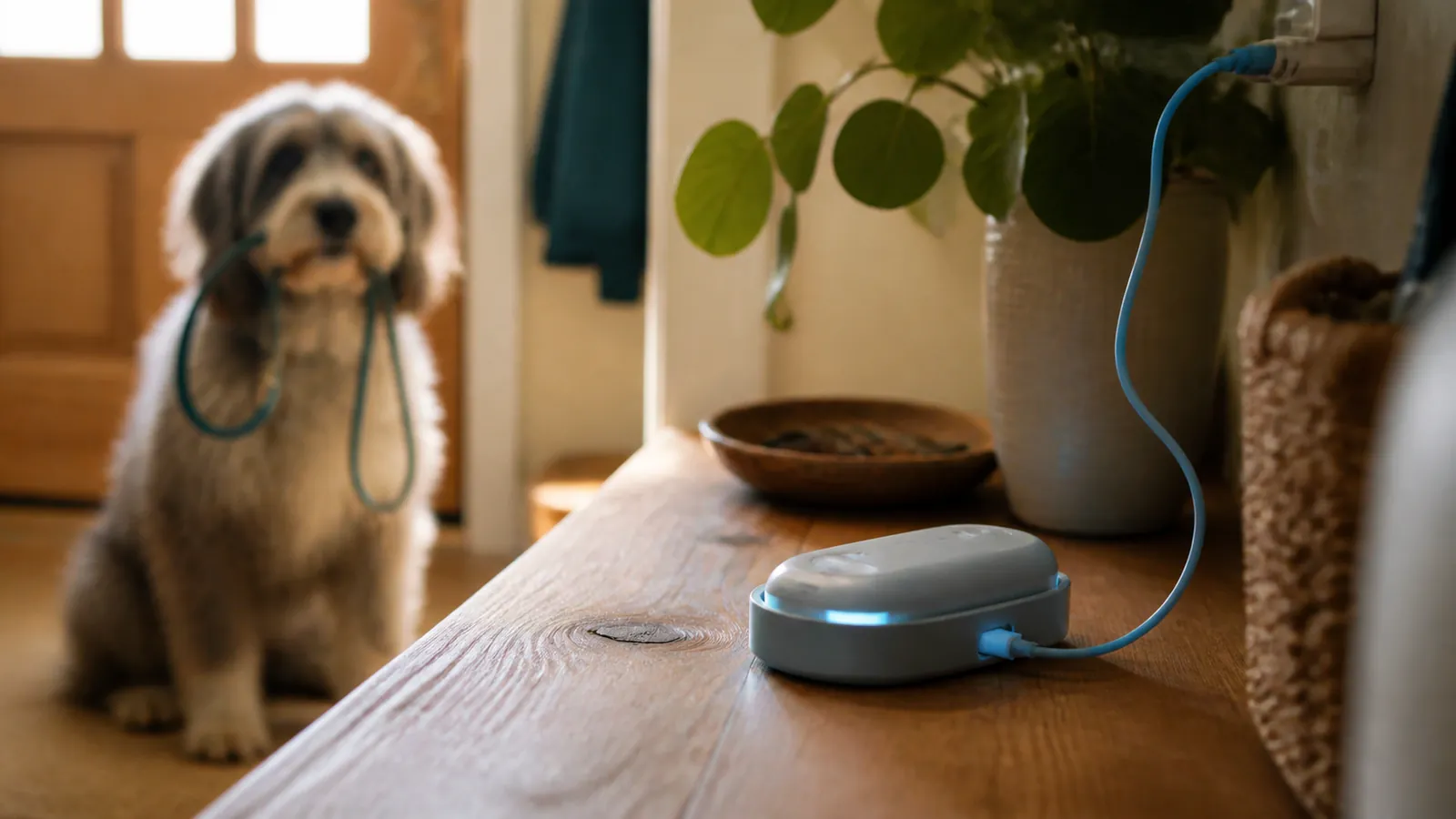
The number that matters is not the advertised maximum — it is whether you will actually charge on the cadence the device needs. Manufacturers state their battery figures under defined conditions, often with power-saving features active, while live tracking, weak signal, cold weather, and frequent alerts all draw more power. Where a manufacturer publishes both figures, as Tractive does, plan on the lower one. A two-week advertised claim you can sustain beats a three-month claim you forget.
Alerts and the workflow you will use at 6 a.m.
On any of these dog trackers, look at how you set a safe zone, how quickly you learn something is wrong, how you switch into live or lost mode, how often the map refreshes in that mode, whether the device has a sound or light to help you find it in the dark, and whether a second person in your household can see the map. These differ: the Tractive DOG 6 and DOG 6 XL and the Fi Series 3+ carry a light, while Fi lists none on the Fi Mini or the Fi Ultra, which instead has an owner-triggered buzzer. Nobody publishes a guaranteed alert speed, and you should not trust one that claims to.
True cost over 12 months, then renewal
This is the third step of the Coverage–Fit–Cost order, and it comes last on purpose: there is no point pricing a device that failed the first two. Add it up in the same order every time: device price, plus activation or setup fee, plus the plan charges actually due in the first 12 months, plus any required accessory, plus shipping and tax, minus a discount you have verified. Then write the renewal cost separately. If a plan requires two or five years paid up front, note both the full cash amount due and the annualized equivalent — never only the smaller monthly figure.
| Input | What to enter |
|---|---|
| Device and exact model | The full version name, not just the brand |
| Hardware price | The price you actually see, with the date and whether it is a sale |
| Activation or setup fee | Separate from the hardware |
| Plan term | Months or years, and whether it is prepaid |
| Cash due for the plan | The full amount charged, not the monthly equivalent |
| Required accessories | Only items you must buy for it to work — check the box contents, since Fi, for one, states its trackers ship without a USB power adapter, and the Fi Mini's longest battery figure assumes a Fi Base it does not include |
| Shipping and tax estimate | Depends on your location |
| Verified discount | With its expiry and eligibility |
| First-year cash outlay | The sum of the rows above |
| Later-year renewal | The current stated rate, which is not guaranteed |
For scale, using the figures checked for this page on August 7, 2026: a low first year is $187 with the Tractive DOG 6 on the Basic annual plan; a middle first year is $199 with the same device on Premium annual, or $209 for a Fi Mini on the one-year bundle plus activation; a high first year is $408 for a standalone Fi Ultra. Those are four observed configurations for specific plan choices, not a market range, and none of them includes tax or shipping. Fi Series 3+ cannot be placed on that scale until its checkout total is confirmed.
A tracker is one line in a much larger first year with a dog. Our first-year puppy budget covers the rest of it, so you can see where this purchase sits against food, veterinary care, and the setup costs that come first.
Returns, warranty, and the questions that come last
Record the return window, whether return shipping or a restocking fee applies, how a trial converts into a paid plan, and the warranty term. A water-resistance rating describes ingress under test conditions; it does not make a device chew-proof or impact-proof. App platform requirements, family sharing, location history, data export, and the provider's privacy terms are real considerations, but they are filters to apply after coverage, fit, and cost — not reasons to overrule them. The same goes for activity and wellness features: they may be worth having, and they are never a reason to delay a veterinary visit.
What about Halo, Garmin, AirTag, and waiting to buy?
Some well-known products solve a different problem, and comparing them on one list would mislead you. The table below carries the same recovery-critical fields the shortlist uses, so you can hold them against the four picks above rather than against each other's marketing.
| Field | Halo Collar 5 | Garmin Alpha T20 / TT25 | Apple AirTag | No tracker |
|---|---|---|---|---|
| What it actually is | A GPS containment system with a virtual fence, with tracking attached | VHF radio collars for hunting and working dogs, paired with a Garmin handheld | A Bluetooth item tracker, not a pet tracker | Identification, containment, and recall, with no device |
| Species and size scope | Dogs, over 5 months old and over 10 lb, with a stated neck size of 8–30.5 in on Halo's feature page and 8–30 in on its shop page | Dogs; sizing varies by collar model and handheld system | Not designed for pets, and no pet size scope published | Any dog, any age |
| Technology and coverage | GPS with cellular connectivity; fences are stored on the collar so they work without Wi-Fi or cellular, but changes and live updates need coverage | VHF radio from collar to handheld. No mobile network and no subscription, but no phone-app tracking either | Bluetooth plus the Find My network of nearby Apple devices. No cellular connection of its own | Not applicable |
| Price basis and recurring cost | $524 sale against a $599 regular price observed July 23, 2026; a further promotional price drop was showing on August 7, 2026, so take the current figure from Halo's shop page. Pack Membership required, from $9.99/month, selected after purchase | Device and handheld priced separately, and a full system price could not be assembled from Garmin's own current checkout pages. No subscription for the VHF collars | One-time device purchase, no subscription | $0 in devices; the cost is a tag, a registry update, a fence repair, or training |
| Advertised battery and condition | Up to 48 hours, with about a one-hour charge | Varies by collar and handheld; not stated on the comparison pages reviewed | Replaceable coin cell, about a year by Apple's description | Not applicable |
| Feedback or correction capability | Six feedback types, each settable to sound, vibration, or static correction at a chosen intensity. Halo states static is always optional and that removing the metallic contact tips disables it | T20 is tracking only. TT25 adds training functions including 18 levels of stimulation | None | None |
| What it does not do | It is not a guarantee of containment, and a virtual boundary is not a barrier. Membership lapses stop the fence | No app-based tracking without a compatible handheld, and no containment function | No reliable location in an empty field, and it is not real-time pet tracking | It cannot tell you where your dog went |
| Best used when | Containment on a property where physical fencing is impractical, and you will complete the training program | Hunting and working dogs in terrain where VHF beats cellular, and you already own or will buy the handheld | A cheap supplement alongside a real tracker in a dense neighborhood | Coverage fails, nothing fits your dog safely, or the budget is better spent on ID and containment |
| Evidence status | Verified with limitation from Halo's shop page and feedback-system page, August 7, 2026; the current promotional price is not stated as a figure on the page reviewed, and Halo's own neck-size limits differ between two of its own pages | Partial — capability confirmed from Garmin's collar comparison and the Alpha TT25 page, August 7, 2026; current system pricing not confirmed | Verified from Apple's AirTag page, August 7, 2026 | Paw Parent HQ editorial position, not a product claim |
Halo Collar 5 is a containment system first, and the short battery in that table is not a flaw but a consequence of a different job. Two things about it need saying plainly, because the product pages lead with tracking.
The first is the feedback system. Halo's own documentation describes six feedback types — Warning, Boundary, and Emergency on the prevention side, plus Whistle, Good Dog, and Go Home as encouragement — each of which can be set to sound, vibration, or static correction at an intensity you choose. Halo states that static is always optional, that many dogs respond to sound or vibration alone, and that removing the collar's metallic contact tips disables static entirely; it also argues that its static is a "tap on the shoulder" rather than a shock. That is the manufacturer's characterization of its own product, not a veterinary finding. The relevant veterinary position is different: the AVSAB Humane Dog Training Position Statement (2021) states that aversive methods — which by definition rely on force, pain, or emotional or physical discomfort, and which AVSAB names as including electronic collars — should not be used in dog training or behavior treatment, and that there is no evidence aversive training is necessary. AVSAB reaffirmed that 2021 statement in a 2025 board statement, noting that an outdated and since-rescinded document had been circulating.
The second is the training program, because buying Halo means adopting a method as well as a device. Halo states that the collar was designed in partnership with Cesar Millan, that he shaped the feedback system and the voice commands, and that the eight-lesson in-app training program is his, including his verbal recordings. AVSAB has published a response statement on that trainer's televised methods, written after an episode of Cesar 911 raised questions about humane training methods. We are not telling you what to conclude from that; we are telling you it exists, because a reader deciding between Halo and a tracker deserves to know that the built-in training is a named methodology with a documented veterinary response, not a neutral setup wizard.
So: if you buy Halo, know that the static capability is in the box and that you decide whether to enable it, that the training program is Cesar Millan's, and that a virtual boundary is not a guarantee of containment. If containment is the real problem, that is a conversation for your veterinarian or a credentialed trainer before it is a purchase, and a repaired fence plus recall work is the route with no welfare question attached. Local rules can also apply to electronic containment collars, and a homeowners' association or lease may restrict fencing and containment systems of any kind — that is a private rule rather than law, and our guide to renting with pets covers how those differ.
Garmin's Alpha ecosystem is a specialist VHF system built for hunting and working dogs, typically paired with a compatible handheld rather than a phone app. Garmin's own collar comparison documentation shows a very different set of capabilities and a different workflow. The two VHF collars are not the same tool: the T20 is tracking only, while the TT25 adds training functions including 18 levels of stimulation, which puts it in the same category as Halo's static for the purposes of the AVSAB position above. Garmin also sells a cellular collar, the Alpha LTE, which does pair with a phone app and needs an LTE service plan; Garmin's launch announcement stated a suggested retail price of $299.99 with service plans sold separately, which is an announcement figure from July 2024 rather than a current checkout price. Across the range, the full system cost depends on which handheld or plan you already have or need to buy, and we could not assemble it from Garmin's own current pages.
Apple AirTag is an item tracker. Apple describes it as using Bluetooth and the Find My network of nearby Apple devices to report a location — which means it depends on someone else's iPhone passing close enough, not on a cellular connection of its own. In a dense neighborhood it can be a useful supplement on a collar. In an empty field it may report nothing at all, and it should never be described as real-time pet tracking.
Buying nothing yet is a legitimate outcome. If coverage fails, if nothing fits your dog safely, or if the budget is tight, the higher-value moves are usually a readable ID tag, confirming that your microchip registration lists a phone number you still use, fixing the gate or fence gap your dog exploits, and working on recall. A tracker tells you where your dog went; it does not bring your dog back. If recall is the real gap, online dog training options are a better use of the same money. And if your dog escapes repeatedly, or panics, paces, or destroys doors and gates when left alone, that is a behavior problem rather than a training gap — it sits beyond what a tracker or a general trainer can solve, and the right referral is a veterinary behaviorist (a diplomate of the American College of Veterinary Behaviorists), which your veterinarian can arrange.
Considered but not included in the shortlist
| Option | Gate it did not pass | As of |
|---|---|---|
| Whistle (Go Explore, Fit, and related models) | Fails the availability gate. Tractive acquired Whistle and the product line was discontinued; Tractive's own transition page confirms the replacement offer for Whistle owners closed on September 30, 2025 and that there are no active offers for former Whistle customers. If you are searching "Whistle vs Fi vs Tractive," that comparison no longer has three sides | August 7, 2026 |
| Garmin Alpha with T20 / TT25 | Current official checkout price and full compatible-system cost could not be confirmed from first-party sources, so it cannot be priced against the ranked picks | August 7, 2026 |
| Garmin Alpha LTE | Same pricing gate: the only Garmin-published figure we could find is a July 2024 announcement price, and the current LTE service-plan cost is not stated on the Garmin pages reviewed | August 7, 2026 |
| Apple AirTag | Fails the technology gate for this shortlist: Bluetooth and crowd-network location rather than cellular GPS tracking | August 7, 2026 |
| Halo Collar 5 | Serves a containment use case rather than everyday tracking; kept as a specialist alternative rather than a ranked pick | August 7, 2026 |
| Discontinued or unsupported tracker models generally | Current sale, support, app compatibility, and service terms could not be confirmed for the exact model | August 7, 2026 |
| Cat-only and multi-species devices | Outside this page's scope, which covers dogs and dog-specific fit documentation. Cat trackers differ on weight limits, breakaway-collar safety, and indoor-outdoor use, and need their own page rather than a row here. If you are shopping for a cat today, start with the manufacturers' cat-specific documentation — Fi's Fi Mini for Cats guidance and Tractive's cat trackers, which publish their own weight ranges — rather than applying this page's dog thresholds | August 7, 2026 |
Each exclusion is a documentation or scope decision, not a judgment about product quality.
How do you set up a tracker before you rely on it?
Do all of this inside the return window, while you can still change your mind.
- Fix identification first. Put a readable tag with a current phone number on the collar, and log into your microchip registry to confirm the contact details are yours and current. If you do not know which registry holds your dog's chip, AAHA's microchip registry lookup will tell you from the chip number — it identifies the registry, but it does not display owner contact details and it is not where you update them, so you still have to contact the registry itself. AAHA also notes that the registry Save This Life has ceased operations and been disconnected from the lookup; if your chip number starts with 991 or 900164, you may need to re-register it with another company, which does not mean replacing the chip. Checked August 7, 2026. If you are still assembling the basics, the new puppy checklist covers what else belongs in the first weeks.
- Measure, then attach exactly as instructed. Fit the collar and device the way the manufacturer specifies, check that a clip-on or strap cannot be worked loose, and look at the skin underneath during the first days of wear.
- Activate the plan and set up notifications. Turn on alerts, add the other people in your household so more than one phone can see the map, and set safe zones around places your dog actually is, not just around the house.
- Test the tracker where you live, not where it was reviewed. Walk your normal route with the tracker on and your phone in hand. Watch how quickly a safe-zone alert arrives, how often the map refreshes in live mode, and whether there is a dead spot on your street or in the yard. This is the test that tells you whether to keep the device.
- Build the charging habit now. Pick a fixed day or a fixed cue, and treat a low-battery notification as a task rather than a nag. Do not head out on a long walk or a hike with a tracker that has not been charged.
- Write down what you would do if your dog went missing, and keep it somewhere you can find it in a panic. Work it in this order, whether or not the tracker is reporting anything: first, call the shelters and emergency veterinary clinics within your likely radius, because that is where a found dog is taken; second, confirm your microchip registry has your current phone number and report the dog missing to it; third, post to the local lost-pet groups and neighborhood channels you identified in advance; and only then, fourth, work the tracker map. A device that is off, out of coverage, or lying in a hedge tells you nothing, and none of the first three steps should wait for it.
How do you pick a tracker without guessing?
The picks at the top of this page name products. This table names situations, because the situation is what decides which of those picks applies to you — and the last row is a legitimate answer that involves buying nothing. One situation is deliberately absent: if what you want is a boundary rather than a location, no row here fits, and the Halo note above is where to start, because an electronic containment collar can deliver static correction and sits outside current veterinary behavior consensus.
| Your situation | Shortlist move | Confirm before you buy |
|---|---|---|
| First dog, reliable coverage, ordinary escape risk | One everyday cellular tracker on the shortest plan term you can get | Which plan term you are actually agreeing to; what happens at renewal; whether the return window covers return shipping |
| Small or growing dog | Filter by device weight and published fit rules before anything else; the Fi Mini at 16 g is the lightest option here, and the Tractive DOG 6 is the lightest with a published minimum dog weight | The exact model's fit rules — minimum dog weight where one is published, and the collar-width range where it is not; the device weight in grams; how often to re-measure a puppy |
| Household with young children | Any pick that fits, plus a rule about handling: the device is one more thing on the dog that a child can pull, and collars can catch during play | Whether the device can be removed quickly; that children are supervised around the dog and taught not to grab the collar; that no product claim is treated as a safety guarantee for any breed |
| Owner away from home most of the day | Prioritize charging cadence and shared access over features — a tracker that is flat at 5 p.m. is not a tracker | Which household members can see the map; the realistic battery figure rather than the advertised maximum; where the charger will live so the habit sticks |
| Two or more dogs | Price the plan per dog before you compare hardware, because the plan cost multiplies and the device cost usually does not dominate | Per-device plan cost; whether family sharing sits on a higher plan tier; whether a second device carries its own activation fee |
| Senior dog, or a dog with a neck, tracheal, or airway condition | Ask your veterinarian before adding any collar-mounted device; a harness-mounted option or no device may be the right answer | Whether your veterinarian considers any wearable device appropriate for this dog; the device weight in grams; whether it is one of the models the manufacturer states can mount on a harness rather than a neck collar |
| Frequent weak-signal use | Only a device with a documented fallback layer, tested on your actual routes | What the fallback covers and where, including any state or regional exclusions; the advertised battery under that mode; the return window for testing it |
| Regular travel outside the U.S. | Only a tracker whose manufacturer publishes supported coverage for every country you actually visit, on the plan tier that carries it | Coverage country by country rather than a "worldwide" claim; which plan tier that coverage sits on; whether your model's network changes at the border |
| Tight budget, or coverage fails at home | Buy nothing yet; spend on ID, microchip registration, and containment | Whether your microchip registry contact details are current; what containment repair would cost; whether recall training addresses the real problem |
Use one scorecard for every option, including any product not listed here: the Coverage–Fit–Cost order plus the setup and testing sequence above is the test. If a product cannot get through coverage, fit, a documented first-year cost, and a real-world route test inside its return window, it does not belong on your list — regardless of how it is ranked anywhere else.
Questions dog guardians ask about GPS collars
Do GPS dog collars work without cell service?
Most everyday dog trackers need a supported cellular network to send a position to your phone, so they do not work in a true dead zone. Fi Ultra adds a satellite fallback layer in the U.S. outside Alaska, and VHF systems like Garmin's use radio to a handheld instead. A collar "without a subscription" is usually one of those different technologies, or a Bluetooth item tracker — not free cellular service.
Is an AirTag a good substitute for a GPS dog collar?
Not as a replacement. An AirTag reports its location by way of nearby Apple devices on the Find My network rather than a cellular connection of its own, so it depends on how many iPhones pass by. That can help in a busy neighborhood and fail completely on a trail. As a low-cost supplement alongside a real tracker, it is reasonable.
How much does a GPS dog collar cost per year?
It depends on the device, the plan term, and where you live. Using prices checked on August 7, 2026, a first year runs $187 to $199 with the Tractive DOG 6 on an annual plan, $209 for a Fi Mini on the one-year bundle plus its activation fee, and $408 for a standalone Fi Ultra as Fi states that total. Fi Series 3+ sells as a purchase that includes a membership, and the pages reviewed did not state the checkout total separately, so take that figure from checkout rather than from us. All of these are observed figures for specific plan choices — not market averages or guaranteed prices — and they move with term, promotions, tax, and shipping.
How long does the battery really last?
Less than the maximum, and it depends on how you use it. Advertised figures are stated under manufacturer-defined conditions — Tractive publishes up to 14 days on the DOG 6 with Power Saving Zones and up to 6 days without, for example — while live tracking, weak signal, cold weather, and frequent alerts all draw more power. Plan around the routine you will keep, not the number on the box, and treat an escape as the moment the battery will drain fastest.
Can a GPS collar replace a microchip?
No. They work at different moments. A tracker helps you search while your dog is missing, as long as it stays attached, charged, and connected. A registered microchip works after someone else has your dog: a shelter or clinic scans it, looks up your registry entry, and calls you. A tag is what a neighbor reads in the first five minutes. Keep all three current.
How long before I can rely on a tracker after I buy it?
Your timeline is set by the slowest dependency. Delivery and setup are quick, but plan activation, a coverage test on your real routes, a live-mode test, a first charge cycle, and your dog getting used to the device all take longer. The manufacturers' windows set the outer limit for testing — 30 days for Tractive, and a 30-day satisfaction guarantee that Fi states applies to the Mini, the Series 3+, and the Ultra, with Fi's six-month membership minimum running alongside it. Treat the device as unproven until you have watched it work where you live.
What happens if I forget to cancel before it renews?
With Fi, you have a stated grace period: Fi says a cancellation requested within 30 days of an auto-renewal charge earns a full refund of that renewal, and that after 30 days renewal charges are not refundable or prorated. Tractive plans are prepaid for the term you choose and can be cancelled, and its 30-day money-back guarantee applies at purchase rather than at renewal. Either way, the safest move is to note the renewal date the day you activate.
Can activity or health alerts tell me whether my dog is sick?
No. Activity, sleep, and behavior features describe patterns in movement data; they do not diagnose anything, and a normal-looking graph is never evidence that a problem can wait. Tractive says as much on its own product page, stating that medical advice and diagnosis should always be sought from a veterinarian. If something about your dog concerns you, that is a conversation with your veterinarian, who can examine your dog. If you think you are looking at an emergency, go to an emergency veterinary clinic rather than opening the app first.
What should you do next?

Work the Coverage–Fit–Cost order, then read the trial, return, auto-renewal, and warranty terms before you open a checkout page — the lowest advertised monthly figure usually depends on a long prepaid term. Then either buy the best-fit option and test it thoroughly inside the return window, or decide that this is not the year for a tracker and put the money into identification, containment, and recall instead. Both are good answers.
Sources and last verified date
Last verified: August 7, 2026
- Pet microchipping FAQs — American Animal Hospital Association — Microchip purpose, registration, and the role of layered identification alongside visible ID.
- Microchip registry lookup — American Animal Hospital Association — What the lookup tool does and does not do, and the Save This Life registry closure affecting chips beginning 991 or 900164.
- AVSAB Humane Dog Training Position Statement, 2021 — American Veterinary Society of Animal Behavior — Veterinary behavior position that aversive methods, including electronic collars, should not be used in dog training.
- Position statements, including the 2025 board statement — American Veterinary Society of Animal Behavior — AVSAB's reaffirmation of the 2021 statement and its warning about a rescinded document in circulation.
- AVSAB response statement to Cesar 911 — American Veterinary Society of Animal Behavior — The published veterinary-behavior response to the televised training methods behind Halo's in-app program.
- Tracheal collapse in dogs — VCA Animal Hospitals — Collar pressure on the trachea as an aggravating factor, and the harness recommendation for affected dogs.
- Model rabies control document — American Veterinary Medical Association — Evidence that rabies vaccination, licensing, and tag requirements are set by individual states and localities rather than federally.
- GPS Tracker for Dogs: DOG 6 and DOG 6 XL — Tractive — U.S. device price, model sizing and weights, advertised battery with and without Power Saving Zones, IP68 rating, connectivity and supported countries, 30-day guarantee, and Tractive's statement that it does not diagnose health conditions.
- Subscription plans — Tractive — Basic and Premium plan pricing, terms, and the features that sit on each tier including location-history length.
- Cat GPS trackers — Tractive — Cat-specific models and weight ranges, cited only to route cat owners off this dog-scoped page.
- Transitioning from Whistle to Tractive — Tractive — Confirmation that the Whistle transition offer closed on September 30, 2025 and that no active offers remain.
- Fi Membership Billing — Fi — Membership requirement, U.S. plan pricing for Series 3+ and Fi Mini, $20 activation fee, six-month minimum across all plans, auto-renewal, the 30-day post-renewal refund window, the free-trial option, and the 30-day satisfaction guarantee covering Series 3+, Fi Mini, and Fi Ultra.
- Fi Mini Overview — Fi — Fi Mini weight, dimensions, IP68 rating, collar and harness width ranges, charging and Fi Base compatibility, and the statement that its price includes the device and membership.
- Fi Mini for Cats — Fi — Cat-specific Fi guidance, cited only to route cat owners off this dog-scoped page.
- Fi membership management — Fi — Where Fi members change or cancel a plan.
- Choose the Best Fi Product For You — Fi — Side-by-side weights, networks, water-resistance ratings, and advertised battery for Fi Mini, Series 3+, and Fi Ultra, and Fi's recommended use case for each.
- Fi Ultra Overview — Fi — Fi Ultra's $408 standalone total and $299 add-on price, weight and dimensions, salt-water-tested IP68 rating, battery and Power Saving Mode, mounting and maximum collar thickness, dog-only restriction, U.S.-only scope with the Alaska satellite exclusion, and Fi's off-leash-not-off-grid caution.
- Fi Tracker Coverage — Fi — Stated tracking geography across the United States, Canada, and Mexico.
- Fi Tracker Cellular Coverage — Fi — Network dependency and checking coverage before purchase.
- What's Included With Your Fi Purchase — Fi — Series 3+ box contents, the excluded USB power adapter, the one-year product warranty, and the statement that a purchase includes a Fi Membership.
- Halo Collar 5 shop — Halo — Observed sale and regular price, plan starting price, advertised battery, 90-day satisfaction guarantee, one-year warranty, and stated neck-size and weight limits for the containment category.
- Feedback system — Halo — Six feedback types, the sound/vibration/optional-static modalities and contact tips, the Pack Membership requirement, and the published dog age, weight, and neck-size limits.
- Cesar Millan training program — Halo — Halo's own statement of the partnership and of the eight-lesson in-app training program and voice commands.
- Alpha dog collar comparison — Garmin — T20 and TT25 capability and compatibility context for VHF hunting and working-dog systems.
- Alpha TT25 dog collar — Garmin — Confirmation that the TT25 is a tracking and training collar with 18 levels of stimulation, unlike the tracking-only T20.
- Garmin unveils Alpha LTE — Garmin — Garmin's July 2024 announcement of the cellular Alpha LTE, its suggested retail price, and that service plans are sold separately.
- AirTag — Apple — Bluetooth and Find My crowd-network location behavior that distinguishes an item tracker from a cellular GPS dog tracker.
- Fi Ultra hands-on — The Verge — Labeled independent launch-stage context on charging burden, satellite update cadence, and reconnection behavior.
Next review: September 6, 2026
Fi Smart Collar
GPS escape alerts, activity and sleep tracking, and a multi-week battery — the best-in-class dog collar tracker.
Get FiTractive GPS
Live GPS tracking for dogs AND cats at a budget-friendly hardware price — the value pick, and the cat pick.
See Tractive