
Fresh Dog Food vs. Kibble: Which Fits Your Dog?
Neither commercial fresh cooked dog food nor dry kibble is automatically better for every dog. The format on the front of the package is not the decision. The decision is the exact product: whether its nutritional adequacy statement says it is complete and balanced for a dog at your dog's life stage, how many calories it delivers, what it costs every month once any introductory offer ends, and whether your household can store it, handle it, portion it, and keep buying it without a gap.
In this article, "fresh" means a commercially prepared, cooked dog food sold refrigerated or frozen. It does not mean raw food, and it does not mean a recipe you cook at home. Those are separate decisions with separate safety and formulation requirements, and they are handled by a veterinarian or a veterinary nutrition specialist rather than by a format comparison. Everything here is dog-specific. Cats have different nutritional requirements, and nothing on this page transfers to them.
Stop the generic comparison and talk to your veterinarian first if your dog is a puppy, pregnant or nursing, underweight or overweight, has persistent vomiting or diarrhea, has a suspected food reaction or a chronic condition, or is eating a diet your veterinarian prescribed. Those dogs need an individual feeding plan, not a format verdict.
Your first action takes about five minutes. Photograph the label of the food your dog eats now: the nutritional adequacy statement, the calorie content, and the feeding directions. Write down how much your dog actually eats per day and what you actually pay per bag or per delivery. Then collect the same fields for the food you are considering. If you cannot find those fields for a candidate food, you have your answer for now — you are not ready to switch.

Start here: which path fits your dog
- If your food budget is fixed, your freezer and refrigerator space is limited, or you travel, board, or evacuate with your dog often — start with kibble. Shelf stability, portability, and a predictable monthly spend all count as real advantages.
- If you can name the exact formula, confirm its life-stage adequacy statement, absorb the delivered recurring price every month, and keep the freezer, thawing, and delivery routine running week after week — start with a commercial fresh cooked food.
- If you can say how many of your dog's daily calories come from each food, and both foods are complete and balanced for his life stage — a deliberate mixed plan can work. Without a written calorie split, it is not a plan.
- If a candidate food's adequacy statement, life stage, or calorie content is not published — do not buy it yet. An unverifiable label is a reason to wait, not a reason to guess.
- If your dog is a puppy, pregnant or nursing, under- or overweight, has ongoing symptoms, or eats a prescribed diet — call your veterinarian before changing anything. This one overrides the four above.
If you think your dog has eaten something harmful, this is not a food-choice question. Contact your veterinarian, an emergency veterinary hospital, or an animal poison control service immediately — the ASPCA Animal Poison Control Center at (888) 426-4435, or the Pet Poison Helpline at (855) 764-7661. Both operate around the clock and both charge a consultation fee.
On this page
- Start here: which path fits your dog
- How do commercial fresh cooked food, kibble, and a mixed plan compare?
- What do fresh, human grade, and natural actually mean on a dog food label?
- How do I check that a food is complete and balanced for my dog?
- Why two dog food labels can look completely different right now
- What will each food actually cost me per day?
- Can my household store, handle, and keep buying this food?
- How should I switch foods, and when should I stop?
- Can I mix fresh food and kibble?
- How did we compare these foods, and what could we not verify?
- How do I pick a food I can actually keep buying?
- What else do dog guardians ask?
- Sources and last verified date
How do commercial fresh cooked food, kibble, and a mixed plan compare?
Every field below applies to all three paths, so you can compare them on the same terms instead of comparing a fully documented fresh plan against an unnamed bargain bag. Later sections interpret these differences rather than repeat them. All three columns describe feeding a dog; fields checked August 6, 2026.
| Field | Commercial fresh cooked | Dry kibble | Deliberate mixed plan |
|---|---|---|---|
| Species and life stage | Dogs only; the life stage comes from the adequacy statement, not the marketing | Dogs only; same rule | Dogs only; both foods must match the same life stage |
| What it is | A named cooked formula sold refrigerated or frozen, usually on a recurring delivery | A named dry formula sold in bags, usually bought at retail or on autoship | A planned calorie split between two named foods, each with its own label |
| Primary evidence you need | The exact formula's label or manufacturer documentation, plus current plan terms | The exact formula's label, plus the current package price | Both labels, plus a written split of daily calories |
| Adequacy gate | Complete and balanced for your dog's life stage, or directed by your veterinarian | Complete and balanced for your dog's life stage, or directed by your veterinarian | Each food's role and the total diet stay explicit; a topper does not fix an inadequate base |
| Calorie basis | Kilocalories per pack, per portion, or per shipment, with a documented daily portion | Kilocalories per kilogram, usually with a per-cup figure, and a measured daily amount | Daily kilocalories from each food, plus treats, chews, and training rewards |
| Recurring cost basis | Delivered recurring price after any introductory offer, plus shipping and tax, for a full or partial plan | Recurring or buy-once package price, plus any waste | Both recurring costs combined, counted once each |
| Storage | Freezer and refrigerator capacity, plus the manufacturer's opened-pack rules | Cool, dry pantry space, with the food kept in its original bag | Both sets of rules, running at the same time |
| Supply and travel | Delivery timing, skipped or delayed shipments, thawing lead time, boarding acceptance | Retail availability, bag life, easy portability, simple backup | A written routine and a backup for each food |
| Daily labor | Thaw, portion, weigh, serve, wash bowls and utensils | Measure or weigh, scoop, seal, wash bowls and utensils | More measurement, and active effort to prevent portion creep |
| Switching load | Gradual transition, enough current food on hand, watch how your dog does | Gradual transition, enough current food on hand, watch how your dog does | Two transitions, or one transition plus a stable calorie split |
| Watch for | Portion creep when thawed packs are served by eye instead of weighed | Portion creep when scooping quietly replaces measuring | Portion creep from an unmeasured topper on an already full bowl |
| Revisit the decision when | The recurring price rises, deliveries slip repeatedly, or the recipe list changes | The formula or label changes, or the same bag stops being stocked near you | Either food changes, or the calorie split stops being written down |
| Not ideal when | Adequacy or calories are not published, the recurring price is not sustainable, cold storage is short, or deliveries are unreliable | Adequacy or calories are not published, your dog does not eat it reliably, or portioning and storage are not being managed | The calorie split is guesswork, either food is unverified, or the routine cannot be sustained |
The table is a Paw Parent HQ decision framework. The label, safety, and storage requirements inside it come from the regulatory and veterinary sources cited throughout this page and listed at the end.
What do fresh, human grade, and natural actually mean on a dog food label?
Most of the words that make one bag feel better than another are descriptive or promotional rather than evidence of a health outcome. The WSAVA Global Nutrition Committee's guidance on selecting pet foods, updated March 10, 2021, puts it plainly: labels carry marketing images and phrases designed to promote sales rather than convey nutritional information, and unregulated terms such as "holistic" or "premium" are of little practical value when you are actually assessing a food. Sorting them out early keeps the rest of the decision honest.
Commercial fresh cooked food is a specific manufacturer's cooked product, sold chilled or frozen, with its own formula, label, calorie declaration, storage instructions, and subscription terms. There is no single "fresh food" standard, so nothing about one brand's product transfers to another.
Kibble is dry commercial dog food. It is also product-specific. Two dry foods can differ more from each other than either differs from a fresh product, so "kibble" tells you almost nothing on its own.
Raw food is a separate category and a separate safety decision. The FDA's position is that raw pet food poses significant health risks to pets and people, because raw food is more likely than processed pet food to carry bacteria such as Salmonella and Listeria monocytogenes; the agency's raw diet guidance sets out the handling precautions for owners who feed raw anyway. Cooked commercial fresh food is not raw food, and "fresh" does not require raw feeding.
Human grade is a marketing term with specific requirements behind it. AAFCO's consumer guidance describes it that way and points to its Official Publication and human-grade guidance documents for the actual criteria. Those criteria describe how a food is made and handled. They are not evidence that the food produces a better outcome in your dog.
Natural is a label term, not a safety ranking. AAFCO says plainly that natural and similar terms are not expressions of safety and fit a fairly loose definition, and it publishes separate guidance on natural claims. Premium carries even less weight: AAFCO describes it as an entirely unregulated term in feed law, with no requirements that differ from any other pet food.
Ingredient lists are ordered by weight, from most to least, and the actual amount of each ingredient is not stated, as AAFCO's label guidance explains. The WSAVA guidance above makes the practical point: an ingredient list tells you nothing about ingredient quality and can be misleading about the food overall. Recognizing the ingredients is not the same as verifying the food, which is why AAFCO's ingredient guidance is worth reading before you use an ingredient panel as a scorecard.
Who says so? Where each kind of dog food claim comes from
| Category | Who establishes it | What it changes for you and your dog |
|---|---|---|
| Regulation and label rules | FDA and state feed control officials, using AAFCO model regulations that most states adopt | Sets what must appear on the label and what a claim like "complete and balanced" legally requires |
| Veterinary guidance | Professional bodies such as AAHA, AVMA, and WSAVA, and your own veterinarian | Sets how nutrition decisions should be made for an individual dog, including when to escalate |
| Manufacturer documentation | The company that makes the exact formula | Establishes that product's ingredients, calories, adequacy statement, storage rules, and subscription terms — and nothing about any other product |
| Retail observation | The store or site where you buy it | A price at one moment; not a market average and not a guarantee |
| Paw Parent HQ editorial aid | Us | Frameworks, worksheets, and checklists to organize your decision; never a diagnosis, a prescription, or a promise |
When a field is missing, say so rather than approximating it. This page uses four words for that: verified, verified with a limitation, partial, and blocked. A blocked field cannot support a recommendation.
What about grain-free diets and heart disease?
This question comes up in almost every food conversation, so here is where the evidence actually stands. In July 2018 the FDA began investigating reports of canine dilated cardiomyopathy — DCM, a disease of the heart muscle — in dogs eating diets containing a high proportion of peas, lentils, other legume seeds, or potatoes among the main ingredients, many of them labeled grain-free. Many of the reported cases were in breeds with no known genetic predisposition to the disease.
The agency's position, as stated on that page, which is current as of December 23, 2022, is that the potential association between diet and DCM is a complex scientific issue that may involve multiple factors. FDA also said it does not intend to publish further updates until there is meaningful new scientific information, and noted that adverse event reports on their own do not establish that a product caused a disease. Most dogs in the United States eat commercial pet food without apparently developing DCM. AAHA's 2021 Nutrition and Weight Management Guidelines discuss diet-associated DCM as a topic of current interest, and the veterinary literature remains genuinely divided.
The position this page takes: grain-free is a marketing category, not a food format. Fresh cooked and dry foods both exist with and without grains, so this is not a fresh-versus-kibble question and we make no claim in either direction. What it is, is a reason to know your dog's exact formula and to raise it with someone who knows your dog. If your dog eats a legume-heavy or grain-free diet, bring the label to your next veterinary visit. FDA advises owners to work with their veterinarian, who may consult a board-certified veterinary nutritionist, before making diet changes — and to contact a veterinarian promptly if a dog shows possible signs of heart disease such as decreased energy, coughing, difficulty breathing, or episodes of collapse, seeking emergency care if those signs are severe.
How do I check that a food is complete and balanced for my dog?
This is the gate that comes before price, convenience, or preference. Skip it and the rest of the comparison measures the wrong thing.
What the nutritional adequacy statement has to say
The nutritional adequacy statement is the sentence that carries the answer. As the FDA explains in its guidance on "complete and balanced" pet food, a food carrying that phrase in its adequacy statement is intended to be fed as the animal's sole diet, and it must either meet an AAFCO nutrient profile or pass a feeding trial run under AAFCO procedures. Treats, snacks, and supplements usually are not complete and balanced. A food marketed as treating or preventing a disease sits on the other side of the boundary the FDA describes in its overview of how pet food is regulated; diets used to manage a diagnosed condition belong under veterinary direction, not in a format comparison.
The statement is required to follow a standard format, which is what makes label-to-label comparison possible at all. AAFCO's label guidance calls it perhaps the most important part of a label and publishes the versions you will actually encounter. Expect small print on the back or a side panel.
| What the statement says on the package | What that establishes |
|---|---|
| "[Product] is formulated to meet the nutritional levels established by the AAFCO Dog Food Nutrient Profiles for [life stage]." | The recipe was formulated to meet a published nutrient profile for that life stage |
| "Animal feeding tests using AAFCO procedures substantiate that [product] provides complete and balanced nutrition for [life stage]." | The food was fed to dogs under a standardized AAFCO protocol and assessed |
| "[Product] provides complete and balanced nutrition for [life stage] and is comparable to a product which has been substantiated using AAFCO feeding tests." | A "family product" — similar, but not identical, to one that went through feeding tests. AAFCO notes this version is not used often |
| "This product is intended for intermittent or supplementary feeding only." | Not a sole diet. Fine as a small share of the day, or under veterinary direction for a therapeutic diet |
To show what that looks like in practice: the adult dry food used as the cost example later on this page carries the second version. Its statement says animal feeding tests using AAFCO procedures substantiate complete and balanced nutrition for maintenance of adult dogs — the feeding-trial route, for adult maintenance only, which is also why it would not be an appropriate sole diet for a puppy.
One habit matters more than it sounds: there is no such thing as an AAFCO-approved food. AAFCO states directly that it does not approve, certify, or endorse pet foods and keeps no list of products that meet its standards. The FDA adds that endorsements and seals from other organizations are not assurances of nutritional adequacy either. The statement on the package is the evidence. A seal is not.
Why life stage is half the answer
Life stage is the second half of that adequacy sentence, and it is where a food that is perfectly good for one dog becomes wrong for another. AAFCO recognizes gestation and lactation, growth, maintenance, and all life stages as the label categories, and maintains two dog nutrient profiles behind them — most recently updated in 2016, per the FDA — one for growth and reproduction, which covers puppies and pregnant or nursing dogs, and one for adult maintenance. The FDA notes that adult foods contain lower levels of some nutrients precisely because adult dogs do not need growth-level amounts.
A food labeled for all life stages is formulated for reproduction and growth, as the WSAVA guidance states, which is why it can be fed to a puppy. An adult maintenance food is not, so it is not an appropriate sole diet for a growing dog. This single line resolves a large share of the confusion in dog food aisles.
There is no senior life stage. AAFCO's model regulations for pet food name the recognized categories of nutritional adequacy as gestation and lactation, growth, maintenance, and all life stages. Senior is not among them. A food marketed for seniors still has to name one of those categories in its adequacy statement, and in practice that is usually adult maintenance or all life stages. So "senior" on the front of a bag is a marketing segment, not a nutrient standard, and two senior foods can differ from each other in calories and formulation as much as any two adult foods. Read the adequacy statement and the calorie figure instead, and take questions about an older dog's changing needs — weight, muscle, appetite, mobility, kidney or dental issues — to your veterinarian, who can set the plan from an examination.
One extra phrase matters for a big puppy. When a dog food's adequacy statement names growth or all life stages, AAFCO's model regulations require one of two phrases to be added verbatim: including growth of large size dogs (70 lb. or more as an adult), or except for growth of large size dogs (70 lb. or more as an adult). That qualifier exists because the nutrient levels appropriate for a large-breed puppy are not the same as those for a small one. If you are raising a puppy who may mature at or above that weight, the phrase is the thing to look for, and the growth plan itself belongs with your veterinarian rather than with a package.
Finding the calorie number
Calories are the field most often skipped, and the one you need for every later step. AAFCO's model regulations require a calorie statement on all pet foods, placed under a heading titled "Calorie Content" and expressed in kilocalories per kilogram as fed, together with a familiar unit such as per cup, can, or pack. Without that number you cannot compare two foods honestly, portion accurately, or calculate what either one costs to feed.
One comparison trap is worth naming. Guaranteed analysis percentages on the label are stated on an as-fed basis, which includes moisture, while AAFCO's nutrient profiles are stated on a dry matter basis. The FDA's complete-and-balanced guidance shows why that matters: comparing a high-moisture food with a dry food using the as-fed percentages can reverse the answer entirely, and a conversion is required first.
Here is that reversal in two real labels, both adult-maintenance dog foods from the same manufacturer, checked August 6, 2026. The dry Shredded Blend formula guarantees crude protein at a minimum of 26.0 percent with moisture at a maximum of 12.0 percent. The canned Chicken & Rice Entrée Classic guarantees crude protein at a minimum of 9.0 percent with moisture at a maximum of 78.0 percent. On the front of the package the dry food looks like it carries nearly three times the protein.
The conversion is one line: divide the as-fed percentage by the dry matter, which is 100 minus the moisture percentage, then multiply by 100.
| Food | Protein as fed | Moisture | Dry matter | Protein on a dry matter basis |
|---|---|---|---|---|
| Dry Shredded Blend, adult maintenance | 26.0% min | 12.0% max | 88% | 26.0 ÷ 88 × 100 = 29.5% |
| Canned Chicken & Rice Entrée, adult maintenance | 9.0% min | 78.0% max | 22% | 9.0 ÷ 22 × 100 = 40.9% |
The order flips. Nearly all of that 26-versus-9 gap was water. The same principle is why the two foods declare 3,790 and 1,186 kilocalories per kilogram — a wet food is mostly moisture by weight, so any per-kilogram figure has to be read with the moisture in view. Note also that these two labels reach adequacy by different routes: the dry formula's statement is substantiated by AAFCO feeding tests, and the canned formula's is formulated to meet the AAFCO profile.
The conversion is a real technique, not a shortcut for choosing nutrients for your dog. It tells you what is in a food; it does not tell you what your dog needs. Leave nutrient targets to your veterinarian.
Finally, ask the manufacturer the questions the WSAVA Global Nutrition Committee recommends in the selecting-pet-foods guidance: whether the company employs a nutritionist and with what qualifications — WSAVA names a PhD in animal nutrition or board certification by the American College of Veterinary Nutrition or the European College of Veterinary Comparative Nutrition — who formulates the diet, what quality control runs on ingredients and finished product, whether the company publishes research or a full nutrient analysis, and whether you can reach a person with a question. WSAVA's own advice is to be cautious about a brand that cannot or will not answer.
The Label Audit: capture these fields before you compare anything else
| What to capture | Where it comes from | Mark it as |
|---|---|---|
| Brand, exact product line and formula, species | Label or manufacturer product page | Verified or blocked |
| Nutritional adequacy statement, word for word | Label | Verified, verified with a limitation, or blocked |
| Life stage named in that statement | Label | Verified, mismatched, or blocked |
| Which of the four statement versions above it uses | Label | Verified or verified with a limitation |
| Sole diet, or intermittent and supplemental feeding | Label | Verified or blocked |
| Calorie content in kcal/kg, and per cup, pack, or portion | Label or manufacturer documentation | Verified, partial, or blocked |
| Feeding directions and the unit they use | Label | Captured as a starting point, not a prescription |
| Package or portion size, lot and best-by information, manufacturer contact | Package | Verified or partial |
| Storage, opened-food rules, shipping and subscription terms | Label and manufacturer documentation | Verified or verified with a limitation |
| Date you checked all of the above | You | Required on every row |
Label feeding directions are a starting point stated by body weight, not an individual prescription — AAFCO itself calls them guidelines that may need modification for a particular pet. AAHA's guidance on feeding plans for healthy, appropriate-weight dogs, from its 2021 Nutrition and Weight Management Guidelines, builds the plan from a nutritional assessment, including body and muscle condition scoring, at veterinary visits — which is where a puppy, a pregnant or nursing dog, a dog whose weight is trending in the wrong direction, a dog with a chronic condition, or a dog with a suspected food reaction should have the calorie plan set.
Why two dog food labels can look completely different right now
If you have picked up two bags lately and found the information in different places, you are not imagining it. Pet food labels are in the middle of the largest redesign in decades, and during the changeover both formats are legal and both are on shelves.
AAFCO began its Pet Food Label Modernization project in 2015 to bring pet food labeling closer to the format people already know from human food. Four things change: a Nutrition Facts Box that more closely resembles human-food labeling and includes the nutritional adequacy statement; an Intended Use Statement so the intended purpose and life stage are visible before you turn the package over; clearer ingredient naming, including how vitamins are written; and standardized handling and storage instructions with optional icons. AAFCO publishes one-page factsheets on each of the four.
The Intended Use Statement is the change you will notice first. AAFCO's model regulations place it within the bottom 30 percent of the principal display panel — the front of the package — and set the wording, so a product has to say plainly what it is: a complete dog food, a complete food for a named group such as adult dogs or puppies, a dog treat, a dog food mixer, a dog food supplement, or a veterinary diet. That is the distinction between a sole diet and a topper, moved from the fine print on the back to the front of the bag.
Rollout is not a single date. Each state runs its own rulemaking process, and AAFCO recommends a six-year transition period for manufacturers to work the changes through their packaging, noting that owners will see some changes before then and that all packaging should be consistent by the end of that period. Checked August 6, 2026.
| What you are looking for | On the older label | On the newer label | What to check either way |
|---|---|---|---|
| Nutritional adequacy statement | Small print on the back or a side panel, separate from the nutrient guarantees | Carried inside the Nutrition Facts Box | The exact wording, and which life stage it names |
| Life stage and purpose | Usually only inside the adequacy statement | Also on the front, in the Intended Use Statement | Whether the front and the adequacy statement agree |
| Nutrient guarantees | Guaranteed analysis panel, as-fed percentages | Presented in the Nutrition Facts Box format | That you are comparing like with like before converting to dry matter |
| Calorie content | Under a "Calorie Content" heading, kcal/kg plus a familiar unit | Inside the Nutrition Facts Box, stated as calories per familiar household unit — a cup, can, or piece — with that unit's weight in grams | That you have a kcal figure at all. On the newer format you may need the grams-per-unit figure to work back to kcal/kg for the cost check below |
| Ingredients | Descending order by weight, AAFCO ingredient names | Same order, with clearer common or usual names for vitamins | Order, not order-as-quality |
| Storage and handling | Free text, if present | Standardized instructions, sometimes with icons | The manufacturer's rules for this exact product |
The reassuring part: the questions in the Label Audit do not change. Only where the answers sit on the package does.
What will each food actually cost me per day?
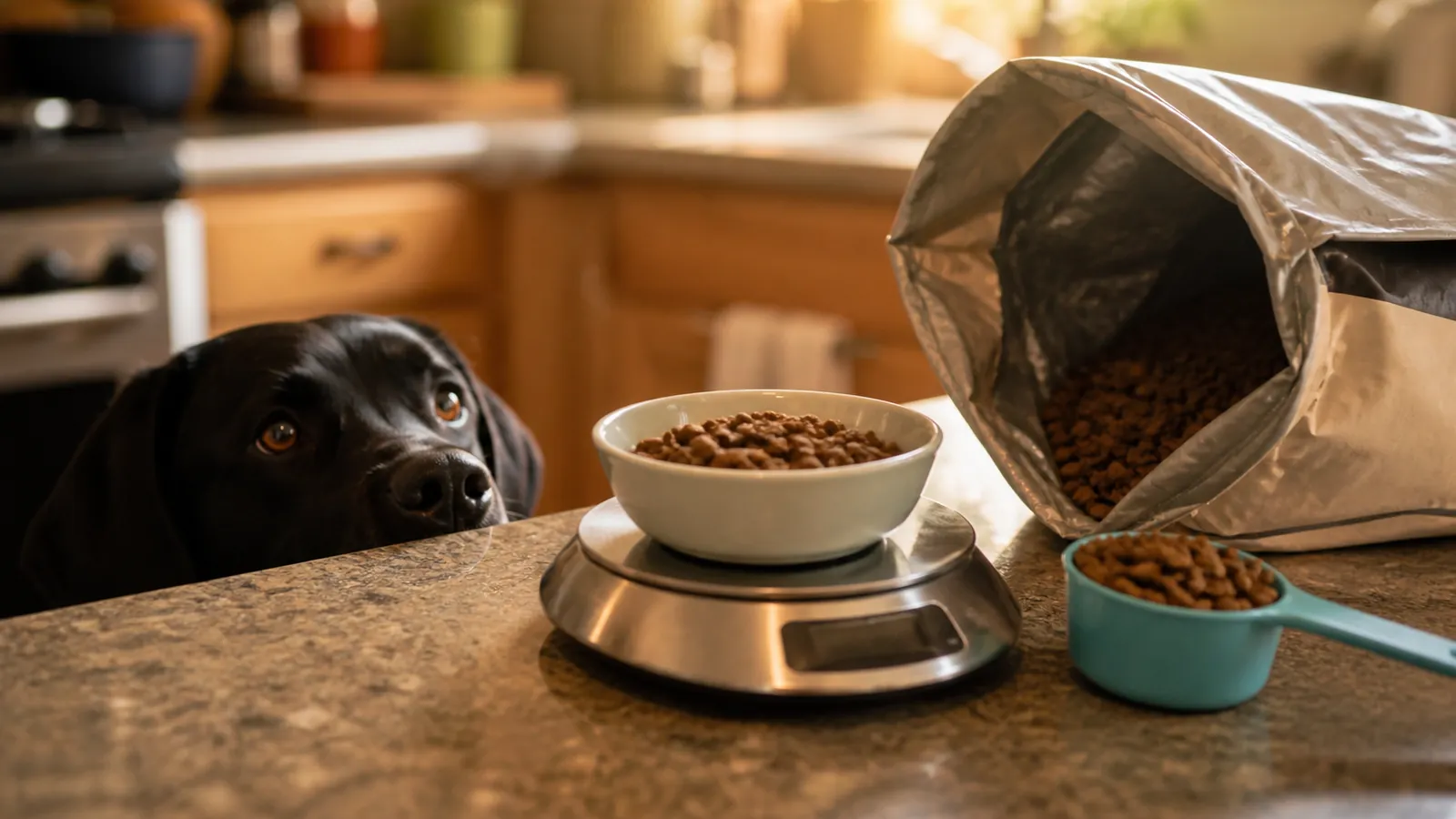
Prices in this section are single observed retail prices for one exact product, first captured July 22, 2026 and re-verified unchanged on August 6, 2026. They are not market averages, not guaranteed prices, and not a recommendation.
Package price is not a comparison. Pounds are not a comparison. Cups are not a comparison. The only honest way to compare a bag against a delivery is to hold the dog and the daily calories constant and price both foods per unit of energy.
How many calories does my dog need a day?
Everything below runs on this number, so it is worth getting a defensible starting point rather than a guess. For your individual dog the figure comes from your veterinarian. If you do not have one yet, there are two legitimate places to start.
The first is on the package you already own: the feeding direction for your dog's current weight, which AAFCO requires to be stated by weight of dog. The second is the WSAVA Global Nutrition Committee's one-page chart of calorie needs for healthy adult dogs, updated July 2020, which lists kilocalorie-per-day ranges by body weight from 2 to 49 kilograms. A 20-kilogram dog — about 44 pounds — falls in a range of 790 to 993 kilocalories a day on that chart, the lower end reflecting an inactive adult and the upper end an active one; the ranges are calculated from the 2006 National Research Council daily maintenance energy requirements for dogs.
Four limits on that number, and they matter more than the number does. WSAVA states plainly that the chart is for guidance only, and that dogs are individuals who may need more or less to hold an ideal, trim body condition. It describes an average healthy adult dog already in ideal body condition, so it is not the figure to use for a puppy, a pregnant or nursing dog, a dog who is over- or underweight, or a dog with a diagnosed condition — those plans are built from a veterinary nutritional assessment, including body and muscle condition scoring, as AAHA's feeding-plan guidance describes. It is a starting point to be adjusted over the following weeks as you watch your dog's weight and body condition. And it should never be estimated from breed alone.
The Same-Dog Cost Check
Run the eight steps in this order.
- Set the dog. Life stage, current weight, body condition, and the daily calorie target — from your veterinarian, or from one of the two starting points above. Keep this figure editable. It is the one input the arithmetic cannot supply for itself, and changing it changes every number that follows.
- Identify each food exactly. Brand, formula, life stage, and the date you checked the label. Two formulas from the same brand are two different foods.
- Find total calories per package or shipment. For a bag: package kilograms × kilocalories per kilogram. For a portion-based fresh plan: the provider's documented calories per pack, per portion, or per shipment. If a provider does not publish that figure, the row is blocked. Do not estimate it from photographs or serving pictures.
- Find the delivered recurring price. The ongoing price after any introductory or first-order discount, plus shipping and tax. Record the introductory price separately, along with when it expires.
- Calculate cost per 1,000 kcal. Delivered recurring price ÷ total calories × 1,000.
- Calculate cost per day. Cost per 1,000 kcal × daily kilocalories ÷ 1,000. Multiply by 365 for an annual planning figure.
- Adjust for reality, but only with real numbers. Add waste or spoilage only if your household actually experiences it, and add a freezer or storage container only if you would actually have to buy one. Do not assume all fresh food is wasted or all kibble is eaten.
- Note what is still blocked. A price you cannot verify is not a low price. It is an unknown.
A worked example: one dry food, priced three ways
| Input or step | Value |
|---|---|
| Exact product | Purina Pro Plan Complete Essentials Adult Shredded Blend Chicken & Rice, 35-lb bag (adult maintenance dry formula). Sold at retail with "High Protein Formula with Probiotics" added to the name, and formerly sold as Pro Plan Savor Shredded Blend, which is why the manufacturer's own product address still reads "savor" — one formula, three names on the shelf, which is exactly why step 2 asks for the formula rather than the brand |
| Adequacy statement | Animal feeding tests using AAFCO procedures substantiate complete and balanced nutrition for maintenance of adult dogs — from the manufacturer's product page, checked August 6, 2026 |
| Calorie content | 3,790 kcal/kg (369 kcal/cup), from the manufacturer's product page |
| Package mass | 35 lb = 15.876 kg |
| Total energy per bag | 15.876 × 3,790 ≈ 60,169 kcal |
| Observed buy-once price | $74.48 |
| Observed recurring autoship price | $70.76, first-order promotion excluded |
| Cost per 1,000 kcal | $1.24 buy-once, $1.18 recurring |
| Cost per day — smaller dog, editable 400 kcal | $0.50 buy-once, $0.47 recurring |
| Cost per day — mid-size dog, editable 900 kcal | $1.11 buy-once, $1.06 recurring |
| Cost per day — larger dog, editable 1,600 kcal | $1.98 buy-once, $1.88 recurring |
| Cost per year at those three levels | $181 / $407 / $723 buy-once; $172 / $386 / $687 recurring |
| Comparable fresh row | Blocked — see below |
| What these figures are not | Not a market average, not a guaranteed price, not a feeding recommendation, and not a claim about any other formula or retailer. One product, one bag size, one retailer, one date |
The exact formula, its adequacy statement, and its calorie figures come from Purina's product page for that food; both prices are single observations from that product's listing at Chewy, re-checked August 6, 2026. The three calorie levels are teaching inputs so the arithmetic has something to work on — they are not feeding recommendations for any dog, and you should replace them with your own dog's target from your veterinarian or the label's direction for his weight. Prices, package sizes, and autoship terms change; recheck them before you rely on the result.
Bag size moves the number more than most people expect. The table below is the same adult-dog dry formula used above — Purina Pro Plan Complete Essentials Adult Shredded Blend Chicken & Rice, 3,790 kcal/kg — at the same retailer on the same day. Only the package changes.
| Bag size (one adult-dog dry formula, 3,790 kcal/kg) | Observed buy-once price | Total energy | Cost per 1,000 kcal |
|---|---|---|---|
| 5 lb | $16.58 | ≈ 8,596 kcal | $1.93 |
| 15 lb | $41.38 | ≈ 25,787 kcal | $1.60 |
| 35 lb | $74.48 | ≈ 60,169 kcal | $1.24 |
| 47 lb | $96.48 | ≈ 80,798 kcal | $1.19 |
Feeding that dog from the 47-pound bag costs about 38 percent less per 1,000 kilocalories than feeding him from the 5-pound bag — identical food, one retailer, observed August 6, 2026. Bag size is a lever worth pulling before brand is.
Why we have not priced a fresh plan here
About The Farmer's Dog versus kibble. This is the most common version of the cost question, and it deserves a straight answer: we have not published a Farmer's Dog cost figure here, because a defined-profile recurring quote has not been captured and archived. A "starts at" figure or a first-box price is not a comparable number, and putting one beside a fully documented kibble row would make the comparison look finished when it is not.
Here is exactly what is missing, so you can see the shape of the gap rather than take our word for it. Every row below is what a comparable fresh quote has to record — and every row is the same field the kibble example above answers.
| Field a comparable fresh quote must record | Status | As of |
|---|---|---|
| Dog profile used: species, breed, adult weight, age, sex, spay or neuter status | Blocked | August 6, 2026 |
| Full plan or partial plan | Blocked | August 6, 2026 |
| Recipes included in the plan | Blocked | August 6, 2026 |
| Quantity and kilocalories in each shipment | Blocked | August 6, 2026 |
| Recurring delivered price after the introductory offer | Blocked | August 6, 2026 |
| Shipping charge and tax | Blocked | August 6, 2026 |
| Introductory price, and the date it expires | Blocked | August 6, 2026 |
| Date and time the quote was pulled, and the quote URL | Blocked | August 6, 2026 |
If you want the comparison for your own dog, run the quote yourself, capture those eight fields from the provider's own ordering flow and published terms, and drop the result into steps 3 through 6 above. That gives you a number that is true for your dog, which is the only kind worth having. When we can complete the table with a captured, archived quote, it will appear here with its collection date attached.
If the food you can verify costs more than you can spend
This is a common situation and not a character flaw, so here is the practical version.
Keeping a verified complete-and-balanced food your dog already eats well is a legitimate answer, not a compromise. The AVMA makes the same point from the veterinary side in its guidance on managing the costs of pet care: good nutrition does not have to be expensive, "premium" foods are not always nutritionally better than less expensive ones, and the adequacy statement — found across a wide range of foods at a wide range of prices — is the check that matters.
- Work the bag size before you work the brand. As the table above shows, the same formula can cost sharply less per 1,000 kcal in a larger package. Store it correctly and finish it before it goes stale. If lifting or handling a large bag is the constraint rather than the money, price the trade-off before you accept it: compare cost per 1,000 kcal at each bag size of the same formula, and ask whether deliveries can be scheduled for a time when someone can help carry them in.
- Ask locally about pet food assistance. Some shelters, rescues, and municipal animal services run pet food pantries, and some veterinary practices keep a client-assistance shelf. These are rarely advertised, so ask.
- Say it out loud at the clinic. If cost is affecting whether your dog gets veterinary care and not only which food he eats, tell your veterinary team plainly. AVMA notes that many clinics offer payment plans or financing, that nonprofit and low-cost clinics operate in some areas, that veterinary schools and nonprofit organizations may be able to help owners who can demonstrate need, and that local veterinary medical associations and humane organizations often keep lists of additional local resources. AVMA also maintains a list of assistance organizations — check each one's own site for current eligibility, and keep asking even after a no.
A plan you can afford and follow is better for your dog than one you abandon in week three.
Food is one line of an annual budget, and it is rarely the line that decides anything. The line most often left out is an emergency reserve, or the insurance premium that stands in for one — the money set aside for the unplanned visit rather than the planned ones. Which of those two suits your household is its own question, and we work through the honest math of it in is pet insurance worth it. Keep it separate from routine costs and set it before you optimize the food line, because an unbudgeted emergency is a far larger problem than a few cents per 1,000 kilocalories. If you are working out the whole first year for a new dog, our breakdown of the first-year cost of a puppy sets those categories out in order; the annual figures above will still apply to an adult dog already in the house.
Can my household store, handle, and keep buying this food?
Operating fit is not a footnote to "is it worth it." A food you cannot store safely, thaw on schedule, or reliably obtain is a food your dog will end up switching off, and repeated abrupt switches are their own problem.
Start with the practices that apply to any dog food. The FDA's pet food storage guidance, current as of May 23, 2024, recommends keeping food in its original container or bag so the UPC code, lot number, product name, manufacturer, and best-by date stay with the food in case of a recall or a complaint — the agency notes that fewer than half of the pet food complaints it receives include a lot number. If you prefer a storage bin, put the whole bag inside it rather than pouring kibble in loose; if you do pour it in, use a clean, dry container with a snug lid, keep the product information taped to the outside, and wash and dry the container between bags. Dry food and unopened cans belong somewhere cool and dry, below 80°F. Leftover canned or pouched food goes into the refrigerator promptly, covered, at 40°F or below, or into the trash.
Handling is the other half. FDA's safe handling guidance recommends washing your hands for at least 20 seconds before and after handling any pet food or treat, washing bowls and utensils after each use, using a dedicated scoop rather than the dog's bowl, and not buying packages that are dented, torn, or discolored. None of this means kibble is sterile, and none of it means cooked fresh food carries the same handling requirements as raw food. It means food is food.
Three household situations change the routine rather than the format:
- If children help with feeding, keep handwashing and a dedicated scoop part of the routine, and have an adult own food storage and any raw product in the house.
- In a multi-pet household, feed separately if one animal is on a prescribed or life-stage-specific diet, and store each food where the other animals cannot reach it.
- Store food securely in any household. A dog who gets into a full bag can eat a large amount very quickly. If that happens, call your veterinarian rather than waiting to see how he does — and seek emergency veterinary care straight away if his abdomen looks swollen or is painful to touch, if he is retching or heaving without bringing anything up, or if he is restless and cannot settle. Do not try to make him vomit.
Then add the fields that differ by format.
| Confirm before you commit | If you are feeding kibble | If you are feeding commercial fresh cooked food |
|---|---|---|
| Space | Cool, dry pantry space for a full bag, kept in the original packaging | Freezer and refrigerator space for a full delivery, measured before the first order |
| Opened product | How long the bag realistically lasts once opened, and whether you finish it before it goes stale | The manufacturer's exact rules for thawing and for how long an opened pack keeps — these differ by product and are not interchangeable |
| Timing | Reorder point that leaves several days of margin | Thawing lead time, delivery windows, and what happens when a shipment is late |
| Travel and boarding | Portability, and whether a boarding facility will feed it | Whether the food can travel, whether a boarding facility can store and serve it, and what you feed instead if it cannot |
| Interruptions | Retail availability of the same formula near you | Whether deliveries can be skipped, changed, or canceled, and whether a non-subscription purchase path exists |
| Backup | A tested backup food your dog already tolerates | A tested backup food your dog already tolerates, for outages, delays, and travel |
| Extra equipment | Only if you actually need a container | Only if you actually need more freezer capacity — do not assume an appliance purchase that is not happening |
Use the manufacturer's instructions for the exact product for thawing, opened-pack duration, and serving. One company's rules do not become a universal fresh-food rule, and a chilled cooked food is not governed by the same window as a canned food or a dry bag.
The backup rule deserves its own line. Decide now what your dog eats if a delivery is late, a store is out of stock, the power goes out, or you leave town. A tested backup that your dog has already eaten without trouble is worth more than an ideal plan that collapses in week three.
If your dog's food is recalled, or something about it seems wrong
This is where keeping the original packaging pays for itself.
- Stop feeding it, and keep the package. The lot number and the use-by date are the two details FDA says matter most for following up a complaint, and they live on the bag or can rather than in your storage bin.
- Call your veterinarian if your dog has eaten it. Go sooner, and to an emergency hospital, if he is unwell rather than fine.
- Check the affected lot range at the source. FDA maintains a running list of animal food recalls and withdrawals, and the manufacturer posts its own notice with the specific lots. A recall usually covers particular lots rather than every bag of a formula, so read the range before deciding your bag is affected — or that it is not.
- Report it, even if your dog is fine. FDA takes reports through the Safety Reporting Portal; its page on how to report a pet food complaint is the route in, and the agency's reporting questions and answers confirm that no animal has to be affected for you to file. Tell the manufacturer and the store as well.
You do not need a recall to report a problem. FDA names foul odor, off color, a swollen can or pouch, a leaking container, and a foreign object in the food as examples worth reporting, and asks for the product type, package type and size, UPC, lot number, use-by date, manufacturer, purchase date, and where you bought it, to the extent you have them.
How should I switch foods, and when should I stop?
Changing food is a small project, not a single decision. Set it up before you buy.
Before day one, write down five things: the food your dog eats now, the exact candidate food, the daily total in calories, the meal schedule, and how much of the current food you still have. That last item matters most. Keeping enough of the current food on hand is what lets you slow down or stop, and it is why buying the new food before the old bag runs out is worth doing.
Then transition gradually. Follow the transition directions the manufacturer publishes for the exact product you are moving to, and follow your veterinarian's guidance if your dog has any medical history. As a structure: start with mostly the current food and a small share of the new one, hold at each step for at least a day, and move to the next step only if your dog is eating normally and doing well. There is no correct number of days that applies to every dog, and any schedule that comes with a promised result should be treated as marketing rather than guidance.
Measure consistently throughout. Weighing food on a kitchen scale is more accurate than scooping, and it matters more than usual during a switch, when it is easy to overfeed by serving a full portion of both foods. Keep treats, chews, dental items, table food, supplements, and training rewards inside the daily calorie total rather than beside it.
Watch four things while you go — and because a first-time guardian has no baseline yet, here is what steady looks like for each:
- Appetite: meals finished within a few minutes, at the usual times, without coaxing.
- Stool: formed and consistent from one day to the next, not looser each morning.
- Energy: the same activity level as the week before the switch.
- Weight and body condition: steady, checked on the same scale on the same day each week rather than daily.
Watch a fifth thing too — whether your household can actually sustain the routine. A plan that only works on quiet weeks is not the plan.
When to stop the switch and call your veterinarian
Contact your veterinarian the same day if your dog has ongoing diarrhea, repeated vomiting, refuses food for more than one meal, is noticeably lethargic, or is losing or gaining weight quickly. Seek veterinary care immediately for blood in vomit or stool, collapse, labored breathing, a distended or painful abdomen, or repeated unproductive retching. Do not keep switching foods to test a symptom. Diagnosing a food-responsive problem is a veterinary workup and a properly designed diet trial, and swapping foods on your own can make that work harder rather than easier.
If you are settling in a new puppy, food continuity belongs to the first week rather than to a diet experiment. Keep the food the shelter, rescue, foster, or breeder was feeding for the first stretch, get the veterinary visit on the calendar, and plan any change afterward — our new puppy checklist covers how that week is sequenced.
Finally, plan to revisit the decision. Reassess when a formula or label changes, when your dog moves from one life stage to the next, when weight trends up or down, when the recurring price rises, when storage or delivery repeatedly fails, or whenever your veterinarian recommends a change.
Can I mix fresh food and kibble?
Yes, deliberately. A mixed plan is a planned split of daily calories between two named foods — not an unmeasured habit of adding something on top of a full bowl. That distinction is the whole difference between a controlled plan and gradual weight gain.
To run one, write down four things: whether each food is complete and balanced for your dog's life stage, your dog's daily calorie target, how many calories come from each food, and every treat, chew, topper, and training reward. The totals have to reconcile. If you reduce one food, reduce it by calories, not by eye.
Two cautions. Combining two complete and balanced foods does not automatically produce an ideal combined nutrient profile, and a topper does not repair a base diet that is not adequate on its own. A food labeled for intermittent or supplementary feeding is not a sole diet and should stay a small share of the day unless your veterinarian directs otherwise. Mixing is a budget, routine, and palatability tool. It is not a nutritional upgrade, and it should not be described as one. The same arithmetic applies if the second food is canned or pouched rather than fresh, which is the wet-and-dry version of the same question. Count the calories rather than the volume: the two adult formulas compared earlier declare 3,790 and 1,186 kilocalories per kilogram, so equal weights of a dry food and a canned food can differ more than threefold in energy. Do not eyeball the spoonful.
Home-prepared food is a different task altogether. AAHA's guidance on home-prepared diets, also from its 2021 guidelines, notes that multiple studies of published recipes — including recipes written by veterinarians — found most do not provide complete and balanced nutrition, and recommends consulting a board-certified veterinary nutritionist. If you go that route, use a formulated recipe and follow it exactly. Your veterinarian can refer you, and because veterinary nutrition is a specialty of the American College of Veterinary Internal Medicine you can also search its owner-facing directory to find a board-certified specialist by state, filtering for nutrition and for specialists who consult remotely. Raw feeding, likewise, is a separate safety decision covered by the FDA guidance linked above, not a version of "fresh."
And "neither, for now" is a legitimate result. If a candidate's label evidence is blocked, if your dog needs a veterinarian-directed plan, if the household cannot sustain the supply or storage, or if symptoms need evaluation, then the right next step is a phone call rather than a purchase.
How did we compare these foods, and what could we not verify?
Research dates July 22 and August 6, 2026. All sources reviewed August 6, 2026. Next scheduled content verification: November 4, 2026, or sooner if a formula, label, price, subscription term, storage instruction, or safety notice changes.
What we compare, and what we don't. This page compares three feeding paths on identical fields: adequacy evidence, life stage, calories, recurring cost, storage, handling, supply, daily labor, transition load, and poor-fit signals. It does not rank brands, score products, or name a best food. There is no rubric on this page because we do not use one — no scores, no stars, no weighted criteria. This page is general education for dog guardians. It is not a substitute for examining your dog, and it does not replace advice from the veterinarian who knows him.
Evidence rules. Regulatory and label facts come from the FDA and from AAFCO's consumer guidance. Guidance about how nutrition decisions should be made comes from veterinary bodies. Product-specific facts — formula, calories, storage rules, shipping, subscription terms, price — come only from the manufacturer's or retailer's own current documentation for that exact product, and hold for nothing else. Retail prices are single dated observations, never averages. Marketing pages, review sites, and owner reports do not establish nutrition, safety, adequacy, or price here.
Applied symmetrically. Every named product on this page is evidenced the same way, or its gap is labeled. The kibble example is priced from its own product listings; the fresh comparison is not priced at all, because a comparable quote has not been captured. Publishing one and estimating the other would be the failure this page exists to avoid.
One disclosure worth making. AAHA's 2021 Nutrition and Weight Management Guidelines, cited three times on this page, state on AAHA's own site that they were supported by educational grants from Hill's Pet Nutrition, Purina Pro Plan Veterinary Diets, and Royal Canin. We cite them as veterinary guidance and we also price a Purina product as an arithmetic example. Neither choice was influenced by any commercial relationship, and every provider relationship on this site is treated as unconfirmed unless it is documented.
Evaluated but outside this comparison
| Not covered here | The specific reason | As of |
|---|---|---|
| Raw diets | A separate safety and handling decision governed by FDA guidance, not a version of commercial cooked fresh food | August 6, 2026 |
| Home-prepared and homemade recipes | A formulation task requiring a board-certified veterinary nutritionist and exact adherence | August 6, 2026 |
| Therapeutic and prescription diets | Selected and monitored by a veterinarian for an individual dog | August 6, 2026 |
| Canned, air-dried, freeze-dried foods, toppers, and treats | Outside the fresh-versus-dry question this page answers; each needs its own adequacy and calorie treatment | August 6, 2026 |
| Cat food | Different species, different nutrient requirements, separate evidence | August 6, 2026 |
| Fresh-food provider rankings and shortlists | Owned by our fresh dog food comparison, which carries its own current inclusion, price, and terms methodology | August 6, 2026 |
| A Farmer's Dog cost figure | No defined-profile recurring quote with calories, plan share, shipping, price, and timestamp has been archived | August 6, 2026 |
How do I pick a food I can actually keep buying?
Category first, product second, brand last. These are the shapes to shortlist for, not vendors to shortlist — a name is not evidence, and every provider relationship on this site is treated as unconfirmed unless it is documented. None of the situations below diagnoses anything, and none of them assumes a budget makes anyone a better or worse guardian.
- Best for a healthy adult dog on a fixed budget: a dry, complete-and-balanced adult-maintenance formula whose adequacy statement, kcal/kg, and per-bag price you can all read before you buy.
- Best for a household that wants measured portions and can run a cold chain: a cooked fresh formula that publishes its life-stage adequacy statement and the calories in each pack or shipment, with a delivered recurring price visible before the first order.
- Best for frequent travel, boarding, or emergency planning: a shelf-stable complete-and-balanced food, or a fresh plan paired with a tested shelf-stable backup your dog already eats.
- Best for a puppy, a pregnant or nursing dog, or a dog with a diagnosed condition: whatever your veterinarian directs. Book the conversation before you shop — this pick is a care decision, not a shopping decision.
- Best when nothing on your shortlist checks out: keep the current food. Staying put with a verified, affordable food your dog eats well is a legitimate outcome, not a failure to decide.
| Your situation | Shortlist move | Ask before you buy |
|---|---|---|
| Healthy adult dog, fixed monthly budget, limited freezer | Shelf-stable complete-and-balanced adult formulas you can buy locally, in the largest bag you can store and finish | What is the adequacy statement and life stage, word for word? What is the kcal/kg? Is this price recurring or promotional, and when does the promotion end? |
| Healthy adult dog, cold storage available, wants portion control | Cooked fresh formulas that publish per-pack or per-shipment calories | How many calories are in each pack or shipment, and is this a full or partial plan? What is the delivered price after the introductory offer, including shipping? What are the exact thawing and opened-pack rules? Can I skip, change, or cancel deliveries? |
| Puppy, pregnant or nursing dog, or a diagnosed condition | Not a format decision — the shortlist starts at the veterinary appointment, where your veterinarian sets the product and the calorie plan | What life stage and calorie target should I feed? Does this candidate's adequacy statement match? Does anything about my dog's condition rule a format out? |
| Nothing on the shortlist checks out, or the budget will not stretch | Keep the current food, and treat that as a decision rather than a delay | Does my current food's adequacy statement name my dog's life stage? Is its kcal/kg published? Would a larger bag of this same formula cost less per 1,000 kcal? |
For a healthy adult dog on a tight budget with little cold storage, fresh cooked food is rarely the right starting point: the recurring delivered price and the freezer space have to work every month, not just the first one. A mixed plan does not solve that constraint either — it adds cost and measurement without removing the limit.
Score every candidate with the same Label Audit above — same fields, same order, same status words. If one option is verified from its published label and calorie declaration while another is only verified from a marketing page, the comparison is not finished yet. That asymmetry, more than the price gap, is often what is really behind a decision that feels hard.
What else do dog guardians ask?
Is fresh dog food healthier than kibble?
Not as a category. Nutritional adequacy is established by a specific product's adequacy statement and how that adequacy was substantiated, not by whether the food is cooked and chilled or dried and bagged. A well-documented food in either format can be an appropriate sole diet for a healthy adult dog. Health outcomes for your individual dog belong to your veterinarian, working from an examination rather than a package.
Is fresh dog food worth the cost?
It depends on what you are buying. If a fresh plan gets you a formula you can verify, calories you can count, and portions you can actually control, and the delivered recurring price is sustainable, then the added cost buys something real. If the same money strains the budget, or the routine breaks and the dog ends up switching foods repeatedly, it does not. Price the recurring cost, not the first box.
How do I compare The Farmer's Dog with kibble?
Use the same dog and the same daily calories for both, then compare cost per 1,000 kcal using the Same-Dog Cost Check above. Never compare a promotional first box against a full-price bag — and if the fields a real quote needs are not in front of you, see why we have not priced a fresh plan here.
How much should I expect to spend on dog food in a year?
It depends far more on your dog's size than on the brand. Annualizing the worked example above puts that one dry food at roughly $172 a year for a dog eating an editable 400 kcal a day, $386 at 900 kcal, and $687 at 1,600 kcal, all on the recurring autoship price. On the buy-once price the same three levels come to about $181, $407, and $723. Those are single observed retail prices for one 35-lb adult formula on August 6, 2026 — not guaranteed prices and not market averages. Your figure moves with your dog's calorie needs, the formula, package size, promotions, shipping, and whether you feed a full or partial plan.
How much fresh food should I feed my dog?
Divide your dog's daily calorie target by the calories the manufacturer states per pack or per portion — that is the arithmetic, and it is why an unpublished calorie figure blocks the whole decision. The calorie target itself is not arithmetic. It comes from your veterinarian, or as a starting point from the label's feeding direction for your dog's weight, adjusted as you watch his body condition over the following weeks.
How long does switching to a new food take?
There is no universal timeline, and any promised one should make you skeptical. The pace is set by the slowest dependency: your individual dog's tolerance, your veterinarian's direction if your dog has any medical history, the manufacturer's published transition instructions for that exact product, and how much of the current food you have on hand. If your dog is doing well, you move to the next step. If not, you hold or stop.
When should I call my veterinarian instead of changing food?
Routine questions — life-stage changes, calorie targets, weight trends, whether a candidate food suits your dog — belong at the next scheduled visit or a phone call. The signs that mean the same day and the signs that mean right now are listed in full under when to stop the switch and call your veterinarian; that block is the one to use, rather than any shorter version of it. Seek emergency care immediately, and call an animal poison control service — ASPCA Animal Poison Control at (888) 426-4435 or the Pet Poison Helpline at (855) 764-7661 — if you think your dog has eaten something toxic. If a food your dog eats is recalled, or the package is off in some way, follow the steps under if your dog's food is recalled. Never route a possible emergency through a purchase decision.
Your next three steps

- Document what you feed now. Photograph the adequacy statement, the calorie content, and the feeding directions, and write down the daily amount and what you actually pay.
- Collect the same fields for one candidate, then run the Same-Dog Cost Check and the storage-and-supply check. Leave blocked fields blank rather than filling them with estimates.
- Use the result. Keep the current food, plan a measured transition, or bring the worksheet to your veterinarian if anything on it points that way. Only once that decision is made is it worth weighing specific providers against each other, which is what our fresh dog food comparison is for.
About this page
This guide was researched and written by the Paw Parent HQ editorial team, which maintains the site's pet-food, cost, and label research and works from primary sources only — the regulator, the veterinary professional body, or the manufacturer's own current documentation for its own product. Every source used is listed below with the date it was reviewed. Veterinary review status: not yet reviewed. When a veterinary review of this page is completed, it will be credited here by name, credential, and date.
How this page is funded: Paw Parent HQ is supported by advertising and, on some pages, disclosed referral links. No provider has paid for placement, ordering, or inclusion on this page, and compensation never determines what is included or how it is ranked. If a compensated link is added to this page, it will be disclosed here.
If you find an error on this page, tell us at hello@pawparenthq.com: we correct the page itself and date the correction rather than quietly revising it.
Sources and last verified date
Last verified: August 6, 2026
- Complete and Balanced Pet Food — U.S. Food and Drug Administration — Nutritional adequacy statements, AAFCO nutrient profiles versus feeding trials, growth and adult maintenance life stages, and as-fed versus dry matter comparison. Page content current as of February 28, 2020.
- FDA's Regulation of Pet Food — U.S. Food and Drug Administration — Labeling requirements and the boundary between food and products marketed to treat or prevent disease.
- FDA Investigation into Potential Link between Certain Diets and Canine Dilated Cardiomyopathy — U.S. Food and Drug Administration — Scope of the DCM investigation, the agency's statement that the association is complex and may involve multiple factors, the December 2022 decision to pause public updates, and the signs that warrant veterinary contact. Content current as of December 23, 2022.
- Proper Storage of Pet Food & Treats — U.S. Food and Drug Administration — Original packaging and lot retention, storage containers, temperature limits, and refrigeration of leftovers. Content current as of May 23, 2024.
- Tips for Safe Handling of Pet Food and Treats — U.S. Food and Drug Administration — Handwashing, bowl and utensil hygiene, damaged packaging, and FDA's position on raw pet food. Content current as of May 23, 2024.
- Get the Facts! Raw Pet Food Diets Can Be Dangerous to You and Your Pet — U.S. Food and Drug Administration — Raw versus cooked commercial food safety boundary and handling precautions.
- How to Report a Pet Food Complaint — U.S. Food and Drug Administration — The Safety Reporting Portal as the route for owner reports of a pet food problem. Accessed August 6, 2026.
- Pet Food Safety Reporting Portal Frequently Asked Questions — U.S. Food and Drug Administration — That an animal need not be affected to file a report, the product information FDA requests, the primacy of the lot number and use-by date, and examples of reportable product problems. Accessed August 6, 2026.
- Recalls & Withdrawals, Animal & Veterinary — U.S. Food and Drug Administration — Running list of animal food recalls and withdrawals, used to check affected lot ranges. Accessed August 6, 2026.
- Reading Labels — Association of American Feed Control Officials — Required label elements, the four nutritional adequacy statement formats, recognized life stages, feeding directions as guidelines, the calorie-content heading, and state adoption of AAFCO model regulations. Page updated June 11, 2024; accessed August 6, 2026.
- Calories — Association of American Feed Control Officials — Calorie declarations on pet food labels, used here for cost normalization. Accessed August 6, 2026.
- Frequently Asked Questions — Association of American Feed Control Officials — AAFCO does not approve or endorse pet foods; "premium" as an unregulated term; "human grade" as a marketing claim with separate published guidance; natural claims are not expressions of safety. Page updated January 9, 2025; accessed August 6, 2026.
- Natural — Association of American Feed Control Officials — What a natural claim covers, and that it is not an expression of safety. Accessed August 6, 2026.
- What's in the Ingredients List? — Association of American Feed Control Officials — Ingredient naming and the limits of reading an ingredient panel as a quality score. Accessed August 6, 2026.
- Pet Food Label Modernization — Association of American Feed Control Officials — The four label changes now phasing in, and AAFCO's recommended six-year state-by-state transition. Page updated June 19, 2025; accessed August 6, 2026.
- Pet Food Label Modernization Factsheets — Association of American Feed Control Officials — Consumer one-pagers for the Nutrition Facts Box, Intended Use Statement, ingredient statement, and handling instructions. Accessed August 6, 2026.
- Model Regulations for Pet Food and Specialty Pet Food Under the Model Bill — Association of American Feed Control Officials — The four recognized categories of nutritional adequacy and the absence of a senior category; the verbatim large-size-dog growth qualifiers; the Intended Use Statement's required wording and placement in the bottom 30 percent of the principal display panel; the calorie declaration required in the Pet Nutrition Facts box. Model regulations dated April 3, 2023; accessed August 6, 2026.
- Guidelines on Selecting Pet Foods — WSAVA Global Nutrition Committee — Manufacturer questions and formulator qualifications, the limits of ingredient lists and unregulated marketing terms, and that all-life-stages foods are formulated for reproduction and growth. Tool updated March 10, 2021.
- Calorie Needs for Healthy Adult Dogs — WSAVA Global Nutrition Committee — Starting-point kilocalorie-per-day ranges by body weight for an average healthy adult dog in ideal body condition, calculated from 2006 NRC daily maintenance energy requirements, with WSAVA's guidance-only caveat. Chart updated July 2020; accessed August 6, 2026.
- Find a Specialist — American College of Veterinary Internal Medicine, VetSpecialists.com — Owner-facing directory used to locate a board-certified veterinary nutritionist by state, including specialists who consult remotely. Accessed August 6, 2026.
- Feeding Plans for Healthy, Appropriate-Weight Cats and Dogs — American Animal Hospital Association, 2021 Nutrition and Weight Management Guidelines — Individualized feeding plans built from a nutritional assessment, including body and muscle condition scoring. 2021 edition; accessed August 6, 2026.
- Home-prepared Diets — American Animal Hospital Association, 2021 Nutrition and Weight Management Guidelines — Recipe inadequacy findings and the recommendation to consult a board-certified veterinary nutritionist. 2021 edition; accessed August 6, 2026.
- Diet-associated Dilated Cardiomyopathy — American Animal Hospital Association, 2021 Nutrition and Weight Management Guidelines — Veterinary treatment of diet-associated DCM as a current topic, and the guidelines' educational-grant disclosure. 2021 edition; accessed August 6, 2026.
- Loving Your Pet, Managing the Costs — American Veterinary Medical Association — Adequate nutrition across price ranges, payment and low-cost clinic options, and the compiled list of assistance organizations. Accessed August 6, 2026.
- ASPCA Animal Poison Control Center — American Society for the Prevention of Cruelty to Animals — 24-hour animal poison control line, (888) 426-4435; a consultation fee may apply. Accessed August 6, 2026.
- Frequently Asked Questions — Pet Poison Helpline — 24-hour animal poison control service, (855) 764-7661; a one-time per-incident consultation fee that includes follow-up consultations. Accessed August 6, 2026.
- Purina Pro Plan Complete Essentials Adult Shredded Blend Chicken & Rice — Purina — Exact adult dry formula, feeding-trial adequacy statement for adult maintenance, 3,790 kcal/kg and 369 kcal/cup, and the guaranteed analysis figures of 26.0 percent minimum crude protein and 12.0 percent maximum moisture used in the dry matter example. Accessed August 6, 2026.
- Pro Plan Complete Essentials Chicken & Rice Entrée Classic Dog Food — Nestlé Purina PetCare product document — Canned adult-maintenance formula: guaranteed analysis of 9.0 percent minimum crude protein and 78.0 percent maximum moisture, formulated-to-meet adequacy statement, and 1,186 kcal/kg. Used only for the dry matter conversion example. Accessed August 6, 2026.
- Purina Pro Plan Adult Shredded Blend Chicken & Rice, 35-lb bag — Chewy — Observed buy-once and recurring autoship prices and the 5-, 15-, 35- and 47-lb bag prices, August 6, 2026; volatile retailer observation.
Next review: November 4, 2026
Not sure what fits your situation?
Answer a few questions and get a shortlist matched to where you are right now.
Take the 2-minute questionnaireKeep reading
 Is Pet Insurance Worth It? Insurance vs. SavingsCompare pet insurance with a dedicated savings fund using liquidity, policy eligibility, owner-share math, and realistic scenarios for dogs and cats.
 First-Year Puppy Cost: A Realistic 2026 BudgetEstimate your puppy's first-year cost with a dated calculator covering adoption, vet care, food, supplies, training, insurance, and an emergency reserve.
 New Puppy Checklist: Your First 30 Days, in OrderFollow a practical new puppy checklist for the first 30 days, from home setup and vet records to routines, safe socialization, ID, and what can wait.
 Best Fresh Dog Food in 2026: 5 Options ComparedCompare five fresh dog foods on adequacy statements, who formulates them, ongoing cost, storage and cancellation terms — and what to verify before ordering.