
What Breed Is My Rescue Dog? When It's Worth Finding Out
Short answer: a dog DNA test is worth buying when you can name a decision the result would change — most often finding relatives, filling in records for a dog with no history, or a medication-sensitivity question your veterinarian has already raised. If you cannot name that decision, records and observation cost nothing and are usually enough. For scale: on August 6, 2026, Embark's Breed ID kit was shown at $109 against a $129 list price, and Wisdom Panel's Breed Discovery at $89.99 against $99.99 — both promotional prices on that date, not standing prices and not averages. Dated capture below.
You brought home a dog with an incomplete history, and somewhere between the adoption paperwork and the first walk, someone asked what he is. Curiosity on its own is a fine reason to find out, if the money and the data trade-off are worth it to you. But knowing is not required to give a rescue dog good care, and it is not a prerequisite for anything your dog needs this week.
This page is about dogs, and the decision works the same whether yours is a four-month-old puppy or a ten-year-old senior. Three limits shape everything below. First, appearance and shelter paperwork describe a dog; they do not establish ancestry. Second, a consumer DNA test returns estimated ancestry and screening information — not a diagnosis, and not a prediction of what your individual dog will do. Third, a result settles no landlord, insurer, or city breed question; those are decided by people applying their own rules and their own evidence, and the testing companies decline that job themselves.
If your dog has symptoms right now, or a behavior problem that has you worried about a bite, that is a veterinarian or a qualified behavior professional today. Those needs do not wait three weeks for a lab.
Your first step costs nothing. Finish the Actionability Sentence: "If the result shows ______, I will ______."

On this page
- What are your three options for identifying your rescue dog's breed?
- What a breed answer cannot do, and when to call your veterinarian
- Why can't you tell your dog's ancestry just by looking?
- How do you weigh cost, confidence, and privacy in a dog DNA test?
- When is a dog DNA test worth buying?
- What can a dog DNA test tell you, and what can't it?
- How should you use health and behavior results?
- Can a DNA result answer a landlord, insurer, or city breed question?
- What should you check before you buy a dog DNA test?
- How does the decision play out in four real situations?
- How to choose a dog DNA test without guessing
- What would a dog DNA result change? Work it out on paper
- Questions rescue guardians ask about breed and DNA tests
- Where to go from here
- Sources and last verified date
What are your three options for identifying your rescue dog's breed?
Three paths, compared on the same fields. Feature and terms details in this table reflect current provider documentation reviewed August 6, 2026; prices are captured and dated separately below.
| Decision field | Records and observation | Consumer DNA test | Wait, and don't test yet |
|---|---|---|---|
| Best for | You need a working description of your dog and no result would change his care | A specific question — relatives, records, or a health topic already raised with your vet — has real value to you | Nothing about your dog's week changes on an estimate, or money and privacy matter more right now |
| Not ideal for | Anyone who needs an ancestry estimate, or who is trying to find littermates | Anyone hoping to diagnose a symptom, explain a behavior problem, or settle a lease, insurance, or ordinance question | Anyone with a decision genuinely waiting on the answer, such as a planned procedure or a litter search with a deadline |
| What you get | Size, coat, build, age estimate, medical history, observed behavior | Estimated breed mix, ancestry back a few generations, possible relative matches, and traits or health screening depending on the exact kit | Nothing new, and no data leaves your house |
| Confidence | High about the dog in front of you; low about ancestry | Moderate for ancestry as an estimate; varies by provider method and reference database | Not applicable |
| Evidence status | Verified with limitation — the gap between appearance and ancestry is measured, but in one 2014–2016 shelter sample | Partial — kit contents and terms verified from provider documentation August 6, 2026; comparative mixed-breed accuracy has no independent benchmark | Not applicable — no claim to verify |
| Cost | Free, plus the exam you were having anyway | Kit price plus any shipping and upgrade charges; dated capture below, and verify at checkout | Nothing |
| Time | Immediate | Weeks, per the provider's current estimate — not a guarantee | None |
| Privacy trade-off | None | You submit your dog's DNA and agree to that company's sample, storage, research, sharing, and deletion terms | None |
| Health and behavior use | Direct: your vet examines the actual dog | Screening information only; never a diagnosis or a behavior forecast | Your vet still examines the actual dog |
| Main limitation | Appearance can mislead about ancestry | Percentages are estimates, relative matching depends on who else tested, and results settle no legal or housing question | The curiosity stays unresolved |
| First step | Ask the shelter for the full intake record | Write down the decision the result would change | Revisit the question at your dog's next annual exam |
Choose a path based on what the answer would change. This comparison is a Paw Parent HQ editorial framework; the evidence behind each row appears in the sections below.
Choose a consumer DNA test if you can name the decision it would change, and you accept that breed figures are estimates from one company's method and reference data.
If your reason for testing is health, talk to your veterinarian before you buy, so the screening you choose matches a question they can actually use — and so you are not paying for a panel that answers nothing about your dog's situation.
Call your veterinarian first if your dog has symptoms now, or a qualified behavior professional if you are worried about safety. Severe bleeding, difficulty breathing, seizures, suspected poisoning, and the other signs the American Veterinary Medical Association lists as emergencies (list reviewed August 6, 2026) mean an emergency clinic now, not a swab kit. If you think your dog swallowed something toxic, call your veterinarian or an emergency clinic right away, or reach a 24-hour animal poison control service: ASPCA Animal Poison Control at (888) 426-4435, where a consultation fee may apply, or Pet Poison Helpline at (855) 764-7661, which charges an $89 per-incident fee that includes follow-up consultations.
What a breed answer cannot do, and when to call your veterinarian
A consumer breed result is information about ancestry. It is not a medical finding, and the companies say so themselves: Wisdom Panel's current terms state that its products and services are provided for research, informational, and educational purposes, are not a substitute for professional veterinary care, and are not intended to diagnose disease or predict behavior in any particular pet (terms reviewed August 6, 2026). Those same terms also say the product is not intended to establish a dog's pedigree — a useful reminder that a consumer report is not an official determination of anything.
That matters in three practical ways. Do not delay care. If your dog is limping, itching, vomiting, or acting unlike himself, that is an appointment, not a research project. Do not read a personality into a percentage. A breed estimate describes ancestry, not the dog asleep on your floor. Do not assume a result settles an administrative question. Landlords, insurers, and municipalities apply their own definitions and their own evidence rules, and a consumer report may carry no weight with any of them; if a specific rule affects you, read the actual lease clause, policy, or ordinance, or ask someone qualified to read it for you.
Before you buy anything, finish the Actionability Sentence. If the second blank stays empty, choose records and observation, or postpone. And if the action you would take involves medication, a diagnosis, current symptoms, or a serious behavior or safety concern, that goes to a veterinarian or a qualified behavior professional instead of a test.
Why can't you tell your dog's ancestry just by looking?
Because coat, ears, and build are the visible result of a small number of genes, and a mixed-breed dog can inherit a look from one ancestor and almost nothing else. The technical distinction is between phenotype, the traits you can see, and ancestry, the family history that produced them. They are related, but they are not the same thing, and in mixed-breed dogs they come apart quickly.
The largest published comparison of shelter labels with genetic testing makes the size of the gap concrete. Researchers genetically tested 919 dogs at two limited-admission shelters in Phoenix and San Diego between December 2014 and April 2016 and compared the results with staff breed assignments at the San Diego shelter. For the 384 dogs where both were available, staff named at least one breed that appeared in the DNA analysis 67.7% of the time — but matched both the primary and secondary breeds for only 10.4% of dogs, and more than half of those complete matches were purebred dogs. Roughly 4.9% of the full sample was purebred at all.
Read those numbers with three limits attached. The study used one commercial test as it existed at the time, Wisdom Panel 2.0, sampling between 2014 and 2016; it covered two shelters in one region of the United States; and it was financially supported by the test's manufacturer, which the authors disclosed. Read it as evidence that appearance-based identification is genuinely hard in mixed-breed dogs — not as a percentage that applies to your shelter, your adoption counselor, or any test sold today.
That difficulty is not only an owner's problem. The American Veterinary Society of Animal Behavior's position statement on breed-specific legislation makes the same point about officials: visual identification is not reliable, and presumed breed identification is often made by neighbors, public officials, and reporters rather than by anyone with genetic evidence.
None of that makes description useless. It makes description a different tool.
| Use your dog's appearance and records for | Do not use them for |
|---|---|
| A working description on vet, boarding, and grooming forms | Establishing ancestry or breed percentages |
| Estimating adult size, coat care, and exercise needs | Predicting temperament or trainability |
| Recognizing changes from your dog's normal baseline | Deciding whether a breed-linked condition applies |
| Reuniting a lost dog and writing a findable listing | Answering a landlord's or insurer's breed question |
How do you weigh cost, confidence, and privacy in a dog DNA test?
The three paths do not trade off along one axis, which is why a simple "is it worth it" answer keeps failing readers. Records and observation cost nothing and are immediately useful, but they leave the ancestry question open, and no amount of careful looking closes it. A DNA test adds information you cannot get any other way — relatives, ancestry back a few generations, and depending on the kit, screening data — but you pay in three currencies at once: money, uncertainty, and your dog's genetic data on someone else's server. Choosing not to test is not a failure of curiosity; it is the correct answer whenever the information would sit unused.
What each path costs you
Kit prices in this category move constantly with promotions and codes, and the same product can display different amounts in different places on the same day. Treat any figure you see as a quote for that moment. If optional testing is competing with a first vaccination series, a spay or neuter, or a dental, the essentials win — our guide to how much a puppy costs in the first year sets out the categories that genuinely cannot wait. If those essentials are themselves out of reach, ask your clinic about payment options and look for a veterinary teaching hospital or a low-cost clinic near you; the animal-welfare organization Humane World for Animals maintains a directory of assistance routes for owners struggling with veterinary costs, including its Pet Help Finder tool and the suggestion to contact nearby veterinary colleges.
How confident the numbers are
Breed estimates are model outputs, not measurements, and different companies reach different conclusions from the same dog. In a 2024 study, researchers sent buccal swabs from 12 registered purebred dogs to six direct-to-consumer testing companies and found a low rate of consensus in the estimated breed makeup — even for dogs with pedigree paperwork. The same paper's headline finding was the more encouraging half of that result: several tests did identify the registered breed reliably, and what varied was how much the companies agreed with each other about the rest of the mix. The study also suggested that at least one company's predictions were influenced by the photograph submitted with the sample. That was 12 purebred dogs and the six tests on the market when the study began, so it is not a ranking of today's products and not a mixed-breed accuracy score. It is a reason to read a percentage as an estimate with a method behind it.
There is no clean break-even number to give you here, and you should be suspicious of any page that offers one. A break-even calculation assumes the information has a fixed cash value, and for most rescue guardians it does not: the same report is worth a great deal to someone hunting for littermates and almost nothing to someone whose dog is healthy, settled, and going nowhere near a breed-restricted lease. What replaces the calculation is the Actionability Sentence at the top of this page, plus an honest read on how much the curiosity itself is worth to you.
What happens to your dog's data
A DNA test is the only path here that creates a permanent record about your dog somewhere else. What happens to the sample, whether the data feeds research, whether relatives can see your dog's profile, and whether you can delete any of it are all set by the company's current policy — and those policies differ between companies and change between versions. That is a decision field, not fine print, and it belongs next to price rather than after it.
When is a dog DNA test worth buying?
Worth-it is not a single calculation, because part of the value is personal. But it becomes a clear yes in four situations.
You want to find relatives, and you accept that it depends on who else tested. Relative matching is a real feature with a real limit: your dog's siblings or parents only appear if their people also bought a test from the same company and left matching switched on.
You are filling in records for a dog with no history. An estimated ancestry, an approximate age, and a set of trait findings give you something to write in the chart and something to tell the next vet, boarding facility, or sitter — as an estimate, clearly labeled.
You have a specific health question you have already discussed with your veterinarian. Not a general wish to "check for problems," but a question with a next step attached: a screening result your vet has said would change what they monitor, or a medication-sensitivity question before a planned procedure.
The curiosity itself is worth the price to you. This is a legitimate reason, and pages that dress it up as medical necessity are doing readers a disservice. Wanting to know is allowed. Paying for it with clear eyes is the whole standard.
It becomes a no when you are expecting the test to diagnose an illness, to explain a behavior problem, or to settle an argument with a landlord, an insurer, or a neighbor. Veterinary research supports the middle position rather than either extreme: in a 2025 survey of 229 veterinary care providers attending a professional conference in February 2023, 81.2% had encountered clients who were using or planning to use direct-to-consumer genetic tests, and the study's central finding was that providers saw clinical utility in genetic testing while reporting limited confidence interpreting consumer results. That was a convenience sample at one conference, so read it as clinician context, not as a verdict on any product. The practical lesson is that a result is most useful when a veterinarian is in the conversation, and least useful when it arrives as a surprise.
Six questions before you spend anything. Answer yes, no, or unsure. There is no score — if two or more answers are "no," the honest choice is records and observation for now.
- Can I name the specific answer I want (ancestry, relatives, traits, or a health screen)?
- Can I name what I would do differently once I have it?
- Am I comfortable with a result that is an estimate rather than a fact?
- Do I have a cost ceiling, including shipping and any upgrade?
- Have I read what happens to my dog's sample and data, and am I fine with it?
- Do I know who I would take a health finding to?
What can a dog DNA test tell you, and what can't it?
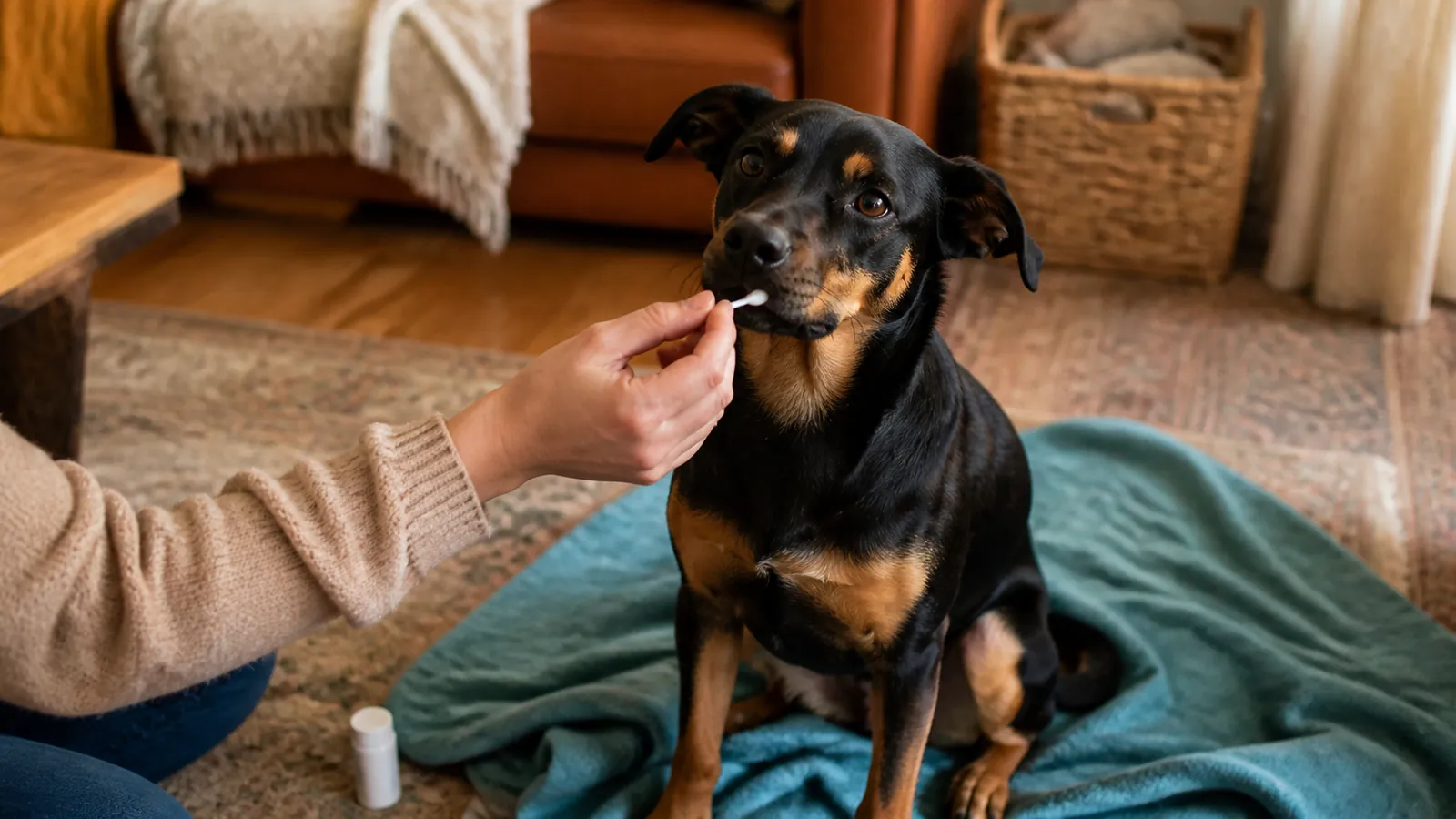
These features are bundled differently by every company and by every kit within a company, which is where most buyers get surprised. Feature descriptions below reflect current provider documentation reviewed August 6, 2026.
| Feature | What the provider returns | Genuinely useful for | Cannot establish | Your next step |
|---|---|---|---|---|
| Breed estimation | An estimated breed mix, usually as percentages | A defensible description; understanding likely adult size and coat care | Certainty; a legal or official breed determination | Record it as an estimate, with the provider and date |
| Ancestry / family tree | A reconstructed family tree, typically back about three generations | Understanding how an unusual mix came about | Ancestry beyond the depth the method reports | Save the report; nothing else required |
| Relative matching | Other tested dogs sharing DNA, with optional contact | Finding littermates and birth family; filling in history | Anything about untested relatives | Check the visibility setting before you opt in |
| Traits and behavior features | Predicted physical traits, and questionnaire-based or genetic "personality" content | Coat, size, and grooming expectations; conversation | What your individual dog will do | Trust the dog in front of you over the report |
| Health screening | Genetic variant results, by exact panel | Raising a specific question with your veterinarian | A diagnosis, a prognosis, or a treatment plan | Bring the report to your next appointment |
Two things that table cannot do for you. First, kit scope varies more than the marketing suggests, and the two breed-focused kits captured below are bundled differently under similar-sounding names. Embark's help documentation states that its Breed ID kit includes breed mix, ancestry and family tree, Relative Finder, a questionnaire-based personality quiz, and personalized activity suggestions, while genetic health risk screening, physical traits, and allergy risk scores require the Breed + Health kit or a later upgrade (help article updated May 22, 2026). Wisdom Panel's Breed Discovery page describes a breed-focused kit that also includes an MDR1 medication-sensitivity test, two behavior tests, relatives, and a family tree back three generations, and that page treats health screening as a different kit rather than an upgrade to this one. Read the whole ladder before you decide: on August 6, 2026 the same provider's United States products page showed Breed Discovery at $89.99 against a $99.99 list price, Essential at $95.99 against $119.99 with 25 or more health tests, and Premium at $127.99 against $159.99 with 265 or more. Six dollars separated the breed-only kit from the cheapest kit carrying health screening that day, which is the kind of thing a page that names only the top tier hides from you. Those are different bundles, and the only reliable way to know what you are buying is the provider's own current documentation for that exact kit.
It also helps to know what a percentage actually is. A breed estimate is produced by comparing your dog's genetic markers against a company's reference panel of known breeds and fitting the best model of ancestry that panel can support. Change the marker set, the reference breeds, or the model, and the percentages move — which is why the same dog can come back as a different mix from a different company, and why very small percentages at the bottom of a report deserve the least weight. Relative matching has a similar dependency in a different direction: it is not searching the world's dogs, only the customers of that one company who tested and left matching enabled. A dog with no matches has not been proved to have no relatives; it means none of them are in that database yet, and a match may appear years later.
Second, a bigger database is not the same as a more accurate answer for your dog. Breed counts and database sizes are provider-reported figures about scale, and no independent benchmark currently available supports ranking these products by mixed-breed accuracy. Paw Parent HQ does not publish a "most accurate" pick, because the evidence to support one does not exist.
Who says so? Sorting claims by their source
Every statement on this page falls into one of these categories, and the category tells you how much weight it carries.
| Claim type | What it is | Who establishes it | What it changes for you |
|---|---|---|---|
| Veterinary guidance | Medical and safety direction | A veterinarian or a professional body such as the AVMA | Governs any decision about your dog's health |
| Independent research | Peer-reviewed studies | Researchers, subject to sample and method limits | Sets realistic expectations; describes populations, not your dog |
| Provider documentation | Features, terms, privacy policy, turnaround | The company, about its own product | Binding on what you buy; version- and date-specific |
| Provider marketing | Superlatives and comparative claims | The company, about itself | Carries no independent weight |
| Paw Parent HQ editorial aid | The decision cards, checklists, and worksheet here | Our editors | A framework for your thinking, not medical, legal, or laboratory advice |
| Owner reports | Reviews and forum stories | Individual owners | Useful color; never evidence for a medical or legal conclusion |
"Verified," "accurate," and "best" mean nothing on their own. Each one needs a source, a scope, and a date attached, or it is a slogan.
How should you use health and behavior results?
Two rules cover almost every case.
Rule one: a screening result is the start of a veterinary conversation, not the end of one. A reported variant means the laboratory found a genetic marker. It does not mean your dog has a disease, will develop one, or needs treatment. Whether a finding matters depends on your dog's age, current health, examination findings, and often on further testing — which is exactly the judgment your veterinarian is trained to make.
The clearest example of a finding worth raising is MDR1, a variant affecting how some dogs process certain medications. Washington State University, which discovered the mutation and developed the first diagnostic tests, advises sharing the result with your veterinarian so they know to avoid or adjust certain medications. That is the correct shape for every health finding: you carry the information to the clinician, and the clinician decides what to do with it. Never change, withhold, or add a medication on your own because of a consumer report.
This is also the one place where a rescue mix has a specific reason to pay attention. Washington State reports that up to 75% of some dog breeds carry the MDR1 variant, with herding breeds, long-haired whippets, and silken windhounds most affected — and that the variant also turns up in mixed-breed dogs, some of which do not look like herding dogs at all. On that basis the university recommends testing mixed-breed dogs for MDR1 before giving one of the medications known to cause adverse reactions.
If that is your actual question, a consumer breed panel is not the only route and may not be the right one. Washington State's Program in Individualized Medicine sells a dedicated MDR1 genotype test directly, and its laboratory also accepts samples submitted by your own veterinary clinic — a diagnostic test rather than a consumer screening feature, with drug-question support attached. It is worth asking your veterinarian which of the two fits the decision in front of you before you buy either; the two are compared field by field at the end of this section.
Rule two: assess behavior from the dog, not the ancestry. This is where breed labels do the most damage to rescue dogs, and the evidence against breed-based prediction is strong. In a 2022 study, researchers surveyed owners of 18,385 dogs and sequenced DNA from 2,155, and found that while most behavioral traits are heritable to some degree, breed explained just 9% of behavioral variation between individual dogs. Breed tells you very little about the specific animal on your couch.
That cuts both ways. A breed result cannot certify that a dog is safe with children or with other animals, any more than it can condemn one, and no report substitutes for supervised, observed introductions and attention to how your particular dog behaves.
So when your dog's report comes back with herding ancestry, the useful question is not "is he a herder?" It is "does he chase moving things, and what do we do about it?" Environment, learning history, and current context outrank ancestry as explanations for what you are seeing. If the behavior involves biting, resource guarding, or anything that makes you feel unsafe, that is a veterinary behaviorist — a Diplomate of the American College of Veterinary Behaviorists, which is an AVMA-recognized specialty — or a credentialed behavior consultant working with your veterinarian, and it starts now rather than after the results arrive. For everyday training questions, a program chosen for your dog's actual behavior is the right move, and our guide to choosing an online dog training program covers how to evaluate one.
One boundary worth stating plainly: a genetic screening result is not insurance and does not create, guarantee, or block coverage. Insurers apply their own underwriting and pre-existing-condition rules to your specific policy. If you are weighing coverage against saving, whether pet insurance is worth it is a separate decision with its own math.
Consumer breed kit or a dedicated MDR1 test?
These are two different products that happen to report the same variant, and almost no shopping page compares them because one of them is not for sale by a testing company. The laboratory draws the distinction itself: it describes what it returns as a medically relevant genotype result rather than a screening result — the difference between a finding you carry to your veterinarian as a question and one they can act on directly. The fields below come from each provider's own current pages, reviewed August 6, 2026, with the university laboratory's own MDR1 page carrying the second column.
| Field | MDR1 inside a consumer breed kit | Dedicated MDR1 genotype test (WSU PrIMe) |
|---|---|---|
| What it is | One result inside a breed-focused ancestry product | A single-purpose genetic test from a university veterinary diagnostic laboratory |
| Whether MDR1 is included | Varies by kit — Wisdom Panel's Breed Discovery page lists an MDR1 test in that kit; Embark's Breed ID kit excludes health screening, which sits in a different kit or a later upgrade | Always; it is the only thing the test reports |
| Species | Dogs | Dogs and cats |
| Price basis | Included in the kit price, whatever the kit costs that day: $109 and $89.99 for the two kits captured on August 6, 2026, both promotional | $70 (US), stated by the provider as including a cheek-swab kit |
| How you order | Direct from the company's website | Direct from the laboratory, or your veterinary clinic submits a blood sample |
| Turnaround as the provider states it | Weeks — see the dated capture below | Results in as little as one week; samples run in weekly batches, and a sample arriving in time for that week's batch returns a result the same week |
| Interpretation support | Varies by provider and kit | Online access to a board-certified veterinary pharmacologist through the provider's MDR1Caddie portal |
| What it cannot establish | A diagnosis, a prognosis, or a treatment plan | Anything other than the MDR1 variant — the provider states plainly that this test does not tell you your dog's breed |
| What happens to your data | Set by that company's current sample, storage, research, sharing, and deletion terms | The provider states results are reported only to the contact on the submission form, and that collective data reports carry no identifying features other than breed |
| Evidence status | Partial — kit contents and terms verified from provider documentation, August 6, 2026 | Verified — price, turnaround, support, and data handling from the provider's own page, August 6, 2026 |
| Confirm before you order | Is an MDR1 result in this kit, or only in a higher tier? | Does my veterinarian want a genotype result before a specific medication or procedure, and by when? |
Read that table as two answers to two different questions. If you want ancestry and the MDR1 result is a bonus, the consumer kit is the sensible buy. If a medication decision is the reason you are shopping at all, the dedicated test cost less than either kit we captured that day, comes back faster, and arrives with a specialist attached — and it will tell you nothing whatsoever about breed. Your veterinarian is the right person to say which question you are actually asking.
Can a DNA result answer a landlord, insurer, or city breed question?
Usually not, and the reason is the same in all three cases: the people asking rarely use DNA as their evidence, and two of the three are not applying law at all. This page does not carry state-by-state or city-by-city breed rules — no single national registry of municipal breed ordinances exists that we were able to verify — so the table below routes you to the body that governs your own situation instead.
| Who is asking | What kind of rule it is | What evidence they actually use | Where to go |
|---|---|---|---|
| Landlord or HOA | A private contract term, not law. There is no governmental authority to appeal to; the governing document is your lease or your community's covenants | Whatever the document says, commonly the manager's visual judgment or a photograph | Read the clause as written, then ask in writing what evidence they accept and what happens if a DNA estimate disagrees. Assistance-animal accommodation is a separate federal question — see our guide to renting with pets |
| Insurer | A private underwriting rule, not law, though some states regulate it | The breed you disclose, and the carrier's own restricted-breed list | Ask the carrier directly before any result exists. For questions about what your state permits, use the National Association of Insurance Commissioners' directory of state insurance departments, which covers all 50 states, Washington DC, and five US territories |
| City or county | An actual ordinance, enforceable by local government | Usually physical characteristics assessed by animal control, not genetics | Read the ordinance your municipality enforces and contact your local animal-control agency. The AVMA's position on breed-specific legislation is useful background if you are asked to comment on a proposed rule |
| State law | Sometimes a limit on what your city may do. Some states restrict or prohibit breed-specific local rules, and many have a dangerous-dog statute that turns on behavior rather than breed | The statute's own text, applied by courts and by state or local agencies | Find your state's statute through Michigan State University College of Law's Animal Legal & Historical Center compilations of dangerous-dog statutes and states that limit breed-specific local regulation, which link each statute and date their entries. Then read the statute itself |
Finding the ordinance that actually applies to you is the hard part, because no single national database of them exists. The Library of Congress maintains a research guide to current municipal codes naming the free publisher libraries where most US city and county codes are posted, with notes on which parts of the country each one covers. Start there or with your city or county clerk, look under the animal chapter, and confirm whatever you find with your local animal-control agency before you act on it.
Before you spend money hoping a report will help, know two more things. The AVMA, which opposes breed-specific legislation, notes that such laws frequently target appearance and physical characteristics rather than an actual breed, which is what makes them hard to enforce. And the testing companies decline the job themselves: Wisdom Panel's terms state that its products are not to be used to prove the pedigree or purebred status of a pet, are not intended to be used to determine whether a particular breed is legislated or banned in a country or province, and are not intended for use in any legal proceedings.
If the stakes are real — a lease you could lose, a policy that could be cancelled — the useful spend is on qualified advice about the document that actually binds you, not on a swab.
What should you check before you buy a dog DNA test?
Run the same fields against every product you are considering, and write down "not published" when a company does not answer. A gap in the documentation is itself a finding.
Doing it properly takes about ten minutes. First, verify from the provider's own current pages — the product page, the help center article for that exact kit, the privacy policy, and the terms — rather than from a roundup, a retailer listing, or a review. Retailer listings in particular go stale: the same kit appears under old names, old breed counts, and old feature lists on third-party sites long after the manufacturer has changed them. A whole brand can move, too. Ancestry's Know Your Pet DNA test was acquired by BioPet Laboratories, and Ancestry stated it would sell kits only through December 31, 2025 and process results only through March 31, 2026 — while third-party listings under the original brand were still findable months later. Second, do it on the day you buy. Kit contents get reshuffled between tiers, promotional prices expire, and privacy policies get new effective dates, so a check you ran three weeks ago may describe a product that no longer exists under that name.
Product and cost fields to verify
| Field | What to confirm |
|---|---|
| Exact product and version | The kit name on the box you are buying, not the brand |
| What's included | Which of breed, ancestry, relatives, traits, and health are in this kit |
| Upgrade path and cost | Whether health features can be added later, and for how much |
| Price basis | Standard price, sale price, code required, subscription, or bundle |
| Shipping and taxes | Both directions, if a return mailer is not prepaid |
| Turnaround | The provider's current estimate, stated as an estimate |
| Support | Whether any veterinary or genetic-counseling follow-up is included |
How we chose the two kits we captured
One gate, stated so you can apply it yourself or disagree with it. A kit was captured if, on the capture date, it was a dog breed-identification kit sold to pet owners direct from the maker's own United States website, with kit-level contents, terms, and a privacy policy published on that maker's own current pages. Two kits met it. We do not rank dog DNA tests and we publish no accuracy score, because no independent benchmark exists that would support one.
Options evaluated and set aside, with the gate each did not pass:
| Option evaluated | Gate it did not pass | As of |
|---|---|---|
| Wisdom Panel Complete for Cats | Species — a cat kit; this page covers dogs | August 6, 2026, provider's products page |
| Embark Purebred Dog DNA Test | Purpose — sold for dogs with known purebred ancestry, not for identifying a mixed dog's breed | August 6, 2026, provider's site |
| Embark for Breeders; Optimal Selection | Audience — sold to breeding programs rather than to pet owners, and outside what this page covers | August 6, 2026, provider's sites |
| Wisdom Panel Essential and Premium; Embark Breed + Health | Scope — health-screening kits rather than breed-focused ones. Their prices that day appear above, because the upgrade decision is a real one | August 6, 2026, providers' products pages |
| Know Your Pet DNA (formerly by Ancestry) | Stable provider — Ancestry announced that BioPet Laboratories acquired the brand, that it sold kits only through December 31, 2025, and that it processed results only through March 31, 2026, so current kit terms could not be captured from one provider's own documentation | August 6, 2026, provider's announcement |
What those fields looked like on one day
Here is that checklist filled in for the two kits that passed the gate, captured the same day from each provider's own United States product page. These are observed retail prices on a single date, not averages, not quotes, and not a promise of what you will pay: promotional pricing in this category changes frequently, and we recheck provider prices and terms at least every 90 days.
| Field | Embark Breed ID DNA Test | Wisdom Panel Breed Discovery |
|---|---|---|
| Captured | August 6, 2026, shop.embarkvet.com | August 6, 2026, wisdompanel.com |
| List price shown | $129 | $99.99 |
| Price shown that day | $109 | $89.99 |
| Price basis | Sale price in the buy box; a second module on the same page described the same $109 as requiring a code | Discounted price shown during a limited-time promotion advertised site-wide that day |
| Shipping | "Free US Shipping," stated on the product page | "Flat rate shipping on all US orders"; the amount was not shown before checkout |
| Turnaround as the provider states it | "Results in 2-4 weeks" | "Results Within 3 Weeks" on the page; the same page's FAQ says 2-3 weeks after the lab receives the sample |
| Adding health later | Offered as an upgrade to an existing kit. The provider's upgrade help article states the upgrade covers 270-plus genetic health conditions, 55 physical traits, and four allergy risk scores with no second swab, and that results appear within 48 hours if breed results have already arrived — but it publishes no price, and upgrading requires a logged-in account | Not offered as an upgrade. Health sits in separate kits, Essential and Premium, priced on the provider's products page and quoted earlier on this page |
| Where privacy is documented | A dog-data help article plus the company's own privacy policy | The product page's privacy link resolves to the Mars corporate privacy policy; we did not locate a Wisdom Panel equivalent to the dog-data help article |
| Best for | An owner who wants breed, ancestry and relatives now and may want health screening later without swabbing again | An owner who wants breed and relatives and wants an MDR1 medication-sensitivity result inside the breed-focused kit |
| Not ideal for | An owner who wants health screening now, because the upgrade price is not published before you buy | An owner who wants broader health screening, because that means buying a different and more expensive kit rather than adding to this one |
| Confirm before you buy | What the health upgrade costs, and whether relative matching and its visibility setting are in this kit | The flat shipping amount at checkout, and whether the MDR1 result is presented as a screening result rather than a diagnostic one |
| What we could not verify | The health-upgrade price, on either the product page or the provider's own upgrade help article | The flat shipping amount before checkout |
What that hour showed matters more than the numbers themselves. On Embark's own product page that day, the Breed + Health kit appeared at $129 in the kit selector and one comparison table and at $159 "with code" in a second comparison module further down the same page — two different current prices for one kit on one page. And the privacy row is not a criticism of either company; it is a description of how far you have to walk to find the answer, which is exactly the kind of gap our own rule treats as a "not published" rather than a pass.
Data and privacy fields to verify
This is the checklist people skip, and it is the one you cannot undo after activation. These terms differ by company and change by version, so read the current policy rather than a summary of it.
| Field | What to confirm |
|---|---|
| Research participation | Whether your dog's data feeds research, and how to decline |
| Sample handling | Whether the physical swab is stored or destroyed, and for how long |
| Data retention and deletion | What you can delete, what survives deletion, and how to request it |
| Public profile | Whether your dog's report is visible to other users by default |
| Relative matching | Whether it is opt-in or opt-out, and what other owners can see |
| Third-party sharing | Who else receives data, and in what form |
| Account closure | What happens to results and samples if you close the account |
As an illustration of how much these policies vary in detail: Embark's help documentation describes a policy of scientific openness under which anonymized, aggregated data with identifying information removed may be shared with research partners, with an option to opt out during activation (updated July 30, 2025), and its full terms sit in the company's privacy policy. Wisdom Panel, a Mars Petcare brand, links its product page to the Mars corporate privacy policy, with data provisions also appearing in its own terms and conditions. Read the one you are actually buying.
Whatever you find, write it down beside the product name and the date you checked, and keep that note with the result when it arrives. Six months from now, when a veterinarian asks what the report covered or you wonder whether a newly launched feature applies to your kit, the version and date will matter more than the marketing you remember. A screenshot of the checkout page takes five seconds and settles most later arguments about what was included.
How does the decision play out in four real situations?
Maya adopted a two-year-old mix and wants to find his siblings. The rescue transported him from out of state and mentioned a litter of five. He is healthy, eating well, and settling in. Maya can finish the Actionability Sentence easily: if the result shows a relative, she will message that owner. That is a real decision changed by a real feature, so the test passes. Her choice: test, with a breed-focused kit. First action: confirm on the provider's own help pages that relative matching is included in the exact kit she is buying rather than a higher tier, and decide before activation whether her dog's profile should be visible to other owners — that setting is easier to choose deliberately than to unwind later.
Dev's rescue has been scratching raw patches for a month. He has read that some kits report allergy risk, and he is hoping a test will identify what is wrong. It will not. A consumer allergy feature reports genetic risk categories for broad allergy types; it does not identify what is irritating this particular dog's skin this month, and a reported risk score would not change the examination, the workup, or the treatment. Buying the kit would delay the appointment by however many weeks the lab takes and answer a different question than the one he has. His choice: neither path yet. First action: book a veterinary appointment this week. Testing stays on the table for later, if his veterinarian says a specific result would help.
Priya has a tight budget and a strong dislike of handing over data. She is genuinely curious about her dog's mix, and she has read the sample-retention and research terms twice without getting comfortable. When she tries the Actionability Sentence, the second blank stays empty: nothing about walks, food, training, or vet visits would change on a percentage. The curiosity is real, but not worth the cost or the trade-off to her this year. Her choice: don't test yet. First action: ask the shelter for the complete intake record, including any medical notes and the finder's report — free, immediate, and often more informative about this dog's actual history than an ancestry estimate. Nothing about the decision expires; she can revisit it at any annual exam.
Sam's building manager has asked whether his dog is a restricted breed. The lease lists breeds, the dog looks like several of them, and Sam is hoping a report will settle it. It will not, and it could make things worse: the lease is a private contract, the manager is judging by appearance, and the testing company's own terms decline the job of establishing pedigree or breed legislation status. A report naming a listed breed becomes a document Sam has to explain. His choice: no test for this purpose. First action: read the clause as written and ask the manager in writing what evidence they accept — then, if the stakes are real, get qualified advice on the lease rather than a swab.
How to choose a dog DNA test without guessing
If you have decided to buy, shortlist by documented characteristics rather than by brand reputation. These picks describe what to look for, not who to buy from. No product named anywhere on this page is a sponsor, partner, or affiliate of ours.
- Best for ancestry and relatives: a breed-focused kit whose help documentation lists exactly which features that specific kit includes, and whose relative-matching visibility can be turned off before results publish.
- Best when you have a health question: a kit whose health panel names the specific variants it screens for — or, for a medication-sensitivity question, a dedicated diagnostic test rather than a consumer panel. Either way, choose it after you have raised the question with your veterinarian, so what you buy matches something they can use.
- Best for a privacy-sensitive household: a provider whose current policy states sample retention, deletion rights, and research opt-out in plain language before you buy, not after activation.
- Best when someone already handed you a result: no purchase at all. Bring the existing report to your next appointment; a second test rarely adds anything.
- Best when money is tight this quarter: no test. Essential veterinary care, and then this decision again next year.
| Your situation | What to shortlist | Ask before you buy |
|---|---|---|
| Adult rescue, no records, curious | A breed-and-relatives kit with published feature lists | What exactly is in this kit? Can relative matching be switched off? What is the total at checkout with shipping? |
| Any age, a health question already raised with your vet | A kit whose health panel publishes the variants it covers, or a dedicated diagnostic test | Does this panel include the variant we discussed? Is this equivalent to a diagnostic test? What follow-up support is included? |
| Any age, privacy is the deciding factor | A provider with a readable, current privacy policy | Is the physical sample destroyed or stored? What can I delete, and what survives deletion? Is research participation opt-in or opt-out? |
| Any age, a lease, insurer, or ordinance is the reason | Nothing yet — the governing document comes first | What does the clause or ordinance actually say? What evidence does the other party accept? Would a result help me or hurt me here? |
| Any age, young children in the household | Nothing breed-related — a result cannot certify a dog as safe with children, or condemn one | What does this dog do around my children, watched actively rather than left to it? Who is present for every interaction while everyone is still learning? At what point does this become a veterinary behaviorist question rather than a training one? |
| Any age, resident pets at home | Records and observation first; the test can wait if the curiosity persists | What do the shelter's intake notes say about how he lived with other animals? Who supervises introductions this week? What would I do differently on a percentage — honestly? |
Use the two checklists in the previous section as your scorecard, unchanged, for every product you consider. The point of symmetry is that a provider who publishes less should not look better simply because there is less to criticize — an unpublished field is a "not published," not a pass.
What would a dog DNA result change? Work it out on paper
This worksheet is a Paw Parent HQ editorial decision aid. It is not veterinary, legal, insurance, or laboratory guidance, and it does not need to be printed, submitted, or shared with anyone.
Write down seven answers:
- The answer I want: ancestry / relatives / traits / a health screen / just curiosity.
- What changes if I get it: one sentence, or leave blank.
- The test type that actually returns that: from the feature table above.
- My cost ceiling: a number, including shipping and any upgrade.
- My privacy line: what I will not agree to.
- Anything urgent right now: symptoms, medication questions, or a safety concern.
- Who I would take a finding to: name your veterinarian, or write "no one yet."
Then apply the rule:
- Line 6 has anything in it → book the appointment first. Everything else waits.
- Line 2 is blank → records and observation. Ask the shelter or rescue for the complete intake file, write your own description of your dog, and revisit in a year.
- Lines 2, 3, and 4 are all filled and line 5 is satisfied → buy that kit, verify the fields in the checklists on the day you order, and note the date and product version with the result.
- Line 7 says "no one yet" and you selected a health screen → establish care with a veterinarian first. A health result with nobody to interpret it is an expensive worry.
If you have just adopted, the more useful list this month is probably the practical one: our new puppy checklist covers the first-week sequence, and the puppy-proofing checklist covers the hazards worth handling before anything else.
Questions rescue guardians ask about breed and DNA tests
Does my dog's age change whether a test is worth it?
Not the biology, but often the value. A puppy's estimated adult size and coat type can genuinely shape decisions about crates, grooming, and exercise, so the same information is worth more earlier. For a settled adult or senior whose size and coat are no longer in question, the practical payoff narrows to relatives, records, and any health question your veterinarian has raised.
What does a dog DNA test cost?
On August 6, 2026, the two breed-focused kits we captured were shown at $109 for Embark's Breed ID kit, against a $129 list price, and $89.99 for Wisdom Panel's Breed Discovery kit, against a $99.99 list price. Adding health screening moved the number that day: Wisdom Panel's Essential was $95.99 against $119.99 and its Premium $127.99 against $159.99, while Embark's health upgrade price was not published on its product page. All of those were promotional prices on that date, not standing prices and not averages, and the dated capture above records what each provider stated about shipping and turnaround. Take your own number from the checkout screen on the day you buy: what moves the total is the kit tier, whether health screening is included or added later as an upgrade, shipping in both directions, and any code applied at checkout. Weigh it against essential care in your first-year cost plan.
Can I get a test free or at a discount?
Sometimes, by two routes that are not shopping. Some shelters and rescues work directly with testing companies and can include or subsidize a kit for a dog they placed, so ask the organization that placed your dog before you buy anything. Separately, Darwin's Ark is a nonprofit community-science project — the one behind the 2022 breed-and-behavior study cited above — that enrolls dogs nationwide, asks owners to complete detailed surveys, and states that it does not own and will never sell your pet's data. It also states that submitting a sample does not guarantee the sample will be processed, and that results are returned for samples that are. Check its current enrollment terms yourself: this is research participation rather than a product, and it is the wrong route if you have a decision on a deadline.
How long does it take to get results?
Longer than the marketing headline, because the clock includes shipping to the lab, processing, and report generation. On August 6, 2026, Embark's product page stated results in 2-4 weeks, and Wisdom Panel's stated results within 3 weeks on the page and 2-3 weeks from the lab receiving the sample in its FAQ — note that those two clocks start at different moments. Each figure is the provider's own current estimate rather than a commitment. Check the turnaround stated on the product page the day you order, and if there is a decision waiting on the answer, assume weeks.
What if two tests give different breed results?
Expect some disagreement. Different companies use different marker sets, reference databases, and algorithms, and the 2024 comparison of six consumer tests found low consensus even for registered purebred dogs. Neither result is "the truth" and a third test will not break the tie. Treat each as one company's estimate, note the provider and date beside it, and stop buying tests.
Can a DNA result settle a housing, insurance, or breed-restriction question?
Do not count on it — and the answer differs by who is asking, so see the routing table above for the body that governs your situation and what evidence it actually uses.
Can my veterinarian interpret a health screening result?
Often, yes — and it is worth asking rather than assuming. Bring the full report, not a screenshot, and be ready for the honest answer that a screening finding may not change anything about your dog's care right now. Some findings do warrant follow-up testing or a note in the chart, and some are genuinely reassuring; either way, a clinician who has examined your dog is the right person to say which.
When should I call the vet instead of ordering a test?
Routine questions — diet, weight, vaccination timing — belong at your next scheduled visit. Anything new or worsening warrants a same-day call. Signs the AVMA lists as emergencies, including severe bleeding, difficulty breathing, seizures, inability to urinate, unconsciousness, or suspected poisoning, mean an emergency clinic immediately. If you suspect your dog swallowed something toxic, call your veterinarian or an emergency clinic right away, or reach a 24-hour animal poison control service: ASPCA Animal Poison Control at (888) 426-4435, where a consultation fee may apply, or Pet Poison Helpline at (855) 764-7661, which charges an $89 per-incident fee that includes follow-up consultations. No test result is the right first response to a sick dog.
Where to go from here

You do not have to resolve the breed question to be a good guardian to this dog. Most rescue dogs are complicated mixes, most owners never get a tidy answer, and none of that affects the care in front of you.
So start with the Actionability Sentence. "If the result shows ______, I will ______." If you can finish it, you know what to shop for and which fields to verify before you pay. If you cannot, ask the shelter for the full intake record, write your own description of the dog you actually live with, and let the question wait. Either answer is a good one — and the dog is the same dog either way.
Paw Parent HQ is an independent educational publisher, and this page is written and maintained by the Paw Parent HQ editorial team. Nothing here is a substitute for care from a veterinarian who has examined your dog. Every price, kit contents list, policy term, and turnaround estimate on this page was read from the provider's own current pages on August 6, 2026 and is dated where it appears; we recheck those at least every 90 days. Veterinary and research claims are sourced below to the professional body, university laboratory, or peer-reviewed paper that established them. No company reviewed this article before publication, and no product named on this page is a sponsor, partner, or affiliate of ours.
Sources and last verified date
Last verified: August 6, 2026
- A canine identity crisis: Genetic breed heritage testing of shelter dogs — Gunter, Barber & Wynne, PLOS ONE 13(8), 2018 — Shelter-label versus genetic-testing comparison; sample sizes, match rates, test version, funding disclosure, and study limitations for visual breed identification.
- Many direct-to-consumer canine genetic tests can identify the breed of purebred dogs — Rando et al., JAVMA 262(5), 2024 — Cross-company consensus, per-company identification of registered breeds, and photograph-influence findings in 12 registered purebred dogs across six tests.
- Ancestry-inclusive dog genomics challenges popular breed stereotypes — Morrill et al., Science 376(6592), 2022 — Heritability of behavior and the finding that breed explains 9% of behavioral variation between individual dogs.
- Veterinary care providers recognize clinical utility of genetic testing but report limited confidence in interpreting direct-to-consumer results — AJVR 86(2), 2025 — Conference survey of 229 veterinary care providers on client use of consumer genetic tests and clinician interpretive confidence.
- 13 animal emergencies that require immediate veterinary consultation and/or care — American Veterinary Medical Association — Emergency signs used for the veterinary escalation tiers.
- Why breed-specific legislation is not the answer — American Veterinary Medical Association — AVMA opposition to breed-specific legislation, and the finding that such laws commonly target appearance and physical characteristics rather than an actual breed.
- Position statement on breed-specific legislation — American Veterinary Society of Animal Behavior — Unreliability of visual breed identification and who typically performs it in a legislative context.
- State dangerous dog laws — Animal Legal & Historical Center, Michigan State University College of Law — State-by-state compilation of dangerous-dog statutes, linking each state's statute text, used as a finding aid in the jurisdiction routing table.
- Overview of states that prohibit breed-specific legislation — Animal Legal & Historical Center, Michigan State University College of Law — Compilation of state laws limiting breed-specific local regulation, distinguishing general prohibitions from those confined to dangerous-dog law.
- Municipal codes: current municipal codes — Library of Congress research guide — Free publisher libraries where US city and county codes are posted, with coverage notes, used as the municipal-ordinance finding route.
- MDR1 testing — Washington Animal Disease Diagnostic Laboratory, Washington State University — MDR1 variant significance, breed and mixed-breed prevalence, the instruction to share results with a veterinarian before medication decisions, and the dedicated test's price, ordering routes, batch turnaround, MDR1Caddie pharmacologist access, breed limitation, and results-reporting terms, reviewed August 6, 2026.
- PrIMe MDR1 genetic testing — Washington State University College of Veterinary Medicine — Dedicated MDR1 genotype test available to owners and to veterinary clinics, and WSU's role in discovering the mutation and developing the first diagnostic tests.
- Member search — American College of Veterinary Behaviorists — Board-certified veterinary behaviorist credential and directory referenced in the behavior escalation path.
- State insurance departments — National Association of Insurance Commissioners — Contact directory for insurance regulators in all 50 states, Washington DC, and five US territories, used in the jurisdiction routing table.
- Are you having trouble affording your pet? — Humane World for Animals — Assistance routes for owners facing veterinary costs, including Pet Help Finder and veterinary colleges.
- ASPCA Animal Poison Control — American Society for the Prevention of Cruelty to Animals — 24-hour animal poison control number and consultation-fee note.
- Pet Poison Helpline — 24-hour animal poison control number and per-incident fee.
- What features are included in the Breed ID DNA kit? — Embark help center, updated May 22, 2026 — Kit-level feature scope and the health, traits, and allergy upgrade boundary.
- What's included in a Total Health Upgrade? — Embark help center, updated May 22, 2026 — Contents of the Breed ID health upgrade, the no-second-swab and 48-hour terms, and the absence of a published upgrade price.
- Embark Dog DNA Test product page — Embark Veterinary — Breed ID list and sale prices, shipping statement, stated turnaround, upgrade availability, and the same-page price discrepancy on the Breed + Health kit, captured August 6, 2026.
- Where does my dog's data go? — Embark help center, updated July 30, 2025 — Research participation, anonymized aggregated data sharing, and opt-out at activation.
- Privacy policy — Embark Veterinary — Current provider data-handling terms referenced in the privacy checklist.
- Wisdom Panel Breed Discovery product page — Breed-focused kit contents including MDR1 test, behavior tests, relatives and three-generation family tree, plus list and promotional prices, shipping statement, and stated turnaround, captured August 6, 2026.
- Dog and cat DNA test products — Wisdom Panel, United States — Kit ladder and list and promotional prices for Breed Discovery, Essential, and Premium, the cat-only Complete for Cats kit, and the flat-rate US shipping statement, captured August 6, 2026.
- Terms and conditions — Wisdom Panel — Informational-purpose scope, non-diagnostic and non-behavior-predictive boundary, and the pedigree, breed-legislation, and legal-proceedings limitations.
- Privacy policy — Mars — The privacy policy linked from the Wisdom Panel product page, referenced in the privacy comparison.
- A thank you to our Know Your Pet DNA customers — Ancestry — Acquisition of the Know Your Pet DNA brand by BioPet Laboratories and the stated last dates for kit sales and result processing.
- Darwin's Ark — Nonprofit community-science enrollment for dogs and cats, its open-science data position, and its stated limits on sample processing and results.
Next review: November 4, 2026
Not sure what fits your situation?
Answer a few questions and get a shortlist matched to where you are right now.
Take the 2-minute questionnaireKeep reading
 First-Year Puppy Cost: A Realistic 2026 BudgetEstimate your puppy's first-year cost with a dated calculator covering adoption, vet care, food, supplies, training, insurance, and an emergency reserve.
 Best Online Dog Training: Live and Self-Paced PicksCompare live classes, self-paced courses and expert support by price, methods, credentials and fit. See when online training is not the right next step.
 Is Pet Insurance Worth It? Insurance vs. SavingsCompare pet insurance with a dedicated savings fund using liquidity, policy eligibility, owner-share math, and realistic scenarios for dogs and cats.
 Renting with Pets: Fees, Lease Rules, and Next StepsCompare pet deposits, pet fees, pet rent, lease restrictions, and assistance-animal rules. Use a renter checklist before you apply, sign, or pay.